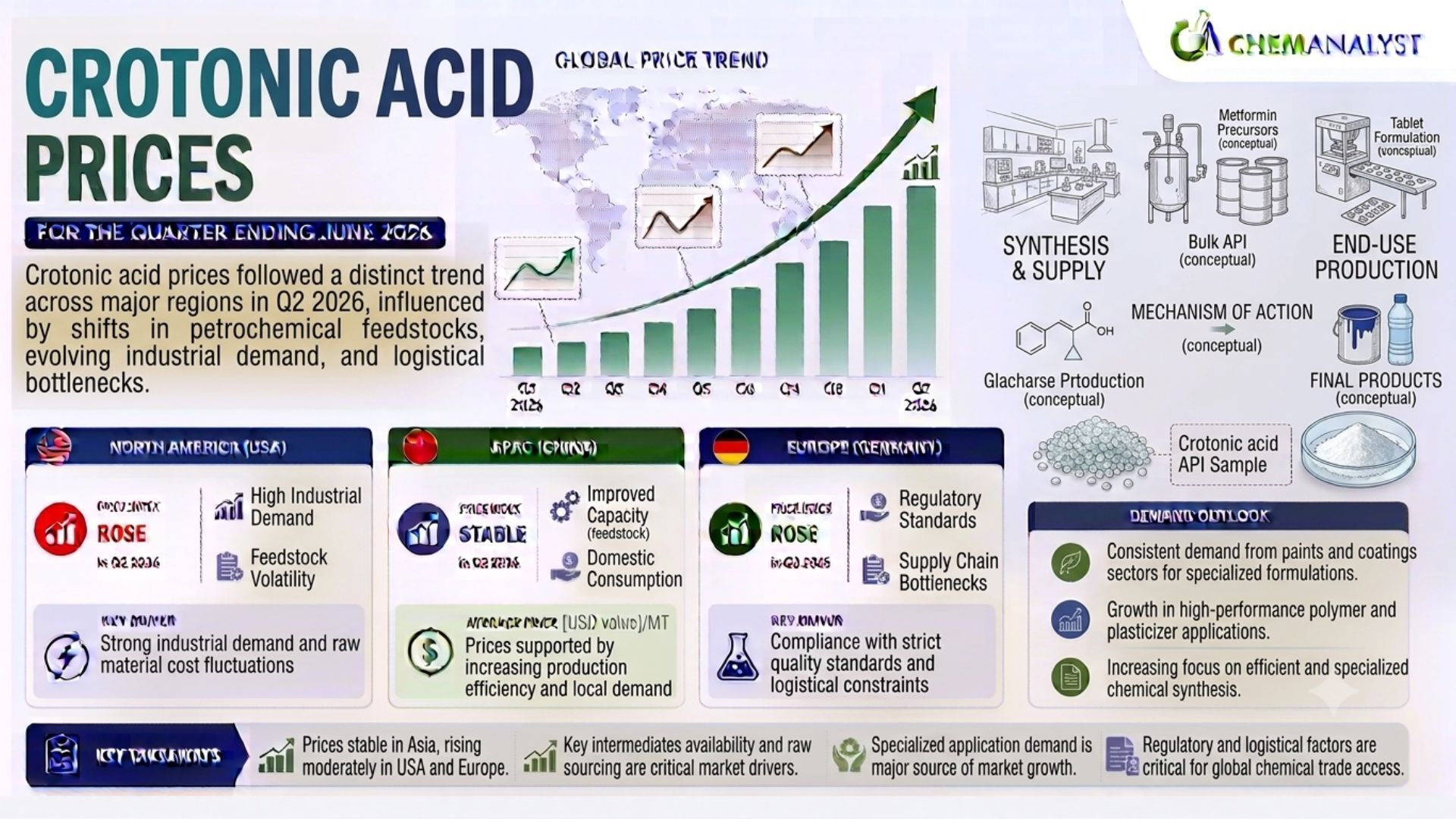
According to ChemAnalyst, the Crotonic acid prices presented a mixed regional trend during the quarter ending June 2026. While the United States and China recorded quarter-over-quarter increases in their Crotonic Acid Price Index, the German market remained broadly stable. The divergent regional performance reflected differences in producer-level inflation, manufacturing activity, industrial demand and input-cost conditions.
Crotonic acid is an unsaturated carboxylic acid used as an intermediate and specialty chemical in applications involving polymers, coatings, pharmaceuticals, chemical synthesis and other industrial formulations. Because of its specialized applications, its pricing can be influenced by both upstream production economics and the operating conditions of industries that consume specialty chemical intermediates.
During Q2 2026, inflationary pressure remained an important factor in North America and APAC. In the United States, elevated producer-level inflation contributed to higher production costs. China also experienced upward price pressure as factory-gate inflation accelerated toward June. In contrast, weaker industrial demand and contracting manufacturing activity in Germany limited the scope for price increases.
Crotonic Acid Prices in North America
In the United States, the Crotonic Acid Price Index rose quarter-over-quarter during Q2 2026, influenced by broad producer-level inflation.
Production costs for Crotonic acid increased during the quarter, with the Producer Price Index (PPI) rising 5.5% year-over-year in June 2026. The increase in producer-level inflation indicated continued pressure on the cost structure faced by chemical manufacturers.
PPI is an important indicator for chemical markets because it captures changes in prices received by producers for goods and can provide an indication of broader manufacturing cost conditions. When producer prices increase across industrial supply chains, chemical manufacturers can face higher expenses for production, utilities, services, logistics and other operating requirements.
The upward movement in the US Crotonic Acid Price Index therefore reflected a broader inflationary environment rather than a major demand-driven surge. Higher producer-level costs can encourage manufacturers and suppliers to adjust offers to protect margins, particularly when the increase persists across the production chain.
Demand from specialty chemical and industrial applications also remains relevant to the US market. Crotonic acid's use as a chemical intermediate means that purchasing activity is linked to the operating conditions of downstream manufacturers. Stable industrial consumption can provide a base level of support, while weaker manufacturing activity could limit the extent to which higher production costs can be passed through.
Overall, the US Crotonic acid market maintained an upward direction during Q2 2026, with producer-level inflation providing an important source of price support.
Get Real Time Online for Crotonic Acid Prices: https://www.chemanalyst.com/Pricing-data/crotonic-acid-2347
Crotonic Acid Prices in APAC
China's Crotonic Acid Price Index rose quarter-over-quarter during Q2 2026, driven by accelerating factory-gate inflation in June 2026.
Crotonic acid production costs faced upward pressure from a 4.1% year-over-year increase in China's PPI in June 2026, despite some moderation in input costs.
The Chinese market therefore experienced a combination of broader factory-gate inflation and comparatively softer input-cost pressure. Factory-gate inflation can affect chemical pricing by raising the prices producers receive and by influencing the cost environment across manufacturing supply chains.
The 4.1% PPI increase indicated that producer-level pricing conditions remained supportive of higher chemical values toward the end of Q2. Even when certain individual input costs moderate, broader inflationary conditions can continue to influence production economics through energy, utilities, labor, transportation, maintenance and other manufacturing expenses.
China's extensive chemical manufacturing sector also makes factory-gate price movements important for specialty chemical markets. Changes in upstream and intermediate chemical pricing can influence procurement decisions and supplier offers across domestic and export channels.
The Q2 2026 increase in the Chinese Crotonic Acid Price Index was therefore consistent with the broader factory-gate inflationary environment. Although some input costs experienced moderation, the overall production-cost structure remained sufficiently firm to support higher pricing.
Crotonic Acid Prices in Europe
Germany presented a different market environment during Q2 2026. The Crotonic Acid Price Index remained stable quarter-over-quarter, reflecting weak industrial demand and contracting manufacturing activity.
The average price of Crotonic Acid in Germany stood at approximately USD 71090/MT FOB Germany during the quarter.
The stable price trend indicates that weaker demand offset some of the cost-related pressure that might otherwise have encouraged higher prices. When manufacturing activity contracts, downstream consumers can reduce purchasing volumes, delay new orders, or operate with lower inventories. This can limit suppliers' ability to pass higher costs through the market.
Germany's industrial sector is an important consumer of specialty chemicals and intermediates. Consequently, changes in manufacturing activity can have a direct influence on purchasing requirements. Contracting manufacturing conditions during Q2 2026 reduced demand-side support for Crotonic acid.
At the same time, suppliers needed to balance production economics against weaker consumption. Maintaining prices near existing levels can become a strategic response when manufacturers face cost pressures but downstream buyers have limited appetite for higher prices.
The result was a comparatively stable German market. With weak industrial demand counteracting potential cost pressures, Crotonic Acid prices remained broadly unchanged on a quarter-over-quarter basis.
Book A Demo for Crotonic Acid Price: https://www.chemanalyst.com/ChemAnalyst/PricingForm?Product=Crotonic%20acid
Key Factors Influencing Crotonic Acid Prices in Q2 2026
Several factors shaped the global Crotonic Acid market during the quarter ending June 2026.
Producer-Level Inflation
Producer-level inflation was one of the most important price drivers in the United States and China. The US PPI increased 5.5% year-over-year in June 2026, while China's PPI increased 4.1% year-over-year during the same month.
These movements indicate that manufacturers in both markets operated within comparatively firm producer-price environments, contributing to upward pressure on Crotonic acid production economics.
Production Costs
Changes in manufacturing costs can directly influence specialty chemical prices. Higher expenses across production and logistics can encourage suppliers to revise offers upward, particularly when demand remains sufficiently stable to absorb cost increases.
In China, production costs experienced upward pressure despite some moderation in input expenses. This demonstrates that Crotonic acid pricing can be influenced by the overall production-cost structure rather than by individual feedstock movements alone.
Industrial Demand
Downstream industrial demand is another critical factor. Stronger industrial activity generally supports chemical consumption, while weaker manufacturing conditions can reduce purchasing requirements.
Germany's stable price performance in Q2 2026 illustrates this relationship. Weak industrial demand and contracting manufacturing activity limited the scope for price increases despite the broader cost environment.
Manufacturing Activity
Manufacturing activity provides an important indication of potential demand for chemical intermediates. When factories operate at lower utilization rates, procurement volumes can decline. This can create a more competitive environment among suppliers and limit price increases.
Germany experienced this dynamic during Q2 2026, helping maintain stable Crotonic Acid prices.
Input Cost Conditions
Input costs remained relevant to Crotonic acid production economics. China's market demonstrated that even when some individual input costs moderate, broader factory-gate inflation can continue to place upward pressure on production costs.
Monitoring both individual feedstocks and wider producer-price indicators is therefore important when evaluating the future direction of Crotonic Acid prices.
Crotonic Acid Demand Outlook
The demand outlook for Crotonic acid will remain closely connected to the performance of downstream specialty chemical and industrial applications. As a chemical intermediate, its consumption depends on production requirements across several value chains.
The United States and China may continue to experience comparatively stronger cost-side support if producer-level inflation remains elevated. However, the extent to which higher production costs translate into actual market prices will depend on downstream purchasing conditions.
In Europe, particularly Germany, industrial demand will remain a major factor to monitor. Continued contraction in manufacturing could limit purchasing activity and prevent significant price increases. Conversely, a recovery in industrial production could strengthen demand and improve suppliers' ability to pass through higher costs.
Inventory levels will also influence short-term demand. If buyers operate with low inventories, even a relatively weak market can experience periodic restocking activity. If inventories remain comfortable, procurement requirements may stay subdued.
Regional Crotonic Acid Market Dynamics
The Q2 2026 Crotonic Acid market demonstrated clear regional differences.
The United States experienced a quarter-over-quarter increase in its Crotonic Acid Price Index, with broad producer-level inflation supporting higher production costs. The 5.5% year-over-year rise in PPI in June 2026 highlighted the strength of the inflationary environment.
China also recorded a quarter-over-quarter increase. Its market was influenced by accelerating factory-gate inflation, while the 4.1% year-over-year increase in PPI in June 2026 added upward pressure to production economics.
Germany remained comparatively stable. The combination of weak industrial demand and contracting manufacturing activity prevented significant price movement, leaving the market broadly unchanged quarter-over-quarter.
The average German price of USD 71090/MT FOB Germany further provides a reference point for the Q2 2026 European market.
Crotonic Acid Supply Chain and Procurement Trends
Supply-chain conditions remained an important consideration for Crotonic acid buyers during Q2 2026. Procurement decisions are influenced not only by the underlying chemical price but also by production costs, supplier availability, transportation expenses, inventory requirements and expected downstream demand.
In markets experiencing producer-level inflation, buyers may encounter higher offers as suppliers seek to recover increased operating expenses. However, where industrial demand is weak, buyers can have greater negotiating leverage because suppliers may prioritize volume retention.
For procurement teams, monitoring producer-price indicators alongside manufacturing activity can provide a more complete view of potential price direction. This is particularly relevant for specialty chemicals, where market volumes can be smaller and price movements may respond significantly to changes in supply availability and purchasing patterns.
Crotonic Acid Market Outlook for the Second Half of 2026
The global Crotonic Acid market entered the second half of 2026 with a mixed regional outlook.
In the United States, continued producer-level inflation could provide support to Crotonic Acid prices if manufacturers continue to face elevated production costs. In China, factory-gate inflation and overall manufacturing cost conditions will remain important indicators for future price direction.
Germany's outlook will depend more heavily on industrial recovery. If manufacturing activity remains weak, demand-side pressure could continue limiting price increases. However, a recovery in industrial production could strengthen downstream consumption and alter the current balanced pricing environment.
The interaction between production costs and demand will therefore be central to the market's direction. Rising costs alone may not guarantee higher prices if downstream consumption remains weak. Conversely, stronger industrial demand could amplify the impact of cost inflation by increasing competition for available material.
Conclusion
Crotonic Acid prices followed different regional trajectories during the quarter ending June 2026. The United States and China recorded quarter-over-quarter increases, supported primarily by broader producer-level inflation and higher production-cost pressures. Germany, in contrast, maintained a stable price trend as weak industrial demand and contracting manufacturing activity offset potential upward pressure.
In the United States, the Producer Price Index increased 5.5% year-over-year in June 2026, contributing to higher Crotonic acid production costs and a firmer price environment.
In China, the 4.1% year-over-year PPI increase in June 2026 supported upward pressure on Crotonic acid production economics, even as some input costs moderated.
Germany's Crotonic Acid Price Index remained stable quarter-over-quarter, with the average price reaching approximately USD 71090/MT FOB Germany.
Overall, the Q2 2026 Crotonic Acid market highlighted the importance of regional economic conditions in determining chemical prices. Producer inflation, manufacturing activity, downstream demand, input costs and procurement behavior will remain the key variables to monitor as the market moves through the second half of 2026.
ChemAnalsyt
Call +1 3322586602
420 Lexington Avenue, Suite 300, New York, NY, United States, 10170
Website: https://www.chemanalyst.com/
Email: sales@chemanalyst.com
この記事をシェア





