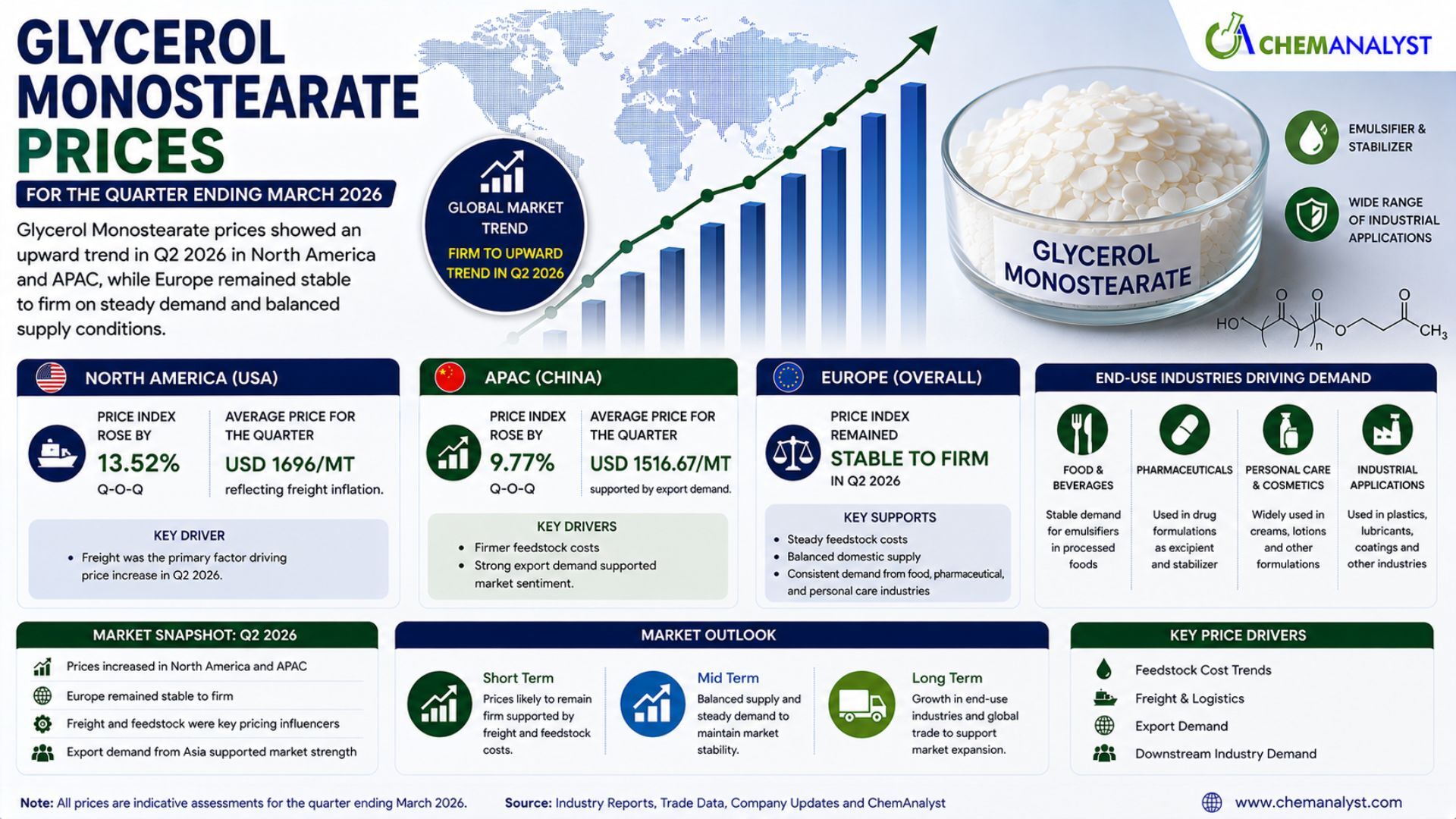
According to ChemAnalyst, the global Glycerol Monostearate Prices market experienced firm to upward price movements during the quarter ending June 2026, with North America and APAC recording significant quarter-over-quarter increases, while Europe remained stable to firm. Freight costs, feedstock prices, export demand, downstream consumption and regional supply conditions were the key factors shaping market sentiment during Q2 2026.
Glycerol Monostearate is widely used as an emulsifier, stabilizer and processing aid across food, pharmaceutical, personal care, cosmetic and industrial applications. Consequently, its market performance is influenced by both upstream feedstock economics and downstream manufacturing activity. Changes in transportation expenses and international trade flows can also have a substantial impact on delivered prices, particularly in import-dependent markets.
In the United States, the Glycerol Monostearate Price Index rose by 13.52% quarter-over-quarter during Q2 2026, primarily driven by freight. The average Glycerol Monostearate price for the quarter reached approximately USD 1696/MT, reflecting freight inflation.
China also recorded a notable increase, with the Glycerol Monostearate Price Index rising by 9.77% quarter-over-quarter. Firmer feedstock costs supported the upward movement, while export demand provided additional market support. The average Glycerol Monostearate price was approximately USD 1516.67/MT.
In Europe, the market remained stable to firm. Consistent demand from the food, pharmaceutical and personal care industries, together with steady feedstock costs and balanced domestic supply, helped maintain market stability.
Overall, the Q2 2026 Glycerol Monostearate price trend reflected a firm global market, although the primary price drivers varied by region.
Glycerol Monostearate Prices in North America
The North American Glycerol Monostearate market recorded the strongest price increase among the assessed regions during Q2 2026. In the United States, the Glycerol Monostearate Price Index rose by 13.52% quarter-over-quarter, driven primarily by freight.
The average Glycerol Monostearate price for the quarter was approximately USD 1696/MT, reflecting freight inflation. Higher transportation costs can significantly influence the landed cost of imported materials and consequently affect supplier quotations and buyer procurement decisions.
Freight plays a particularly important role in markets where material is transported across international supply chains. When shipping expenses increase, importers and distributors may face higher delivered costs even when the underlying product price remains relatively stable.
During Q2 2026, freight inflation therefore became a significant contributor to the upward movement in U.S. Glycerol Monostearate prices.
The increase also demonstrates the importance of logistics in determining the final market price of specialty and performance chemicals. Higher freight expenses can be passed through the supply chain, particularly when demand remains sufficiently stable to support supplier pricing.
The North American Glycerol Monostearate price trend is consequently expected to remain sensitive to freight costs, import flows, feedstock movements, inventory conditions and downstream procurement.
Get Real Time Online for Glycerol Monostearate Prices: https://www.chemanalyst.com/Pricing-data/glycerol-monostearate-2258
Glycerol Monostearate Prices in APAC
The APAC market also experienced a significant upward movement during Q2 2026. In China, the Glycerol Monostearate Price Index rose by 9.77% quarter-over-quarter, supported by firmer feedstock costs.
The average Glycerol Monostearate price for the quarter was approximately USD 1516.67/MT, with export demand contributing to market support.
Feedstock costs represent an important component of Glycerol Monostearate production economics. When upstream material prices increase, producers can face higher manufacturing expenses, encouraging suppliers to revise offers upward to protect margins.
The Chinese market experienced this dynamic during Q2 2026. Firmer feedstock costs provided a direct source of upward pressure, while export demand strengthened the market environment.
Export demand is particularly relevant for China because international purchasing can influence producer utilization, inventory levels and supplier pricing strategies. When overseas buyers maintain procurement activity, suppliers may have greater confidence in maintaining firm quotations.
The combination of higher feedstock costs and export demand resulted in a 9.77% quarter-over-quarter increase in the Chinese Price Index.
The APAC market outlook will therefore remain dependent on feedstock prices, export activity, domestic consumption, production costs and regional availability.
Glycerol Monostearate Prices in Europe
The European Glycerol Monostearate market remained stable to firm during Q2 2026, supported by steady feedstock costs and consistent downstream demand.
Unlike the United States and China, where measurable quarter-over-quarter increases were recorded, the European market maintained a more balanced price environment. Balanced domestic supply and regular procurement helped support market stability throughout the quarter.
Demand from the food, pharmaceutical and personal care industries remained an important source of support. Glycerol Monostearate's applications across these sectors create a diversified downstream demand base, helping maintain regular procurement.
Steady feedstock costs also contributed to the stable-to-firm market environment. When upstream costs remain relatively consistent, suppliers face less pressure to make significant pricing adjustments.
The average Glycerol Monostearate Price Index remained resilient throughout Q2 2026 as balanced domestic supply and regular procurement maintained market equilibrium.
Going forward, the European market will remain influenced by downstream demand, feedstock costs, domestic supply, imports, inventories and procurement cycles.
Key Factors Influencing Glycerol Monostearate Prices
Several factors shaped the global Glycerol Monostearate Prices market during Q2 2026.
Freight Costs
Freight was the dominant factor behind the U.S. price increase. The 13.52% quarter-over-quarter rise in the U.S. Price Index was driven by freight, while the average price reached USD 1696/MT.
Higher freight expenses increase landed costs and can influence the pricing decisions of importers, distributors and suppliers.
Feedstock Costs
Firmer feedstock costs supported the 9.77% quarter-over-quarter increase in China's Price Index. Production economics are closely linked to upstream costs, making feedstock movements an important indicator for future pricing.
Export Demand
Export demand provided additional support to the Chinese market. Continued overseas procurement can strengthen supplier confidence and support firmer offers.
Downstream Demand
Europe benefited from consistent demand from the food, pharmaceutical and personal care industries. Regular procurement helped maintain stable-to-firm market conditions.
Supply Availability
Balanced domestic supply supported the European market, while regional availability and international trade flows influenced pricing conditions across North America and APAC.
Book A Demo for Glycerol Monostearate Price: https://www.chemanalyst.com/ChemAnalyst/PricingForm?Product=Glycerol%20Monostearate
Glycerol Monostearate Demand Analysis
Demand remained an important supporting factor in the global Glycerol Monostearate market during Q2 2026.
China experienced export demand alongside firmer feedstock costs. This combination strengthened market fundamentals and contributed to the 9.77% quarter-over-quarter increase in the Price Index.
In Europe, demand from food, pharmaceutical and personal care industries remained consistent. Regular procurement helped maintain market stability despite the absence of a major price increase.
The U.S. market assessment primarily identifies freight as the driver of the price increase rather than a specific surge in demand. Nevertheless, the higher price environment indicates that freight costs had a meaningful impact on the delivered market.
The diversified end-use base of Glycerol Monostearate provides a relatively broad demand foundation. Food processing, pharmaceutical formulations, personal care products and cosmetics can all contribute to regular consumption.
Future demand will depend on manufacturing activity in these downstream industries and their procurement requirements.
Glycerol Monostearate Supply Analysis
Supply conditions remained relatively balanced across the assessed markets, although logistics played an important role in North America.
In the United States, freight inflation increased the effective cost of moving material through the supply chain. This contributed significantly to the upward Price Index.
China maintained export availability while facing firmer feedstock costs. Export demand provided additional support to suppliers.
Europe experienced balanced domestic supply, which helped prevent significant price volatility. Regular procurement was accommodated without a major supply disruption.
The supply outlook will depend on producer operating rates, feedstock availability, international trade flows, freight conditions and inventory management.
Glycerol Monostearate Production Cost Trend
The Glycerol Monostearate production cost trend varied across regions during Q2 2026.
In China, firmer feedstock costs directly increased production-cost pressure and supported the upward price movement.
In the United States, freight inflation rather than a specified feedstock increase was the major factor affecting the market. Higher transportation expenses increased the overall delivered cost of the material.
Europe maintained relatively stable production economics as feedstock costs remained steady. Balanced supply and consistent procurement further contributed to market stability.
These regional differences demonstrate that Glycerol Monostearate pricing is influenced by more than manufacturing costs alone. Logistics, trade flows, demand and supply conditions can substantially affect the final market price.
Regional Glycerol Monostearate Price Comparison
The Q2 2026 regional market can be characterized as follows:
North America: The U.S. Glycerol Monostearate Price Index increased by 13.52% quarter-over-quarter, driven by freight. The average price reached approximately USD 1696/MT.
APAC: China's Price Index increased by 9.77% quarter-over-quarter, supported by firmer feedstock costs and export demand. The average price was approximately USD 1516.67/MT.
Europe: The market remained stable to firm, supported by steady feedstock costs, balanced domestic supply and consistent demand from food, pharmaceutical and personal care industries.
The comparison shows that North America experienced the strongest reported increase, while APAC also recorded substantial growth. Europe maintained a more balanced pricing environment.
Glycerol Monostearate Market Outlook
The outlook for Glycerol Monostearate Prices remains cautiously firm following the developments observed during Q2 2026.
In North America, freight costs will remain an important variable. Continued freight inflation could maintain upward pressure on delivered prices, while stabilization in logistics costs could reduce the pace of increases.
In APAC, feedstock prices and export demand will remain key market indicators. If feedstock costs remain firm and international purchasing continues, Chinese prices could retain their upward momentum.
Europe is expected to remain comparatively stable if feedstock costs, domestic supply and downstream procurement remain balanced.
Overall, the global market is likely to remain sensitive to logistics, feedstock economics, downstream demand and supply availability.
Glycerol Monostearate Price Forecast
The Glycerol Monostearate Price Forecast indicates a firm-to-stable outlook across the major markets.
For the United States, the direction of freight costs will be particularly important. Continued freight inflation could keep delivered prices elevated, while lower transportation costs could provide relief to buyers.
In China, future pricing will depend heavily on feedstock costs and export demand. Persistent feedstock firmness could maintain production-cost pressure, while sustained export demand could support supplier pricing.
In Europe, stable feedstock costs and balanced supply could continue to support a relatively stable market. Consistent procurement from food, pharmaceutical and personal care manufacturers should provide an underlying demand base.
Market participants should therefore monitor freight rates, feedstock prices, export demand, downstream procurement and inventory conditions when evaluating future Glycerol Monostearate Prices.
Conclusion
The global Glycerol Monostearate Prices market recorded firm conditions during the quarter ending June 2026, although the factors driving the market differed by region.
In the United States, the Glycerol Monostearate Price Index rose by 13.52% quarter-over-quarter, driven by freight. The average price for the quarter was approximately USD 1696/MT, reflecting freight inflation.
In China, the Price Index increased by 9.77% quarter-over-quarter, supported by firmer feedstock costs and export demand. The average Glycerol Monostearate price was approximately USD 1516.67/MT.
In Europe, the market remained stable to firm. Steady feedstock costs, balanced domestic supply and consistent demand from the food, pharmaceutical and personal care industries helped maintain market resilience.
Overall, Q2 2026 demonstrated a firm global Glycerol Monostearate market, with freight emerging as the key driver in North America and feedstock costs and export demand supporting APAC. Europe maintained equilibrium through balanced supply and consistent procurement. Going forward, freight conditions, feedstock prices, downstream demand, export activity and supply availability will remain the primary factors shaping the Glycerol Monostearate price trend.
ChemAnalsyt
Call +1 3322586602
420 Lexington Avenue, Suite 300, New York, NY, United States, 10170
Website: https://www.chemanalyst.com/
Email: sales@chemanalyst.com
この記事をシェア





