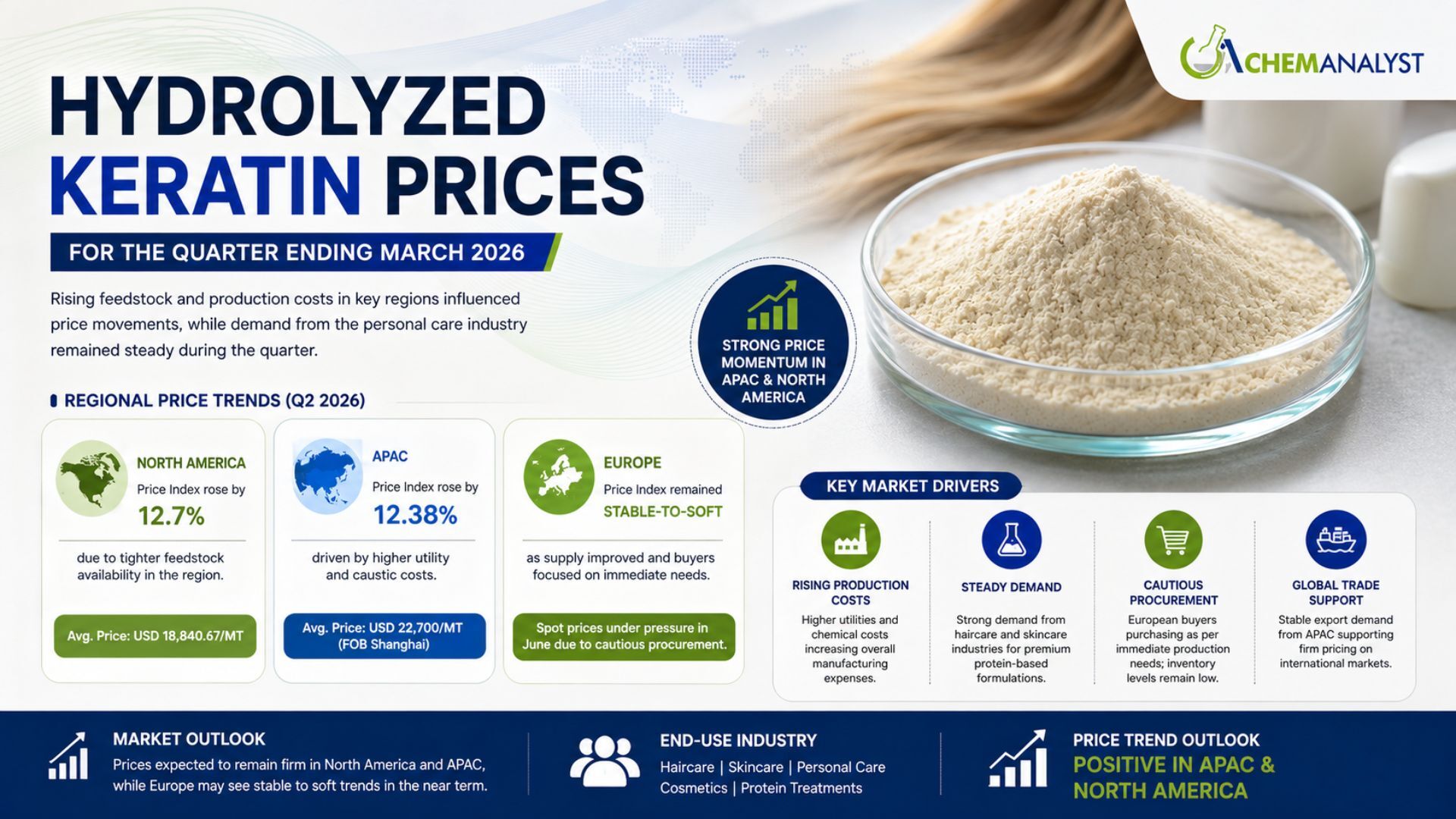
According to ChemAnalyst, the global Hydrolyzed Keratin prices exhibited mixed regional trends during the quarter ending June 2026. While North America and Asia-Pacific experienced significant quarter-over-quarter price increases, the European market remained relatively stable with a slightly softer sentiment due to improved product availability and cautious purchasing behavior. Across major markets, pricing dynamics were influenced by feedstock availability, production costs, utility expenses, and procurement strategies adopted by cosmetic and personal care manufacturers.
Hydrolyzed Keratin is a widely used protein ingredient in haircare, skincare, and cosmetic formulations because of its conditioning, strengthening, and moisturizing properties. As demand for premium personal care products continued across global markets, manufacturers remained focused on maintaining stable production schedules while managing higher raw material and operational costs.
During the second quarter of 2026, increasing manufacturing expenses and tighter raw material availability supported higher prices in the United States and China. Meanwhile, European buyers continued to adopt conservative procurement practices, limiting upward price momentum despite healthy end-use demand.
Hydrolyzed Keratin Prices in North America
The North American Hydrolyzed Keratin market recorded one of the strongest regional gains during the second quarter of 2026. In the United States, the Hydrolyzed Keratin Price Index increased by 12.7% quarter-over-quarter, reflecting tighter feedstock availability and sustained purchasing activity from downstream industries.
The average Hydrolyzed Keratin price during the quarter reached approximately USD 18,840.67 per metric ton, highlighting firm market fundamentals throughout Q2 2026.
The principal factor supporting higher prices was the limited availability of feedstock required for Hydrolyzed Keratin production. Restricted raw material supplies increased manufacturing costs and reduced pricing flexibility for producers. As a result, suppliers maintained firm offers while fulfilling ongoing customer contracts.
Demand from cosmetic and personal care manufacturers remained healthy throughout the quarter. Hydrolyzed Keratin continued to be incorporated into shampoos, conditioners, hair masks, serums, and specialized treatment products, supporting regular procurement activities among manufacturers.
Market participants generally prioritized securing reliable supplies instead of delaying purchases, particularly as concerns over feedstock availability persisted. This buying behavior contributed to sustained upward price momentum throughout the quarter.
Despite higher prices, downstream consumption remained relatively resilient due to the ingredient's importance in premium personal care formulations. Overall, the U.S. market concluded the quarter with firm pricing supported by balanced demand and constrained feedstock availability.
Get Real Time Online for Hydrolyzed Keratin Prices: https://www.chemanalyst.com/Pricing-data/hydrolyzed-keratin-2584
Hydrolyzed Keratin Prices in APAC
The Asia-Pacific region also experienced notable price increases during the second quarter of 2026. In China, the Hydrolyzed Keratin Price Index rose by 12.38% quarter-over-quarter, reflecting rising production expenses across the manufacturing sector.
The average Hydrolyzed Keratin price during the quarter was approximately USD 22,700 per metric ton on an FOB Shanghai basis, indicating firm export pricing and healthy market activity.
Higher utility costs and increased caustic consumption expenses remained the primary factors supporting the upward pricing trend. Manufacturers faced elevated operational expenditures throughout the production process, encouraging suppliers to revise quotations upward.
Chinese producers continued operating steadily while balancing domestic demand with export commitments. Stable international inquiries and consistent domestic consumption helped maintain positive market sentiment despite higher manufacturing costs.
The cosmetic and personal care industry remained a major consumer of Hydrolyzed Keratin across the region. Manufacturers continued incorporating protein-based ingredients into premium haircare products as consumers increasingly preferred formulations focused on hair repair, nourishment, and strengthening.
Export-oriented suppliers also benefited from steady overseas demand, helping sustain FOB prices during the quarter. The combination of healthy buying interest and higher production expenses enabled producers to maintain firm market positions throughout Q2 2026.
Overall, APAC remained a key production hub where increasing operating costs directly translated into stronger Hydrolyzed Keratin prices.
Hydrolyzed Keratin Prices in Europe
Unlike North America and APAC, the European Hydrolyzed Keratin market demonstrated relatively stable pricing conditions during the second quarter of 2026.
Across Europe, the Hydrolyzed Keratin Price Index remained stable to slightly soft, primarily because product availability improved while buyers maintained cautious procurement strategies.
Market participants reported that Hydrolyzed Keratin spot prices remained under pressure during June 2026 as cosmetic and personal care manufacturers focused on purchasing only according to immediate production requirements rather than rebuilding inventories.
Improved supply conditions reduced the urgency among buyers, allowing manufacturers greater flexibility when scheduling purchases. Instead of aggressively securing additional inventory, many companies adopted a just-in-time procurement strategy designed to optimize working capital and inventory management.
Although consumer demand for haircare and cosmetic products remained generally healthy, purchasing activity was carefully aligned with actual production schedules. This approach limited speculative buying and prevented significant upward movement in prices.
European suppliers continued maintaining stable production while monitoring customer requirements closely. Improved availability across regional distribution channels further contributed to balanced market conditions throughout the quarter.
Consequently, Europe remained the most stable Hydrolyzed Keratin market among the three major regions analyzed during Q2 2026.
Book A Demo for Hydrolyzed Keratin Price: https://www.chemanalyst.com/ChemAnalyst/PricingForm?Product=Hydrolyzed%20Keratin
Factors Influencing Hydrolyzed Keratin Prices
Several important market factors influenced Hydrolyzed Keratin prices globally during the second quarter of 2026.
Feedstock Availability
Restricted feedstock availability played a major role in supporting higher prices, particularly in the United States, where tighter raw material supplies increased production costs.
Rising Manufacturing Costs
Chinese producers experienced higher utility expenses and increased caustic costs, contributing directly to stronger production costs and firmer market quotations.
Cosmetic and Personal Care Demand
Hydrolyzed Keratin remained an important ingredient for manufacturers producing premium shampoos, conditioners, hair masks, serums, and other protein-enriched personal care products.
Procurement Strategies
Purchasing behavior varied across regions. North American and Asian buyers continued maintaining regular procurement activities, while European manufacturers focused primarily on immediate production requirements rather than inventory expansion.
Supply Availability
Improved product availability across Europe created a balanced supply environment that limited upward pricing despite continued downstream demand.
Market Outlook for Hydrolyzed Keratin
Looking ahead, Hydrolyzed Keratin prices are expected to remain influenced by production costs, feedstock availability, and procurement activity across major consuming markets.
North America may continue experiencing firm market conditions if raw material availability remains limited. Manufacturers are expected to closely monitor feedstock supplies while maintaining stable production schedules to satisfy ongoing demand from the personal care sector.
China is likely to remain an important global supplier, with pricing largely dependent upon utility expenses, chemical processing costs, and export demand. Any changes in manufacturing economics could continue influencing FOB quotations during upcoming quarters.
Europe may continue demonstrating balanced market conditions provided supply availability remains comfortable and buyers maintain disciplined inventory management. Procurement strategies will likely remain focused on operational requirements rather than speculative stock building.
The personal care industry's ongoing emphasis on premium protein-enriched formulations is expected to support long-term consumption of Hydrolyzed Keratin, providing a positive demand outlook for producers worldwide.
Regional Market Comparison
Among the three major regions, North America recorded the highest quarterly increase, with the United States registering a 12.7% rise driven by tighter feedstock availability. China closely followed with a 12.38% increase, supported by higher utility and caustic costs alongside stable export demand. Europe, meanwhile, experienced comparatively softer market conditions as improved supply availability and cautious procurement limited price growth.
These contrasting regional developments demonstrate how local production economics, procurement behavior, and supply conditions continue shaping Hydrolyzed Keratin pricing across global markets.
Conclusion
The Hydrolyzed Keratin prices market displayed varied regional performance during the quarter ending June 2026. North America and APAC experienced robust price growth supported by tighter feedstock availability, rising manufacturing costs, and healthy downstream demand from cosmetic and personal care manufacturers. In contrast, Europe maintained relatively stable pricing as improved supply conditions and cautious procurement strategies moderated market sentiment.
In the United States, the Hydrolyzed Keratin Price Index increased by 12.7% quarter-over-quarter, with an average quarterly price of approximately USD 18,840.67 per metric ton. China reported a 12.38% quarter-over-quarter increase, while the average FOB Shanghai price reached approximately USD 22,700 per metric ton. Europe remained comparatively balanced as buyers continued purchasing according to immediate production needs.
ChemAnalsyt
Call +1 3322586602
420 Lexington Avenue, Suite 300, New York, NY, United States, 10170
Website: https://www.chemanalyst.com/
Email: sales@chemanalyst.com
この記事をシェア





