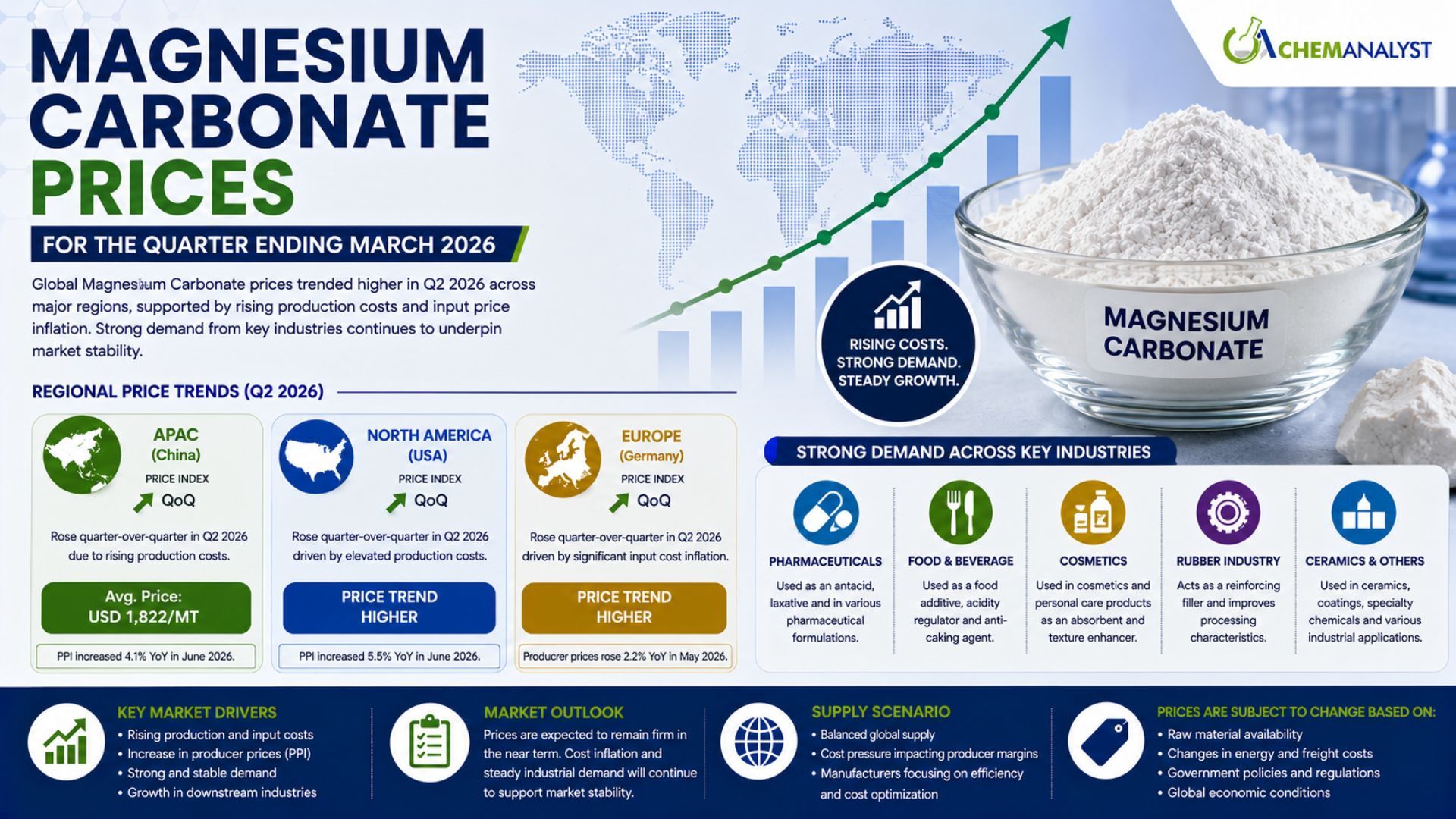
According to ChemAnalyst, the global Magnesium Carbonate prices market recorded an upward trend during the quarter ending June 2026, with major markets across Asia-Pacific, North America and Europe reporting quarter-over-quarter price increases. The primary factor supporting the upward movement was the rise in production and input costs, which placed additional pressure on manufacturers and encouraged suppliers to maintain firmer pricing.
Magnesium Carbonate is an important inorganic chemical used across a diverse range of industries. Its applications include pharmaceuticals, food and beverage processing, cosmetics, rubber manufacturing, ceramics, specialty chemicals and industrial formulations. The material is available in different grades depending on the requirements of downstream applications, with purity, particle characteristics and production processes influencing its commercial value.
During Q2 2026, production economics remained an important consideration for Magnesium Carbonate manufacturers. Higher producer prices increased the cost environment for chemical producers, while downstream industries continued procuring material for regular manufacturing requirements. As a result, suppliers across the major markets were able to pass part of the increased production burden through higher market prices.
China recorded an average Magnesium Carbonate price of USD 1,822/MT during Q2 2026. Meanwhile, the United States and Germany also experienced quarter-over-quarter increases, primarily reflecting elevated production costs and broader input cost inflation.
Magnesium Carbonate Prices in APAC
The Asia-Pacific Magnesium Carbonate market experienced firm pricing during the second quarter of 2026. In China, the Magnesium Carbonate Price Index rose quarter-over-quarter in Q2 2026, with the market settling at approximately USD 1,822/MT.
The increase was primarily attributed to rising production costs. Manufacturers faced a higher overall cost environment during the quarter, encouraging suppliers to maintain firmer quotations across the domestic market.
China remains an important manufacturing and supply center for inorganic chemicals and changes in its production economics can influence pricing across regional and international markets. During Q2 2026, the increase in producer prices added pressure to manufacturing expenses, contributing to the upward movement in Magnesium Carbonate prices.
Production costs for Magnesium Carbonate increased during Q2 2026, with China's Producer Price Index (PPI) rising by 4.1% year-over-year in June 2026. The higher PPI reflected a broader increase in producer-level pricing and contributed to a more challenging cost environment for manufacturers.
Downstream industries continued maintaining regular procurement activity during the quarter. Magnesium Carbonate's use across pharmaceutical, food, cosmetic, rubber, ceramic and specialty chemical applications supported baseline demand and enabled producers to manage the increased cost environment.
Buyers generally focused on securing material according to their production requirements, while suppliers monitored raw material and operating expenses when determining commercial offers. The combination of stable downstream requirements and higher production costs kept the Chinese market on a firm trajectory throughout Q2 2026.
Overall, the APAC market ended the quarter with positive pricing momentum, with production economics remaining the key factor influencing the Magnesium Carbonate price trend.
Get Real Time Online for Magnesium Carbonate Prices: https://www.chemanalyst.com/Pricing-data/magnesium-carbonate-2488
Magnesium Carbonate Prices in North America
The North American Magnesium Carbonate market also recorded an upward price trend during Q2 2026. In the United States, the Magnesium Carbonate Price Index rose quarter-over-quarter, primarily driven by elevated production costs.
The increase in production expenses created additional pressure on manufacturers and contributed to firmer market quotations during the quarter. The U.S. market remained influenced by broader producer-level inflation, which affected the economics of chemical manufacturing.
According to the provided market assessment, Magnesium Carbonate production costs increased during Q2 2026 due to a 5.5% year-over-year rise in the Producer Price Index in June 2026. The higher PPI contributed to the overall cost environment faced by producers and supported the upward movement in Magnesium Carbonate prices.
Manufacturers continued supplying material to downstream sectors while managing higher operating expenses. Demand from industries using Magnesium Carbonate as an ingredient, processing aid, filler, or functional material remained an important component of market activity.
The pharmaceutical industry represents an important application sector for Magnesium Carbonate, while food processing, cosmetics, rubber and industrial manufacturing also contribute to demand. Regular purchasing requirements from these industries provided a stable consumption base during the quarter.
As production costs increased, suppliers were required to carefully balance pricing with customer requirements. Buyers, meanwhile, remained focused on maintaining adequate supplies for ongoing manufacturing activities.
The combination of elevated producer-level costs and consistent downstream requirements resulted in a firm Magnesium Carbonate price trend in the United States throughout Q2 2026.
Book A Demo for Magnesium Carbonate Price: https://www.chemanalyst.com/ChemAnalyst/PricingForm?Product=Magnesium%20Carbonate
Magnesium Carbonate Prices in Europe
The European Magnesium Carbonate market also experienced a positive pricing trend during the quarter ending June 2026. In Germany, the Magnesium Carbonate Price Index rose quarter-over-quarter, driven by significant input cost inflation.
Higher input costs increased the overall expense associated with Magnesium Carbonate production and contributed to firmer supplier quotations. The European market remained particularly sensitive to changes in manufacturing costs, as producers continued balancing production economics with downstream purchasing requirements.
According to the provided market data, Magnesium Carbonate production costs increased during Q2 2026, influenced by a 2.2% rise in producer prices in May 2026. The increase in producer-level prices contributed to higher input costs and supported the upward movement in the German Magnesium Carbonate market.
Downstream demand remained an important factor supporting regular procurement. Magnesium Carbonate continues to serve multiple industries, including pharmaceuticals, food processing, cosmetics, rubber, ceramics and specialty chemical manufacturing. These diversified applications provide a broad demand base for the product.
European buyers continued monitoring cost movements and supply conditions when planning purchases. Manufacturers and distributors remained focused on maintaining reliable material availability while managing procurement expenses.
The increase in producer prices added to the cost pressure experienced by suppliers during the quarter. As a result, the German market recorded a firm upward price trend throughout Q2 2026.
Key Factors Influencing Magnesium Carbonate Prices
Several factors contributed to the movement in Magnesium Carbonate prices during the quarter ending June 2026.
Rising Production Costs
Higher production costs represented the central factor behind the upward pricing trend across China, the United States and Germany. Increased manufacturing expenses encouraged producers to maintain higher selling prices to protect operating margins.
Producer Price Inflation
Producer price movements had a direct influence on Magnesium Carbonate production economics. China recorded a 4.1% year-over-year increase in PPI in June 2026, while the United States recorded a 5.5% year-over-year increase during the same month.
Germany also experienced higher producer prices, with the provided market data indicating a 2.2% increase in May 2026. These developments contributed to a broader inflationary cost environment across major Magnesium Carbonate markets.
Input Cost Pressure
Higher input costs increased the expenses associated with manufacturing Magnesium Carbonate. Suppliers consequently maintained firmer quotations as they adjusted to changing production economics.
Downstream Industrial Demand
Magnesium Carbonate is consumed across several industries, including pharmaceuticals, food and beverage, cosmetics, rubber, ceramics and specialty chemicals. This diversified application base helps maintain consistent demand and supports regular procurement activity.
Regional Production Economics
Although the global Magnesium Carbonate market experienced a broadly upward trend, the magnitude of price movement varied between regions because production structures and cost conditions differ across markets.
Magnesium Carbonate Market Demand Analysis
Demand remained an important supporting factor for the Magnesium Carbonate market during Q2 2026. The material's wide application base helped maintain regular procurement despite rising production costs.
In pharmaceuticals, Magnesium Carbonate can be used in formulations and manufacturing processes where specific functional properties are required. The food and beverage sector also represents an important application area, while cosmetics and personal care manufacturers utilize magnesium-based ingredients in selected formulations.
Industrial applications further diversify demand. Rubber, ceramics and specialty chemical manufacturers can use Magnesium Carbonate according to formulation and processing requirements. This broad end-use base reduces the market's dependence on a single downstream industry.
During Q2 2026, the combination of continuing industrial requirements and higher production costs supported a firm pricing environment across the major markets covered in this assessment.
Magnesium Carbonate Production Cost Trend
The Magnesium Carbonate production cost trend remained upward during Q2 2026. Cost inflation was visible across the three major regions, although the indicators differed by market.
In China, the 4.1% year-over-year increase in June PPI contributed to higher production costs. In the United States, a stronger 5.5% year-over-year increase in June PPI added to manufacturing cost pressure. Germany also recorded a 2.2% rise in producer prices in May, influencing its production economics.
These developments demonstrate the important relationship between producer-level inflation and Magnesium Carbonate pricing. When manufacturing expenses rise, suppliers generally face greater pressure to adjust quotations in order to maintain sustainable operating margins.
Magnesium Carbonate Price Trend Outlook
The outlook for Magnesium Carbonate prices will remain closely connected to production costs, producer price movements, input expenses and downstream demand. If manufacturing costs remain elevated, suppliers may continue maintaining firm price positions in major markets.
In China, future pricing will depend on production economics and the direction of producer prices, alongside domestic and international purchasing activity. The country's role as a major chemical manufacturing hub means changes in its cost structure can have broader implications for regional supply.
In North America, the direction of producer-level inflation will remain an important indicator for Magnesium Carbonate pricing. Continued demand from pharmaceutical, food, cosmetic and industrial applications should provide a stable consumption base.
In Europe, input cost developments and producer prices will remain important market indicators. German manufacturers and buyers are expected to continue monitoring production expenses and procurement conditions as they plan future purchases.
Overall, the market outlook remains sensitive to cost inflation and industrial demand. Any moderation in production costs could reduce upward pricing pressure, while continued cost increases could keep Magnesium Carbonate prices firm.
Regional Magnesium Carbonate Price Comparison
The regional Magnesium Carbonate market displayed a consistent upward direction during Q2 2026, although the underlying drivers were primarily linked to production and input costs.
China recorded an average Magnesium Carbonate price of USD 1,822/MT, with the Price Index increasing quarter-over-quarter due to rising production costs. The country's June PPI increased by 4.1% year-over-year, adding to manufacturing cost pressure.
In the United States, the Magnesium Carbonate Price Index also increased quarter-over-quarter as elevated production costs supported firmer pricing. The U.S. June PPI rose 5.5% year-over-year, contributing to the higher production cost environment.
Germany similarly experienced a quarter-over-quarter increase in the Magnesium Carbonate Price Index. Significant input cost inflation and a 2.2% rise in producer prices in May 2026 supported the upward market trajectory.
Conclusion
The Magnesium Carbonate prices market recorded a firm upward trend across APAC, North America and Europe during the quarter ending June 2026. Rising production costs and input cost inflation remained the primary factors behind the positive price movement across the major markets.
In China, the Magnesium Carbonate Price Index rose quarter-over-quarter, with prices settling at approximately USD 1,822/MT. The increase was supported by higher production costs and a 4.1% year-over-year rise in PPI in June 2026.
In the United States, Magnesium Carbonate prices also increased quarter-over-quarter as elevated production costs influenced market quotations. The 5.5% year-over-year increase in PPI in June 2026 contributed to the higher production cost environment.
Germany recorded a similar upward trend, with the Magnesium Carbonate Price Index increasing quarter-over-quarter due to significant input cost inflation. Production costs were influenced by a 2.2% rise in producer prices in May 2026.
Overall, the Q2 2026 Magnesium Carbonate market remained firm, with production economics playing a central role in price formation. Going forward, producer price movements, input costs, manufacturing expenses and downstream industrial demand will remain key factors shaping the global Magnesium Carbonate price trend.
ChemAnalsyt
Call +1 3322586602
420 Lexington Avenue, Suite 300, New York, NY, United States, 10170
Website: https://www.chemanalyst.com/
Email: sales@chemanalyst.com
この記事をシェア





