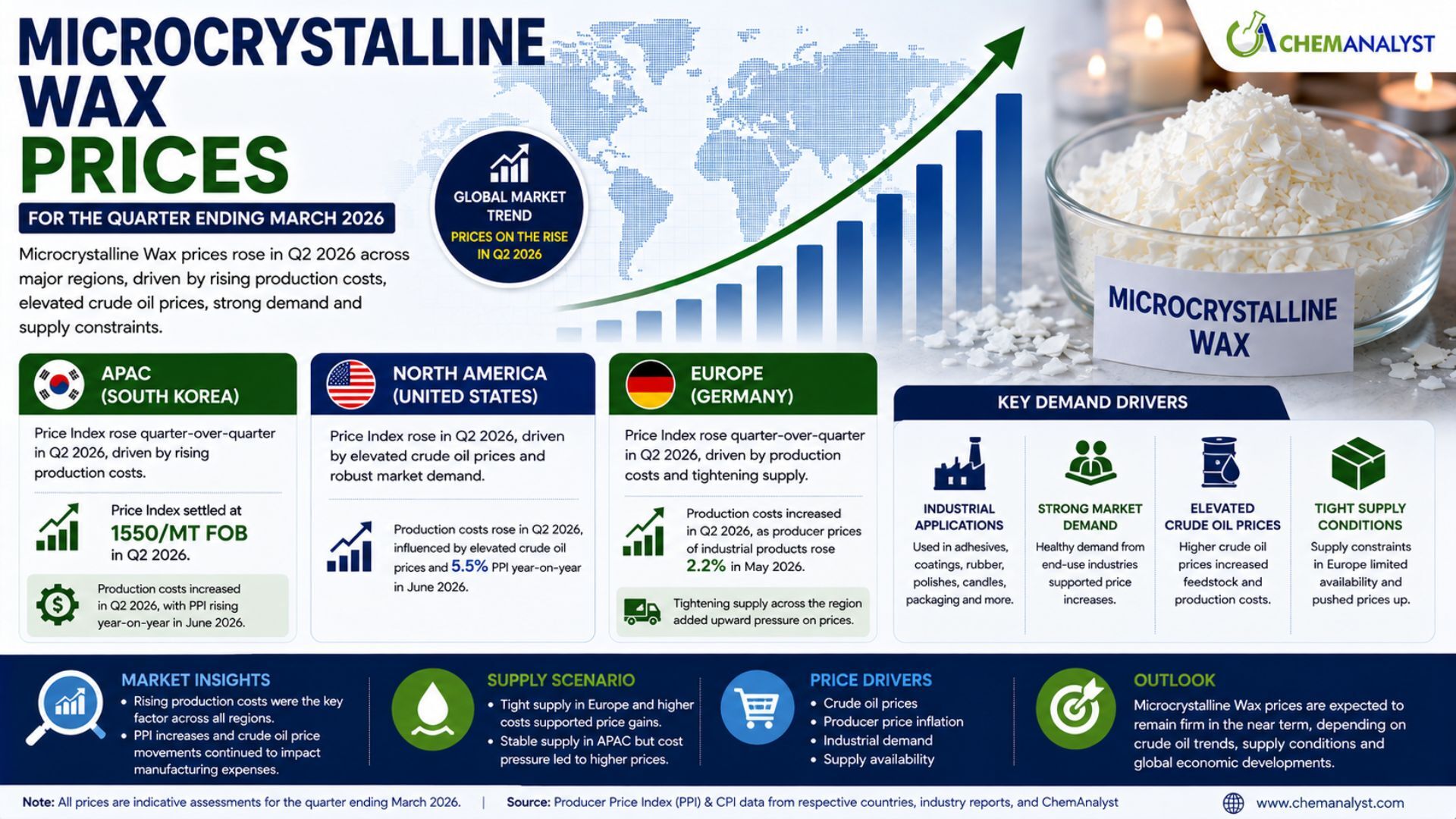
According to ChemAnalyst, the global Microcrystalline Wax Prices market recorded an upward movement across APAC, North America and Europe during the quarter ending June 2026. The market was supported by rising production costs, elevated crude oil prices, robust demand and tightening supply conditions. Although the primary drivers differed by region, cost pressures remained a common theme across the three major markets.
Microcrystalline wax is a refined petroleum-derived wax characterized by its fine crystalline structure, flexibility, higher melting point and strong binding properties. It is used across a range of applications, including candles, adhesives, coatings, cosmetics, packaging, rubber processing, polishes and other industrial formulations. Consequently, changes in crude oil economics, refining costs, industrial demand and supply availability can influence its pricing.
In South Korea, the Microcrystalline Wax Price Index rose quarter-over-quarter in Q2 2026, settling at USD 1550/MT FOB, driven by rising production costs. Production costs increased during the quarter, while the Producer Price Index also rose year-on-year in June 2026.
In the United States, the Microcrystalline Wax Price Index rose in Q2 2026, supported by elevated crude oil prices and robust market demand. Production costs increased due to elevated crude oil prices and a 5.5% year-over-year increase in PPI in June 2026.
Germany also recorded a quarter-over-quarter increase in the Microcrystalline Wax Price Index. The market was influenced by increasing production costs and tightening supply. Production costs increased alongside a 2.2% rise in producer prices of industrial products in May 2026.
Overall, Q2 2026 reflected a firm Microcrystalline Wax price trend, with crude oil prices, production economics, demand and supply availability shaping regional market performance.
Microcrystalline Wax Prices in APAC
The APAC Microcrystalline Wax market moved upward during Q2 2026. In South Korea, the Microcrystalline Wax Price Index rose quarter-over-quarter, settling at USD 1550/MT FOB.
The increase was primarily driven by rising production costs. Microcrystalline wax is closely linked to petroleum refining economics, meaning changes in feedstock and manufacturing expenses can influence supplier pricing.
Production costs increased during Q2 2026, while the Producer Price Index also recorded a year-on-year increase in June 2026. The supplied market data does not specify the exact PPI percentage for South Korea, so no additional figure is applied here.
Higher producer costs can influence the operating economics of manufacturers and refiners. When production expenses increase, suppliers may seek to preserve margins through higher selling prices, especially when downstream demand remains supportive.
The South Korean market therefore maintained an upward price direction during Q2 2026. The USD 1550/MT FOB assessment provides an important benchmark for understanding regional market conditions during the quarter.
Demand from industrial and consumer-facing applications can also influence procurement requirements. Microcrystalline wax is valued for properties such as flexibility, adhesion, moisture resistance and controlled melting behavior, supporting its use across multiple downstream applications.
The combination of rising production costs and market demand created a firm pricing environment in South Korea during Q2 2026.
Get Real Time Online for Microcrystalline Wax Prices: https://www.chemanalyst.com/Pricing-data/microcrystalline-wax-2349
Microcrystalline Wax Prices in North America
The North American market experienced an upward movement during Q2 2026. In the United States, the Microcrystalline Wax Price Index rose, driven by elevated crude oil prices and robust market demand.
Crude oil prices are an important factor for petroleum-derived products because changes in upstream feedstock economics can influence refining and downstream production costs. When crude oil prices rise, producers can face increased cost pressure throughout the value chain.
Microcrystalline Wax production costs rose during Q2 2026, influenced by elevated crude oil prices and a 5.5% year-over-year increase in U.S. PPI in June 2026.
The combination of higher crude oil prices and producer inflation provided significant support to the upward price movement.
At the same time, robust market demand strengthened the pricing environment. Strong downstream procurement can provide suppliers with greater pricing leverage, particularly when production costs are increasing.
The U.S. market consequently recorded a firm Microcrystalline Wax price trend during Q2 2026. Buyers across industrial applications needed to consider both crude oil movements and demand conditions when assessing procurement costs.
If crude oil prices remain elevated, production economics could continue to influence Microcrystalline Wax quotations. Similarly, sustained downstream demand could provide additional support to supplier pricing.
Microcrystalline Wax Prices in Europe
The European Microcrystalline Wax market also recorded an upward trend during Q2 2026. In Germany, the Microcrystalline Wax Price Index rose quarter-over-quarter, driven by increasing production costs and tightening supply.
Tightening supply can place upward pressure on prices because buyers may face reduced availability and increased competition for material. This effect can become more pronounced when production costs are simultaneously rising.
Microcrystalline Wax production costs increased during Q2 2026 as producer prices of industrial products rose 2.2% in May 2026.
The combination of higher production costs and tightening supply created a supportive pricing environment in Germany.
For downstream buyers, tightening supply can also encourage earlier procurement and inventory planning. Companies requiring consistent Microcrystalline Wax availability may increase their focus on supplier reliability, contract coverage and procurement lead times.
The German market therefore experienced a firm Microcrystalline Wax price trend during Q2 2026. Future developments will depend on the availability of material, production costs, industrial demand and broader market conditions.
Key Factors Influencing Microcrystalline Wax Prices
Several factors influenced Microcrystalline Wax Prices during Q2 2026.
Crude Oil Prices
Crude oil prices were particularly important in North America. Elevated crude oil prices increased production costs and contributed to higher Microcrystalline Wax prices in the United States.
Production Costs
Rising production costs were a common factor across APAC, North America and Europe. Higher manufacturing expenses can place upward pressure on supplier quotations.
Downstream Demand
Robust market demand supported the U.S. market during Q2 2026. Strong demand can help suppliers maintain firmer pricing when supply conditions remain balanced or constrained.
Supply Availability
Germany experienced tightening supply during Q2 2026. Reduced availability can increase competition among buyers and support higher market prices.
Producer Price Inflation
Producer-price movements provided an important indicator of manufacturing cost pressure. U.S. PPI increased 5.5% year-over-year in June 2026, while Germany's producer prices for industrial products increased 2.2% in May 2026.
Microcrystalline Wax Demand Analysis
Demand remains an important component of the global Microcrystalline Wax market. The material is used in multiple applications where flexibility, adhesion, moisture resistance and thermal properties are important.
During Q2 2026, the United States experienced robust market demand, which supported the upward movement in the Microcrystalline Wax Price Index.
Demand conditions can significantly influence supplier pricing. When downstream manufacturers maintain regular procurement while production costs increase, suppliers may have greater ability to pass higher expenses through to buyers.
In APAC, the supplied assessment primarily identified rising production costs as the key factor behind the price increase in South Korea. Demand nevertheless remains an important variable for the regional outlook.
In Europe, tightening supply was a major driver of the upward price movement in Germany. If demand remains steady while supply becomes more constrained, market prices can remain supported.
Overall, downstream demand from industrial and consumer-related applications will remain an important factor in determining future Microcrystalline Wax price movements.
Book A Demo for Microcrystalline Wax Price: https://www.chemanalyst.com/ChemAnalyst/PricingForm?Product=Microcrystalline%20Wax
Microcrystalline Wax Production Cost Trend
The Microcrystalline Wax production cost trend remained upward across the assessed markets during Q2 2026.
In South Korea, production costs increased during Q2 2026, alongside a year-on-year rise in PPI in June 2026.
In the United States, production costs increased due to elevated crude oil prices and a 5.5% year-over-year rise in PPI in June 2026.
In Germany, production costs increased as producer prices of industrial products rose 2.2% in May 2026.
The data indicate that production economics played a central role in supporting higher Microcrystalline Wax prices during the quarter.
For producers and buyers, monitoring upstream energy and petroleum-market conditions alongside producer-price indicators can provide useful insight into potential changes in manufacturing costs.
Microcrystalline Wax Supply Analysis
Supply conditions varied across the three assessed regions.
In South Korea, the upward price movement was primarily associated with increasing production costs. The market benchmark of USD 1550/MT FOB reflected the prevailing Q2 2026 conditions.
In the United States, elevated crude oil prices and robust demand supported the market. Strong demand can tighten the effective availability of material even when physical supply remains adequate.
Germany experienced tightening supply, adding direct upward pressure to prices. When supply becomes constrained, buyers may need to secure volumes earlier to protect their production schedules.
Supply availability will therefore remain an important factor for the Microcrystalline Wax market. Changes in refinery operations, production economics, inventories, imports and downstream purchasing patterns can all influence market balance.
Regional Microcrystalline Wax Price Comparison
The three assessed regions recorded upward Microcrystalline Wax price movements during Q2 2026, although the underlying drivers differed.
In APAC, South Korea's Microcrystalline Wax Price Index rose quarter-over-quarter and settled at USD 1550/MT FOB, driven by rising production costs.
In North America, the U.S. Microcrystalline Wax Price Index increased due to elevated crude oil prices and robust market demand. Production costs were also influenced by a 5.5% year-over-year rise in PPI in June 2026.
In Europe, Germany recorded a quarter-over-quarter increase due to rising production costs and tightening supply. Producer prices of industrial products increased 2.2% in May 2026.
The regional comparison shows that production costs were a common source of upward pressure, while crude oil prices, demand and supply availability created additional regional differences.
Microcrystalline Wax Market Outlook
The outlook for Microcrystalline Wax Prices will depend on crude oil prices, production costs, downstream demand, supply availability and producer-price movements.
In APAC, future price developments will depend on whether production costs continue increasing and how downstream procurement evolves. South Korea's Q2 2026 benchmark of USD 1550/MT FOB provides a reference point for the quarter.
In North America, crude oil prices will remain an important market indicator. Continued elevation in crude oil prices could maintain pressure on Microcrystalline Wax production costs. Robust downstream demand could provide additional support.
In Europe, supply availability will be particularly important. If tightening supply persists, prices could remain firm, particularly if production costs continue increasing.
The market outlook therefore remains sensitive to both upstream petroleum economics and downstream supply-demand fundamentals.
Microcrystalline Wax Price Trend Forecast
The Microcrystalline Wax price trend forecast remains closely linked to the balance between production costs, crude oil prices, supply and demand.
In the United States, sustained crude oil prices and robust market demand could continue to support firm pricing. A reduction in upstream cost pressure or downstream demand could moderate the market.
In South Korea, future price movements will depend on production costs and regional supply-demand conditions. Changes in PPI and manufacturing expenses will remain important indicators.
In Germany, tightening supply could continue supporting prices if availability remains constrained. Conversely, improved supply could reduce upward pressure.
Overall, the direction of Microcrystalline Wax prices will depend on how these factors evolve in subsequent quarters.
Conclusion
The global Microcrystalline Wax Prices market recorded an upward trend across APAC, North America and Europe during the quarter ending June 2026. Rising production costs emerged as a common factor, while elevated crude oil prices, robust demand and tightening supply provided additional regional support.
In South Korea, the Microcrystalline Wax Price Index rose quarter-over-quarter and settled at USD 1550/MT FOB, driven by rising production costs. Production costs increased during Q2 2026, with PPI also rising year-on-year in June 2026.
In the United States, Microcrystalline Wax prices increased due to elevated crude oil prices and robust market demand. Production costs rose amid elevated crude oil prices and a 5.5% year-over-year increase in PPI in June 2026.
In Germany, the Microcrystalline Wax Price Index rose quarter-over-quarter as production costs increased and supply tightened. Producer prices of industrial products increased 2.2% in May 2026, adding to cost pressures.
Overall, Q2 2026 reflected a firm Microcrystalline Wax price trend, shaped by upstream crude oil economics, producer inflation, demand, production costs and supply availability. Going forward, market participants will need to closely monitor crude oil prices, industrial producer prices, downstream demand and regional supply conditions to evaluate the direction of Microcrystalline Wax prices.
ChemAnalsyt
Call +1 3322586602
420 Lexington Avenue, Suite 300, New York, NY, United States, 10170
Website: https://www.chemanalyst.com/
Email: sales@chemanalyst.com
この記事をシェア





