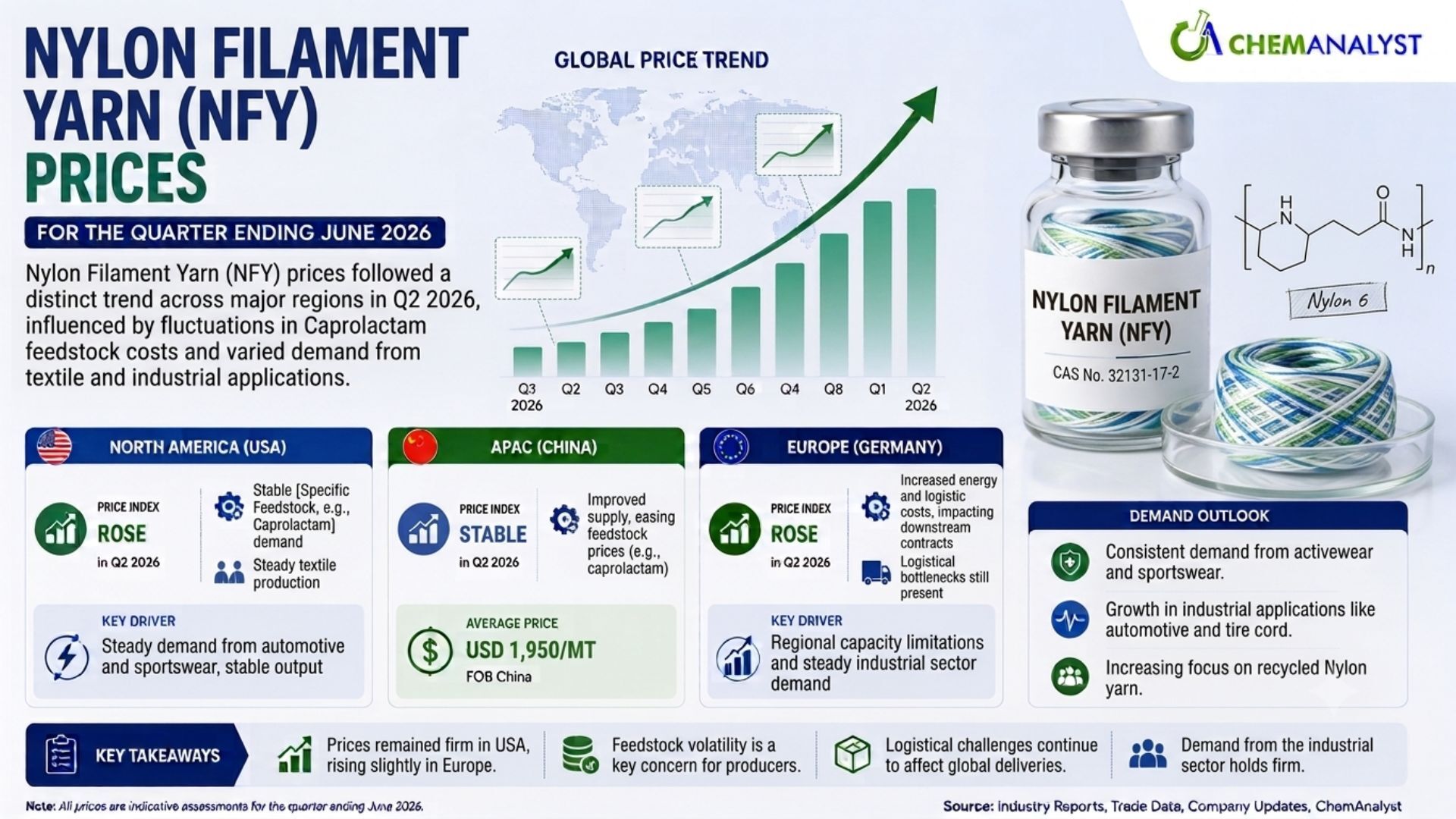
According to ChemAnalyst, the global Nylon Filament Yarn (NFY) Prices market moved upward across North America, Europe and APAC during the second quarter of 2026. Regional markets experienced quarter-over-quarter increases in their respective NFY Price Indices, with production costs remaining the key factor behind the overall firm pricing environment.
Nylon Filament Yarn is an important synthetic textile material used across apparel, home textiles, industrial fabrics and other applications where strength, flexibility, abrasion resistance and durability are required. As a downstream product, its pricing is closely connected with the availability and cost of upstream petrochemical and chemical feedstocks, particularly benzene and caprolactam.
During Q2 2026, the US market experienced upward pressure as the Producer Price Index increased by 5.5% year-over-year in June. Feedstock movements were also mixed, with benzene prices surging before declining, while caprolactam softened after strengthening during the early part of the quarter. Despite these fluctuations, the overall production-cost environment remained supportive of higher NFY prices.
In Europe, Germany recorded a quarter-over-quarter increase in the NFY Price Index amid rapidly rising production costs and a 2.2% increase in the Producer Price Index in May 2026. Meanwhile, China also experienced higher NFY prices as firm caprolactam feedstock costs increased production expenses.
The Q2 2026 market therefore reflected the strong influence of upstream feedstock costs and broader producer-price trends on global Nylon Filament Yarn (NFY) Prices.
Nylon Filament Yarn (NFY) Prices in North America
In the United States, the Nylon Filament Yarn (NFY) Price Index rose quarter-over-quarter during Q2 2026, influenced by broader increases in producer-level costs. The market faced a challenging production environment as upstream feedstock prices experienced significant fluctuations during the quarter.
A key macroeconomic indicator supporting the upward price movement was the 5.5% year-over-year increase in the US Producer Price Index in June 2026. Higher producer prices indicate a broader increase in costs across the production economy, which can influence manufacturing expenses for synthetic fibers and downstream textile products.
NFY production costs also remained sensitive to upstream benzene and caprolactam movements. Benzene prices surged during part of Q2 before subsequently declining, creating a volatile cost environment for producers. Since benzene is an important upstream component in the nylon production chain, fluctuations in its price can affect the cost structure of downstream nylon products.
Caprolactam, another critical feedstock for nylon production, softened after strengthening during the early part of Q2. Although the later decline provided some relief to manufacturers, the earlier increase and overall volatility kept production-cost considerations elevated.
The combination of higher producer prices and fluctuating feedstock costs supported the quarter-over-quarter increase in the US NFY Price Index. Market participants continued to monitor upstream chemical prices closely because changes in feedstock economics can influence producer offers and procurement decisions.
Impact of Benzene and Caprolactam on US NFY Prices
The relationship between upstream feedstock costs and NFY pricing was particularly important in the United States during Q2 2026.
Benzene experienced a notable surge before declining later in the quarter. Such fluctuations can create uncertainty for nylon manufacturers because changes in upstream petrochemical costs can affect production economics and inventory valuations.
Caprolactam followed a different trajectory. The feedstock strengthened during the early part of Q2 before softening later. The subsequent decline reduced some cost pressure, but the earlier increase contributed to a higher overall cost environment during the quarter.
For NFY producers, these developments created a mixed feedstock landscape. Although some cost relief emerged later in the quarter, broader producer-price inflation remained an important factor supporting higher Nylon Filament Yarn Prices.
Nylon Filament Yarn (NFY) Prices in Europe
In Europe, Germany recorded a quarter-over-quarter increase in the Nylon Filament Yarn (NFY) Price Index during Q2 2026. The upward movement was driven primarily by rising production costs.
The German market faced rapidly increasing manufacturing expenses during the quarter. A major indicator of this pressure was the 2.2% increase in the Producer Price Index in May 2026. Higher producer prices reflected increased costs across the industrial economy and contributed to a more expensive manufacturing environment for synthetic textile producers.
NFY manufacturing requires several energy and chemical inputs, making the product sensitive to fluctuations in industrial production costs. When producer prices rise, manufacturers may experience pressure on margins and subsequently seek higher selling prices to offset additional expenses.
During Q2 2026, the increase in German producer prices therefore contributed to higher NFY production costs. The resulting cost pressure supported the quarter-over-quarter increase in the German NFY Price Index.
The European market remained closely connected to developments in upstream chemical and industrial costs. Textile and synthetic-fiber manufacturers continued to evaluate feedstock and production economics when determining procurement and selling strategies.
Rising Production Costs in Germany
Production costs became a central factor affecting Nylon Filament Yarn Prices in Germany during Q2 2026. The rapid increase in manufacturing expenses reduced the scope for producers to absorb additional costs without adjusting prices.
The 2.2% increase in the Producer Price Index in May 2026 provided evidence of a broader increase in producer-level costs. For NFY manufacturers, higher industrial expenses can affect raw material procurement, processing, utilities, logistics and other operational requirements.
The increase in the NFY Price Index was therefore consistent with the wider cost environment. If production expenses remain elevated, suppliers may continue to face pressure to maintain margins through adjustments in selling prices.
Get Real Time Online for Nylon Filament Yarn (NFY) Prices: https://www.chemanalyst.com/Pricing-data/nylon-filament-yarn-1096
Nylon Filament Yarn (NFY) Prices in APAC
In APAC, China recorded a quarter-over-quarter increase in the Nylon Filament Yarn (NFY) Price Index during Q2 2026, primarily driven by elevated production costs.
The Chinese NFY market remained particularly sensitive to caprolactam feedstock economics during the quarter. Caprolactam feedstock costs remained firm in China throughout Q2 2026, increasing the production expenses associated with Nylon Filament Yarn.
Caprolactam is a critical feedstock in nylon manufacturing and changes in its pricing can have a direct impact on the cost structure of NFY producers. Firm caprolactam prices therefore created a supportive environment for higher NFY prices in China.
Manufacturers were required to account for the increased feedstock expenses when evaluating production costs and selling prices. As a result, the higher cost of caprolactam contributed to the quarter-over-quarter rise in the Chinese NFY Price Index.
The Chinese market demonstrated how upstream feedstock conditions can influence downstream synthetic fiber pricing. With caprolactam costs remaining firm, NFY producers faced sustained cost pressure during Q2 2026.
Key Factors Influencing Nylon Filament Yarn (NFY) Prices in Q2 2026
Several factors contributed to the global increase in Nylon Filament Yarn Prices during the second quarter.
Rising Producer Prices
Producer-price inflation was an important market factor in both North America and Europe. The US Producer Price Index increased by 5.5% year-over-year in June 2026, while Germany recorded a 2.2% increase in May 2026.
These movements reflected higher producer-level costs and contributed to the upward pressure on NFY manufacturing expenses.
Benzene Price Volatility
Benzene prices in the US experienced a surge before declining during Q2 2026. This volatility created uncertainty for manufacturers and affected the upstream cost environment for nylon-related products.
Although prices subsequently dropped, the earlier increase contributed to cost pressure during the quarter.
Caprolactam Costs
Caprolactam remained one of the most important factors affecting NFY production costs. In the United States, caprolactam softened after strengthening in early Q2. In China, however, caprolactam feedstock costs remained firm throughout the quarter.
The different regional feedstock movements contributed to variations in NFY market behavior.
Manufacturing Costs
Higher manufacturing expenses remained a common factor across all three regions. Producers had to manage changes in feedstock, industrial costs and operating expenses, creating upward pressure on NFY prices.
Book A Demo for Nylon Filament Yarn (NFY) Price: https://www.chemanalyst.com/ChemAnalyst/PricingForm?Product=Nylon%20Filament%20Yarn%20%28NFY%29
Impact of Supply and Demand on the NFY Market
Supply and demand fundamentals also influenced the Nylon Filament Yarn market during Q2 2026. However, production costs remained the dominant price-supporting factor across the major regions.
In the United States, higher producer prices and upstream feedstock volatility contributed to the rise in the NFY Price Index. In Germany, increasing industrial producer prices supported higher production expenses. In China, firm caprolactam costs strengthened the cost base for NFY manufacturers.
The relationship between production costs and downstream demand remains important for determining how effectively manufacturers can pass cost increases through the supply chain. When demand remains sufficiently stable, producers have greater flexibility to reflect higher input expenses in selling prices.
Regional Comparison of Nylon Filament Yarn (NFY) Prices
The Q2 2026 market showed a consistent upward trend across North America, Europe and APAC, although the individual drivers differed.
In the United States, the NFY Price Index increased quarter-over-quarter, supported by a 5.5% year-over-year increase in the Producer Price Index in June. Benzene volatility and changes in caprolactam prices also influenced production economics.
In Germany, the NFY Price Index rose quarter-over-quarter as production costs increased rapidly. The 2.2% rise in the Producer Price Index in May contributed to the higher cost environment.
In China, the NFY Price Index also increased quarter-over-quarter, primarily because caprolactam feedstock costs remained firm and increased production expenses.
The common element across all three markets was higher production-cost pressure, although the specific upstream and macroeconomic factors varied by region.
Nylon Filament Yarn Market Outlook
The Q2 2026 performance indicates that the global Nylon Filament Yarn market entered the second half of 2026 with a firm cost environment.
In North America, future NFY prices will remain sensitive to movements in benzene and caprolactam, as well as broader producer-price trends. A sustained decline in feedstock prices could reduce cost pressure, while renewed increases could support further price growth.
In Europe, producer-price movements will remain an important indicator of manufacturing costs. Any continued increase in industrial production expenses could maintain upward pressure on German NFY Prices.
In China, caprolactam prices will remain particularly important. Continued firmness in the feedstock market could keep NFY production costs elevated and support higher prices.
Market participants should therefore monitor upstream feedstock trends, producer-price indices, manufacturing expenses and downstream textile demand when evaluating future Nylon Filament Yarn (NFY) Prices.
Nylon Filament Yarn (NFY) Price Trend: Q2 2026 Summary
The second quarter of 2026 was characterized by an overall increase in Nylon Filament Yarn (NFY) Prices across North America, Europe and APAC. The upward movement was primarily associated with higher production costs and changes in upstream feedstock economics.
In the United States, the NFY Price Index rose quarter-over-quarter, influenced by a 5.5% year-over-year increase in the Producer Price Index in June 2026. Benzene prices surged before declining, while caprolactam softened after strengthening during early Q2, creating a volatile but broadly cost-sensitive environment.
Germany also recorded a quarter-over-quarter increase in the NFY Price Index. Rising production costs were a major factor, with the Producer Price Index increasing by 2.2% in May 2026.
China experienced a quarter-over-quarter rise in its NFY Price Index as elevated production costs continued to affect the market. Firm caprolactam feedstock costs during Q2 increased NFY production expenses and supported higher prices.
Overall, Q2 2026 demonstrated the strong relationship between upstream chemical costs and synthetic fiber pricing. Benzene and caprolactam movements, together with broader producer-price trends, remained key indicators for the Nylon Filament Yarn market. Monitoring these factors alongside downstream textile demand will remain essential for understanding future Nylon Filament Yarn (NFY) Price Trends and making informed procurement decisions.
ChemAnalsyt
Call +1 3322586602
420 Lexington Avenue, Suite 300, New York, NY, United States, 10170
Website: https://www.chemanalyst.com/
Email: sales@chemanalyst.com
この記事をシェア





