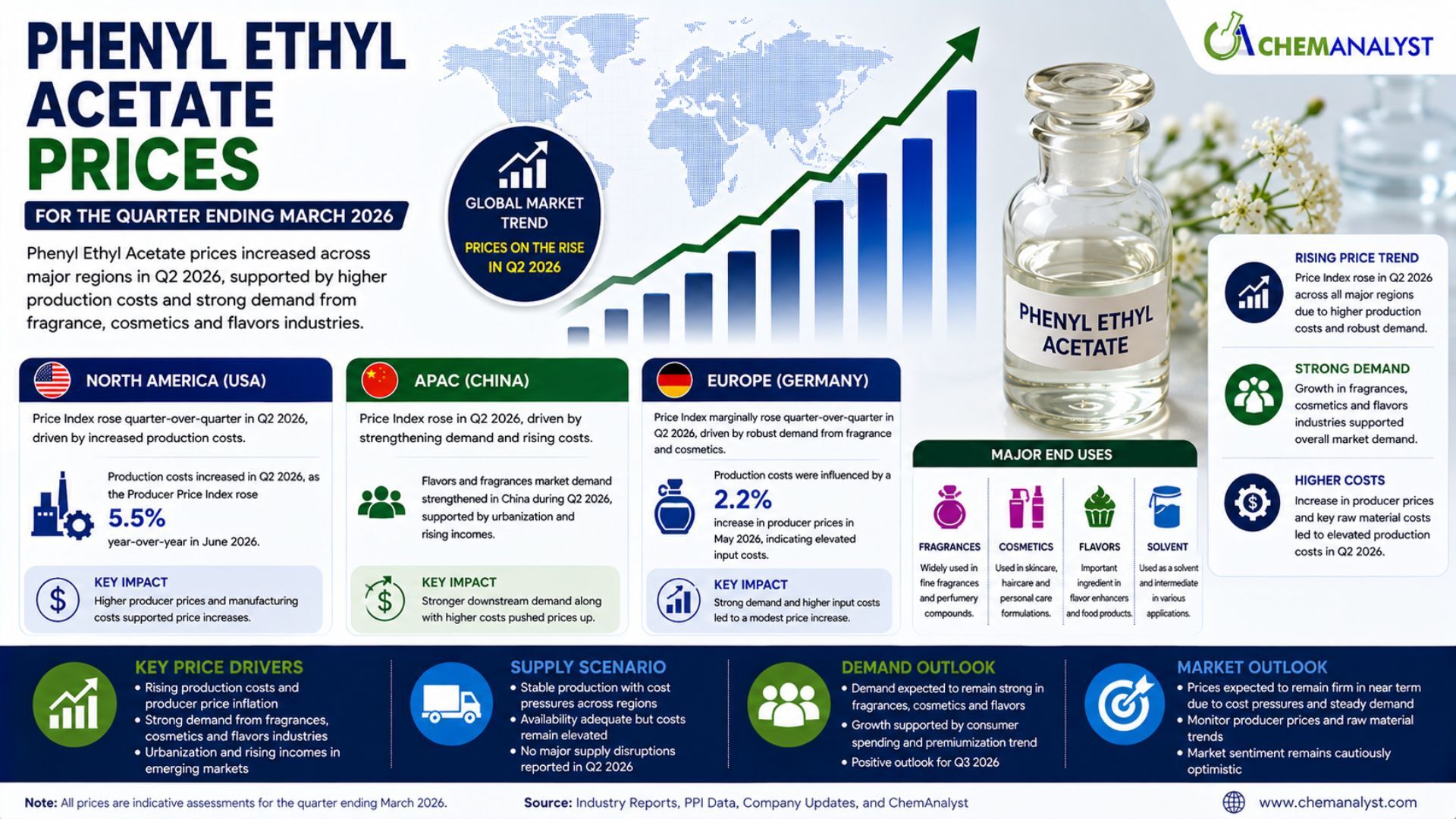
According to ChemAnalyst, the global Phenyl Ethyl Acetate Prices market remained firm during the quarter ending June 2026, with North America, APAC and Europe all recording upward price movements. The market was influenced by a combination of higher production costs, strengthening demand from flavors and fragrances and elevated producer prices.
Phenyl Ethyl Acetate is an ester commonly associated with flavor and fragrance applications. Its market performance is therefore closely linked to demand from fragrance, cosmetics, personal care and flavor-related industries. At the same time, production economics, raw material costs and broader industrial inflation can influence supplier pricing.
In the United States, the Phenyl Ethyl Acetate Price Index rose quarter-over-quarter in Q2 2026, driven by increased production costs. Production costs increased during the quarter as the Producer Price Index (PPI) rose 5.5% year-over-year in June 2026.
In China, the Phenyl Ethyl Acetate Price Index also rose in Q2 2026, supported by strengthening demand and rising costs. Demand from the flavors and fragrances market strengthened during the quarter, supported by urbanization and rising incomes.
Germany recorded a marginal quarter-over-quarter increase in the Phenyl Ethyl Acetate Price Index. Robust demand from fragrance and cosmetics applications supported pricing, while producer prices increased 2.2% in May 2026, indicating elevated input costs.
Overall, the Q2 2026 Phenyl Ethyl Acetate price trend remained positive, although the strength of the increase differed across regions.
Phenyl Ethyl Acetate Prices in North America
The North American market experienced an upward movement during Q2 2026. In the United States, the Phenyl Ethyl Acetate Price Index rose quarter-over-quarter, primarily due to increased production costs.
The production-cost environment remained elevated during the quarter, with the U.S. Producer Price Index increasing 5.5% year-over-year in June 2026. Higher producer prices can increase manufacturing expenses across industrial supply chains and may encourage producers to maintain higher selling prices.
For Phenyl Ethyl Acetate manufacturers, higher production costs can influence the economics of producing and supplying material to downstream customers. When the cost base increases, suppliers may seek to recover part of the additional expense through higher offers.
The Q2 2026 market movement therefore reflected a cost-driven increase rather than a specific supply shortage. The U.S. market remained supported by the elevated producer-cost environment.
Downstream demand from fragrance, cosmetics, personal care and flavor applications remains an important consideration for the North American market. However, the supplied Q2 2026 assessment identifies increased production costs as the primary factor behind the price increase.
Going forward, changes in producer prices and manufacturing costs will remain important indicators for the Phenyl Ethyl Acetate market in North America. If producer inflation remains elevated, prices could continue to face upward pressure. Conversely, stabilization in production costs could moderate the rate of price increases.
Get Real Time Online for Phenyl Ethyl Acetate Prices: https://www.chemanalyst.com/Pricing-data/phenyl-ethyl-acetate-2466
Phenyl Ethyl Acetate Prices in APAC
The APAC market recorded an upward movement during Q2 2026, with China emerging as an important driver of regional demand. The Phenyl Ethyl Acetate Price Index in China rose during Q2 2026, supported by strengthening demand and rising costs.
One of the key factors supporting demand was the strengthening flavors and fragrances market in China. The market experienced stronger demand during Q2 2026, supported by urbanization and rising incomes.
Urbanization can contribute to changing consumer preferences and greater consumption of products incorporating fragrances and flavors. Rising incomes can similarly support demand for consumer products in which flavor and fragrance ingredients are used.
This stronger downstream environment provided support to Phenyl Ethyl Acetate demand during the quarter. At the same time, rising production costs added another layer of upward pressure to the market.
The combination of stronger demand and higher costs created a firm pricing environment in China. Unlike the U.S. market, where production costs were the principal factor identified, the Chinese market experienced support from both demand and cost-side developments.
For buyers, monitoring downstream consumption patterns will remain important. Any continued expansion in fragrance, cosmetics, flavor and personal care applications could support demand for Phenyl Ethyl Acetate.
The Chinese market will also remain sensitive to production economics. If manufacturing costs increase alongside strong downstream demand, suppliers may continue maintaining firm price offers.
Phenyl Ethyl Acetate Prices in Europe
The European market recorded a more moderate increase during Q2 2026. In Germany, the Phenyl Ethyl Acetate Price Index marginally rose quarter-over-quarter, supported by robust demand from fragrance and cosmetics applications.
The European fragrance and cosmetics sectors remained an important source of downstream demand. Continued consumption from these industries helped provide market support during the quarter.
Production costs also contributed to the upward price movement. Producer prices increased 2.2% in May 2026, indicating an elevated input-cost environment.
Although the increase in Germany was marginal compared with stronger movements that can occur under more constrained market conditions, the combination of demand and cost factors kept the market supported.
The German market therefore demonstrated a balanced upward trend, where healthy downstream demand and higher input costs provided support without indicating a severe supply shortage.
Future price developments in Europe will depend on the direction of producer prices, fragrance and cosmetics demand and supplier cost structures.
Key Factors Influencing Phenyl Ethyl Acetate Prices
Several factors shaped the Phenyl Ethyl Acetate Prices market during Q2 2026.
Production Costs
Higher production costs were an important factor in both North America and Europe. Increased producer prices can raise expenses associated with manufacturing and distribution.
Producer Price Inflation
The U.S. PPI increased 5.5% year-over-year in June 2026, contributing to a higher industrial cost environment.
In Germany, producer prices increased 2.2% in May 2026, adding pressure to production economics.
Fragrance and Cosmetics Demand
Demand from fragrance and cosmetics applications supported the European market and contributed to the firm pricing environment.
Flavors and Fragrances Market in China
China experienced stronger demand from the flavors and fragrances sector during Q2 2026. Urbanization and rising incomes supported this downstream market development.
Consumer Market Development
Changes in consumer spending and demand for products incorporating fragrances and flavors can influence the downstream consumption of Phenyl Ethyl Acetate.
Book A Demo for Phenyl Ethyl Acetate Price: https://www.chemanalyst.com/ChemAnalyst/PricingForm?Product=Phenyl%20Ethyl%20Acetate
Phenyl Ethyl Acetate Demand Analysis
Demand remained an important market factor during Q2 2026, particularly in APAC and Europe.
In China, strengthening demand from the flavors and fragrances market supported the upward movement in Phenyl Ethyl Acetate prices. Urbanization and rising incomes contributed to stronger demand conditions, supporting consumption from downstream industries.
In Germany, robust demand from fragrance and cosmetics applications provided additional support to prices. The marginal increase in the German Price Index indicates that demand remained healthy enough to offset some market pressures.
In North America, the supplied data emphasizes production costs rather than a specific change in downstream demand. Therefore, the U.S. price increase should primarily be associated with increased production costs.
Going forward, demand from flavors, fragrances, cosmetics, personal care and related consumer-product industries will remain important for determining market balance.
Phenyl Ethyl Acetate Supply Analysis
Supply conditions remained closely connected to production economics during Q2 2026. The supplied market data does not identify a major supply disruption in any of the three regions.
Instead, the upward movement was primarily associated with increasing production costs and stronger downstream demand.
In the United States, higher producer prices contributed to increased manufacturing costs. In China, rising costs occurred alongside stronger demand. In Germany, elevated input costs and robust fragrance and cosmetics demand supported a marginal increase.
This suggests that the Q2 2026 market remained relatively balanced from a physical supply perspective while experiencing upward cost pressure.
For buyers, monitoring supplier availability, production costs and downstream procurement will remain important for understanding future market movements.
Phenyl Ethyl Acetate Production Cost Trend
The Phenyl Ethyl Acetate production cost trend remained elevated during Q2 2026.
In the United States, the 5.5% year-over-year increase in PPI in June 2026 indicated significant producer-cost pressure. This contributed directly to the increase in the Phenyl Ethyl Acetate Price Index.
In Germany, producer prices increased 2.2% in May 2026, indicating higher input costs and supporting the marginal price increase.
China also experienced rising costs during Q2 2026, although its market movement was additionally supported by stronger downstream demand.
The regional developments demonstrate that production economics remained an important component of Phenyl Ethyl Acetate pricing.
Regional Phenyl Ethyl Acetate Price Comparison
The Q2 2026 regional market showed an upward direction across all three assessed regions.
North America: The U.S. Phenyl Ethyl Acetate Price Index rose quarter-over-quarter, driven by increased production costs. The U.S. PPI increased 5.5% year-over-year in June 2026.
APAC: China's Phenyl Ethyl Acetate Price Index rose, supported by strengthening demand and rising costs. The flavors and fragrances market benefited from urbanization and rising incomes.
Europe: Germany recorded a marginal quarter-over-quarter increase. Robust fragrance and cosmetics demand supported the market, while producer prices rose 2.2% in May 2026.
The regional comparison shows a consistent upward direction, although the underlying drivers differed. Cost inflation dominated the U.S. market, demand and costs supported China, while Germany benefited from both downstream demand and elevated producer prices.
Phenyl Ethyl Acetate Market Outlook
The outlook for Phenyl Ethyl Acetate Prices will depend on the interaction between production costs and downstream demand.
In North America, producer-price developments will remain an important indicator. Continued cost inflation could support firm pricing, while stabilization in production costs could reduce upward pressure.
In China, the performance of the flavors and fragrances market will remain important. Continued urbanization, income growth and consumer demand could provide support to downstream consumption.
In Europe, fragrance and cosmetics demand will remain a key market factor. The direction of producer prices will also influence supplier cost structures.
The market therefore remains sensitive to both industrial cost conditions and consumer-oriented downstream demand.
Phenyl Ethyl Acetate Price Trend Forecast
The Phenyl Ethyl Acetate price trend forecast remains cautiously firm following the upward movement recorded during Q2 2026.
For the United States, sustained producer-cost inflation could keep prices elevated. A moderation in PPI and manufacturing expenses, however, could reduce cost-related pressure.
For China, the combination of stronger flavors and fragrances demand and rising costs could continue supporting prices. Any slowdown in downstream consumption could moderate the market's upward momentum.
For Germany, continued demand from fragrance and cosmetics applications could provide price support, while producer-price developments will determine the degree of cost pressure.
Overall, the market outlook points toward a relatively firm environment, with future price direction depending on the balance between production economics and downstream demand.
Conclusion
The global Phenyl Ethyl Acetate Prices market moved upward during the quarter ending June 2026, with North America, APAC and Europe all recording positive price movements.
In the United States, the Phenyl Ethyl Acetate Price Index rose quarter-over-quarter due to increased production costs. The U.S. PPI increased 5.5% year-over-year in June 2026, highlighting the elevated producer-cost environment.
In China, the Price Index increased during Q2 2026, supported by strengthening demand and rising costs. The flavors and fragrances market benefited from urbanization and rising incomes, supporting downstream demand.
In Germany, the Phenyl Ethyl Acetate Price Index marginally increased quarter-over-quarter. Robust demand from fragrance and cosmetics applications supported the market, while producer prices increased 2.2% in May 2026.
Overall, Q2 2026 represented a firm period for the Phenyl Ethyl Acetate market. Rising production costs were a common theme across regions, while stronger flavors, fragrances, fragrance and cosmetics demand provided additional support in China and Europe. Going forward, market participants should monitor producer-price inflation, production costs, consumer demand and downstream procurement trends to evaluate the future direction of Phenyl Ethyl Acetate prices.
ChemAnalsyt
Call +1 3322586602
420 Lexington Avenue, Suite 300, New York, NY, United States, 10170
Website: https://www.chemanalyst.com/
Email: sales@chemanalyst.com
この記事をシェア





