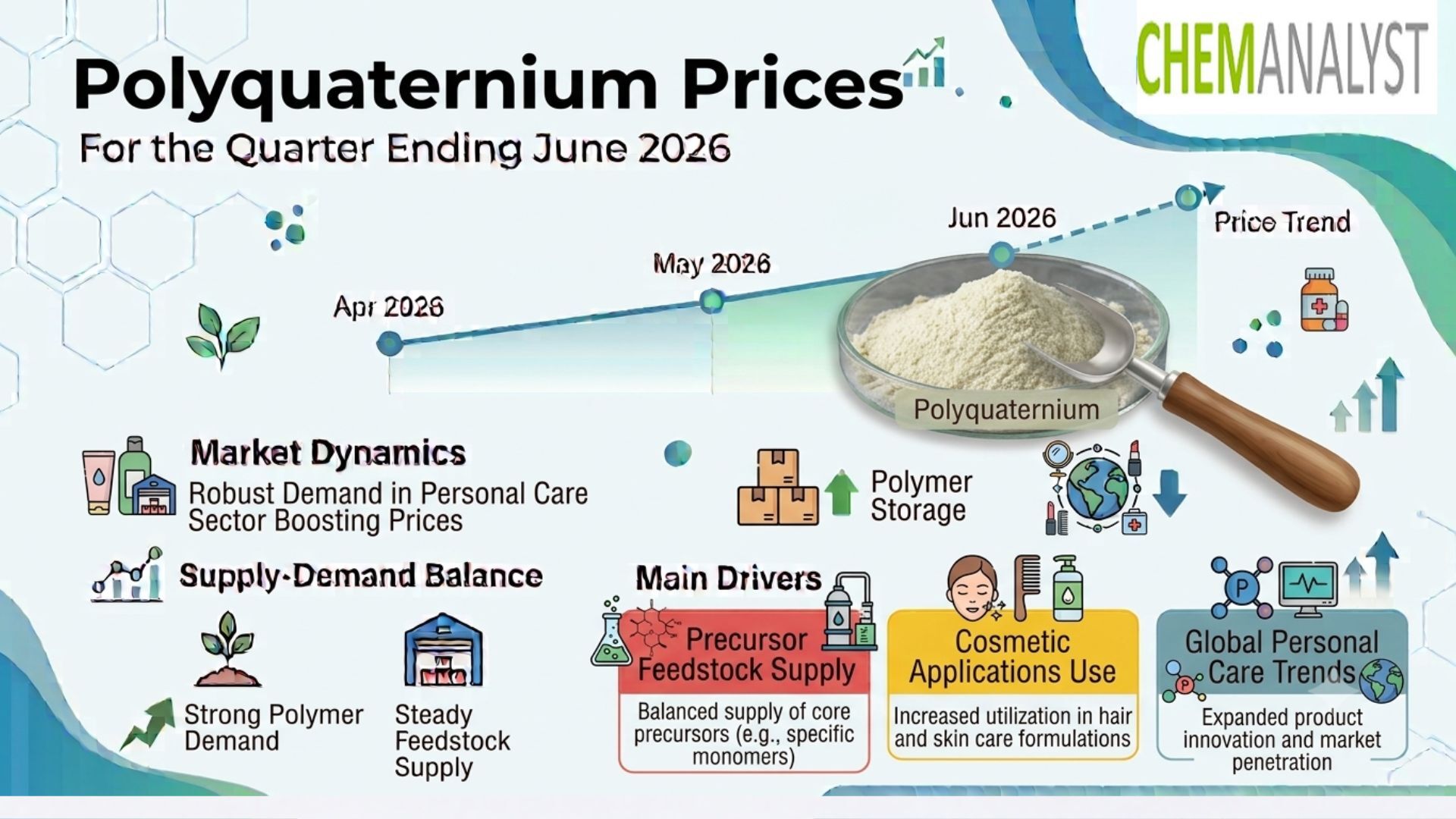
According to ChemAnalyst, the global Polyquaternium Prices market experienced mixed regional movements during the quarter ending June 2026. While the United States and major European markets recorded moderate quarterly increases, China experienced a decline due to softer downstream demand. India and Belgium also recorded increases in their respective price indices, although competitive imports and comfortable inventories limited spot-market pricing power.
Polyquaterniums are cationic polymers widely used in personal care and cosmetic formulations, particularly in hair-care products, conditioners, shampoos, styling products and skin-care formulations. Their functional properties make them valuable for conditioning, film formation, anti-static performance and improving the sensory characteristics of finished formulations.
Because polyquaternium products serve specialized downstream applications, their pricing can be influenced by several factors, including raw-material costs, production stability, downstream demand, inventory levels, imports, exports and supplier competition. During Q2 2026, these factors produced distinctly different pricing environments across North America, APAC and Europe.
In the USA, the Polyquaternium Price Index rose by 2.27% quarter-over-quarter, supported by stable supply conditions. China recorded a 3.77% quarter-over-quarter decline, reflecting softer downstream demand. India saw a 1.65% increase, while Germany and Belgium recorded increases of 1.09% and 1.60%, respectively.
Polyquaternium Prices in North America
USA Polyquaternium Price Trends
In the United States, the Polyquaternium Price Index rose by 2.27% quarter-over-quarter during Q2 2026. The increase was supported by stable supply conditions across the market.
The average Polyquaternium price for the quarter was approximately USD 17052.67/MT, FOB New York terms.
Stable supply conditions provided a relatively predictable environment for buyers and sellers. Although demand conditions can influence purchasing activity, consistent material availability can help prevent significant supply disruptions and provide greater stability to the market.
The quarterly increase indicates that despite stable supply, the overall pricing environment remained slightly firmer. For downstream formulators, particularly those operating in personal care and cosmetic applications, maintaining reliable access to specialty conditioning ingredients remains important because changes in supplier availability can affect production planning.
The U.S. market's modest increase also demonstrates that stable supply does not necessarily result in flat prices. Other factors affecting procurement economics, including supplier pricing strategies and broader market conditions, can still contribute to gradual price movements.
Get Real Time Online for Polyquaternium Prices: https://www.chemanalyst.com/Pricing-data/polyquaternium-3089
Polyquaternium Prices in APAC
China Polyquaternium Price Trends
China experienced a different pricing direction during Q2 2026. The Polyquaternium Price Index fell by 3.77% quarter-over-quarter, reflecting softer downstream demand conditions.
The average Polyquaternium price in China was approximately USD 672.33/MT, with suppliers offering discounts strategically.
Softer downstream demand reduced purchasing pressure and created a more competitive selling environment. When buyers reduce procurement volumes or delay replenishment, suppliers may have to become more flexible with quotations to maintain order flow.
Strategic discounting therefore became an important feature of the Chinese market during Q2 2026. Suppliers sought to remain competitive and stimulate purchasing activity by adjusting offers in response to weaker downstream conditions.
The decline in China's Polyquaternium Prices highlights the importance of demand fundamentals in specialty chemical markets. Even where production and supply remain available, weaker consumption can place downward pressure on selling prices.
Impact of Supplier Discounting in China
Supplier discounting played a significant role in the Q2 2026 Chinese market. With downstream demand softer, suppliers had an incentive to offer more competitive prices to secure transactions.
This type of pricing strategy can create additional pressure on the market when multiple sellers compete for limited buying interest. Buyers may also benefit from greater negotiating flexibility during periods of subdued demand.
For procurement teams, China's Q2 performance demonstrates the importance of monitoring not only benchmark prices but also supplier quotation behavior. Strategic discounts can sometimes provide opportunities for buyers to optimize procurement costs when market demand is weak.
Polyquaternium Prices in India
India Polyquaternium Price Trends
In India, the Polyquaternium Price Index rose by 1.65% quarter-over-quarter, supported by steady imports and softer domestic demand.
At first glance, the combination of steady imports and softer domestic demand could suggest downward pricing pressure. However, the Indian market was also influenced by the availability of imported material and competitive supplier behavior.
Import competition and ample cargoes pressured Polyquaternium Spot Price, prompting sellers to offer more competitive CIF quotes.
The availability of ample cargoes increased competition among suppliers. Buyers consequently had more alternatives when negotiating purchases, encouraging sellers to remain competitive on delivered pricing.
The difference between the quarterly Price Index and spot-market behavior is particularly important. While the index recorded a 1.65% increase, spot prices faced pressure from import competition and sufficient cargo availability.
This indicates that short-term market quotations can behave differently from broader quarterly benchmarks. Procurement teams therefore need to assess both historical price movements and current spot-market conditions when evaluating purchasing opportunities.
Import Competition and CIF Quotes
Import competition remained a central feature of India's market during Q2 2026. Ample cargoes created sufficient availability and limited the ability of sellers to maintain aggressive spot quotations.
As competition increased, sellers responded with more competitive CIF quotes. This provided buyers with greater flexibility when evaluating supply options and negotiating procurement contracts.
The Indian market therefore illustrates the importance of international trade flows in determining domestic specialty chemical pricing. Changes in import availability can influence seller behavior even when the broader quarterly price index records an increase.
Polyquaternium Prices in Europe
Germany Polyquaternium-46 Price Trends
Germany recorded a moderate increase in the Polyquaternium-46 Price Index, which rose by 1.09% quarter-over-quarter during Q2 2026.
The increase was supported by stable production and export offers. The average Polyquaternium-46 price for the quarter was approximately USD 7441.67/MT, reflecting subdued demand and inventories.
Stable production helped maintain material availability, while export offers provided an important reference point for market participants. However, subdued demand and existing inventories limited the potential for stronger price growth.
The German market therefore experienced a relatively controlled upward movement rather than a sharp increase. The 1.09% quarterly rise suggests that supply-side stability provided some support, but demand conditions prevented more significant upward momentum.
For buyers, the combination of subdued demand and available inventories can provide opportunities for more measured procurement. However, monitoring production and export conditions remains important because changes in supply availability could quickly alter the market balance.
Polyquaternium Prices in Belgium
Belgium Polyquaternium Price Trends
In Belgium, the Polyquaternium Price Index rose by 1.60% quarter-over-quarter, reflecting limited demand recovery broadly.
Despite the increase in the Price Index, the Polyquaternium Spot Price weakened as Asian competitive offers and comfortable inventories limited seller pricing power.
The Belgian market therefore experienced a mixed pricing environment. The quarterly index moved higher, but spot-market conditions were softer because buyers had access to competitive Asian offers and sufficient local inventories.
Comfortable inventory levels reduced the urgency to purchase additional material. When buyers are adequately stocked, suppliers may have to compete more actively for new orders, particularly when alternative imported material is available at competitive prices.
Asian offers added another layer of competitive pressure. European sellers competing against lower-priced imported material may need to adjust their quotations to remain attractive to buyers.
Book A Demo for Polyquaternium Price: https://www.chemanalyst.com/ChemAnalyst/PricingForm?Product=Polyquaternium
Key Factors Influencing Polyquaternium Prices in Q2 2026
Several factors shaped the global Polyquaternium Prices market during Q2 2026.
Downstream Demand
Demand conditions were one of the most important drivers. China experienced a 3.77% quarter-over-quarter decline because of softer downstream demand. Belgium also recorded only limited demand recovery, which restricted seller pricing power.
Supply Stability
Stable supply conditions supported the 2.27% increase in the U.S. Polyquaternium Price Index. Germany also benefited from stable production and export offers.
Import Competition
Import competition was particularly important in India and Belgium. Ample cargoes in India pressured spot prices, while competitive Asian offers affected Belgian spot-market pricing.
Inventory Levels
Inventory availability influenced European pricing. In Germany, subdued demand and inventories limited the extent of price increases. In Belgium, comfortable inventories weakened spot prices.
Supplier Pricing Strategies
Chinese suppliers strategically offered discounts in response to weaker downstream demand. Similarly, Indian sellers provided more competitive CIF quotes because of import competition and ample cargoes.
Regional Comparison of Polyquaternium Price Trends
The Q2 2026 Polyquaternium Prices market demonstrated significant regional variation.
The United States recorded a 2.27% quarter-over-quarter increase, with an average price of approximately USD 17052.67/MT FOB New York, supported by stable supply conditions.
China moved in the opposite direction, with its Price Index falling 3.77% quarter-over-quarter and the average price reaching approximately USD 672.33/MT. Softer downstream demand encouraged suppliers to offer strategic discounts.
India recorded a 1.65% quarterly increase, although import competition and ample cargoes pressured spot prices and encouraged competitive CIF quotations.
Germany's Polyquaternium-46 Price Index rose 1.09%, with an average price of approximately USD 7441.67/MT, while subdued demand and inventories limited stronger gains.
Belgium recorded a 1.60% increase, but spot prices weakened because competitive Asian offers and comfortable inventories limited seller pricing power.
These differences show that regional Polyquaternium pricing is determined by the interaction of demand, supply, imports, inventories and supplier strategies rather than by a single global market factor.
Example: How Import Competition Can Influence Polyquaternium Prices
Consider a buyer in India sourcing polyquaternium during Q2 2026. Steady imports and ample cargo availability give the buyer access to several supply options.
With multiple sellers competing for the same purchasing requirement, suppliers may respond by lowering their CIF quotations to secure the transaction. As a result, the Polyquaternium Spot Price can weaken even when the quarterly Price Index records an increase.
This example demonstrates why buyers should consider both benchmark indices and current market quotations. A quarterly index provides a broader view of market movement, while spot prices reflect immediate supply, inventory and competitive conditions.
Impact on Procurement and Supply Chain Planning
The Q2 2026 market conditions provide several important lessons for polyquaternium buyers.
Procurement teams should monitor downstream demand because weaker consumption can create opportunities for competitive purchasing. China's market demonstrates how strategic supplier discounts can emerge when demand conditions soften.
Import-dependent markets should closely follow cargo arrivals and international supplier offers. India's experience shows that ample imports can increase competition and pressure spot pricing.
Inventory management is equally important. Comfortable inventories can provide buyers with greater flexibility and reduce the need for immediate replenishment. However, buyers must balance inventory savings against the risk of supply disruptions or changes in supplier pricing.
European buyers should also monitor Asian export offers because competitive imported material can influence regional seller pricing. Maintaining visibility across both domestic and international markets can help procurement teams identify cost-saving opportunities.
Polyquaternium Prices Outlook
The outlook for Polyquaternium Prices will depend on downstream demand, supply availability, inventory positions, imports, export offers and supplier pricing strategies.
In the United States, stable supply conditions may continue to support a relatively predictable market, although changes in downstream consumption could influence future price direction.
China's outlook will remain closely connected to downstream demand. If demand remains subdued, suppliers may continue using strategic discounts to stimulate purchasing. A recovery in consumption could reduce competitive pressure and provide greater support to prices.
India will remain sensitive to import competition and cargo availability. Continued ample imports could keep spot-market pricing competitive, while tighter import flows could strengthen seller pricing power.
Germany and Belgium will remain influenced by inventories and Asian competition. Stable production may support Germany's market, while comfortable Belgian inventories and competitive Asian offers could continue limiting spot-price increases.
Conclusion
The global Polyquaternium Prices market showed mixed regional trends during the quarter ending June 2026.
In the USA, the Polyquaternium Price Index increased by 2.27% quarter-over-quarter, supported by stable supply conditions, with the average price reaching approximately USD 17052.67/MT FOB New York.
China recorded a 3.77% quarter-over-quarter decline, reflecting softer downstream demand. The average price was approximately USD 672.33/MT, with suppliers strategically offering discounts.
India's Polyquaternium Price Index increased by 1.65%, supported by steady imports and softer domestic demand, while import competition and ample cargoes pressured spot prices and encouraged competitive CIF quotes.
In Germany, the Polyquaternium-46 Price Index rose by 1.09%, supported by stable production and export offers. The average price was approximately USD 7441.67/MT, with subdued demand and inventories limiting stronger gains.
Belgium recorded a 1.60% quarter-over-quarter increase, although competitive Asian offers and comfortable inventories weakened spot prices and limited seller pricing power.
Overall, Q2 2026 demonstrated that Polyquaternium Prices are shaped by regional demand, supply stability, import competition, inventory levels and supplier pricing strategies. Monitoring these factors will remain essential for manufacturers, formulators, distributors and procurement teams seeking to understand market direction and optimize purchasing decisions.
ChemAnalsyt
Call +1 3322586602
420 Lexington Avenue, Suite 300, New York, NY, United States, 10170
Website: https://www.chemanalyst.com/
Email: sales@chemanalyst.com
この記事をシェア





