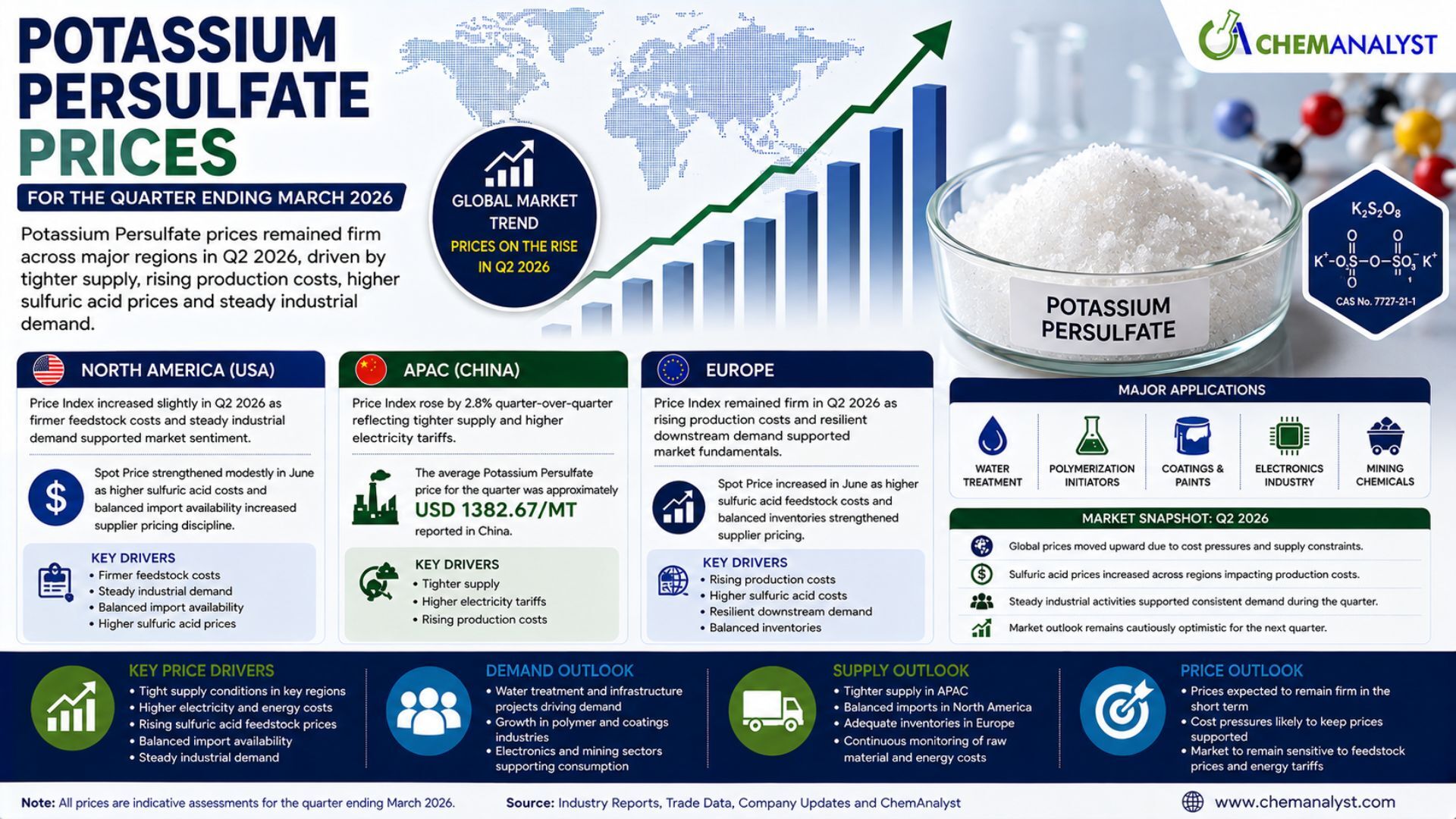
According to ChemAnalyst, the global Potassium Persulfate Prices market remained firm during the quarter ending June 2026, with regional markets across APAC, North America and Europe experiencing varying degrees of upward price pressure. Tightening supply, higher electricity tariffs, firmer feedstock costs, steady industrial demand and elevated sulfuric acid costs were among the key factors influencing market conditions during Q2 2026.
Potassium Persulfate is an important inorganic persulfate compound used across several industrial applications. Its market performance is closely linked to manufacturing activity, raw material costs, electricity expenses, import availability and downstream procurement. As a result, changes in production economics or supply conditions can quickly influence supplier pricing and spot-market sentiment.
In China, the Potassium Persulfate Price Index rose by 2.8% quarter-over-quarter in Q2 2026, reflecting tighter supply and higher electricity tariffs. The average Potassium Persulfate price for the quarter was approximately USD 1382.67/MT, reported in China.
North America experienced a slight increase in the Potassium Persulfate Price Index during Q2 2026. Firmer feedstock costs and steady industrial demand supported market sentiment. The Potassium Persulfate Spot Price strengthened modestly in June as higher sulfuric acid costs and balanced import availability encouraged suppliers to maintain disciplined pricing.
In Europe, the Potassium Persulfate Price Index remained firm during Q2 2026. Rising production costs and resilient downstream demand supported market fundamentals, while higher sulfuric acid feedstock costs and balanced inventories contributed to an increase in the June spot price.
Overall, the Q2 2026 Potassium Persulfate price trend reflected a firm market environment, with cost pressures and steady demand providing support across the major regions.
Potassium Persulfate Prices in APAC
The APAC market recorded a clear upward movement during Q2 2026, particularly in China. The Potassium Persulfate Price Index in China increased by 2.8% quarter-over-quarter, driven by tighter supply and higher electricity tariffs.
The average Potassium Persulfate price during the quarter was approximately USD 1382.67/MT in China. The increase indicates that suppliers were able to maintain firmer pricing as market availability tightened and production expenses increased.
Electricity tariffs played an important role in the Chinese market during the quarter. Energy represents an important component of industrial manufacturing costs and higher electricity expenses can raise the overall cost of production. When these additional expenses occur alongside tighter supply, manufacturers may seek to recover higher operating costs through increased selling prices.
Supply conditions also contributed to the positive price movement. Tighter availability can increase competition among buyers, particularly when downstream consumers need to maintain regular procurement schedules. This can strengthen supplier negotiating power and support higher market offers.
The combination of supply constraints and higher electricity tariffs therefore created a supportive pricing environment for Potassium Persulfate in China.
For buyers, monitoring inventory levels and supplier availability will remain important. If supply conditions remain tight, the market could continue to experience firm pricing. However, improved availability or lower production costs could reduce the upward pressure.
Get Real Time Online for Potassium Persulfate Prices: https://www.chemanalyst.com/Pricing-data/potassium-persulfate-3096
Potassium Persulfate Prices in North America
The North American Potassium Persulfate market remained stable-to-firm during Q2 2026, with the Potassium Persulfate Price Index increasing slightly over the quarter.
Firmer feedstock costs and steady industrial demand supported market sentiment. Although the market did not experience the same magnitude of movement as the Chinese market, suppliers maintained a firm pricing stance as production economics remained elevated.
The Potassium Persulfate Spot Price strengthened modestly in June. Higher sulfuric acid costs contributed to increased production expenses, while balanced import availability prevented the market from experiencing a significant supply shortage.
Balanced imports were an important stabilizing factor. Adequate import availability can help meet downstream requirements and reduce the possibility of severe supply constraints. Nevertheless, higher feedstock costs can still encourage suppliers to maintain firm offers.
Steady industrial demand also provided support to the North American market. Consistent procurement from downstream users can help absorb available material and maintain market stability.
The Q2 2026 market therefore reflected a balance between adequate imports and rising input costs. The slight increase in the Price Index suggests that cost pressures were sufficient to support higher prices without creating a significant supply imbalance.
Going forward, the North American Potassium Persulfate price trend will remain sensitive to sulfuric acid costs, feedstock prices, import availability and industrial demand.
Potassium Persulfate Prices in Europe
The European market remained firm during Q2 2026. The Potassium Persulfate Price Index remained supported by rising production costs and resilient downstream demand.
Production-cost pressures were an important factor in the European market. Higher feedstock expenses can increase the manufacturing cost of Potassium Persulfate and encourage producers to maintain firmer selling prices.
The Potassium Persulfate Spot Price increased in June as higher sulfuric acid feedstock costs and balanced inventories strengthened supplier pricing.
Balanced inventory conditions helped maintain adequate market availability. However, sufficient inventories did not eliminate cost pressure. Instead, suppliers continued to reflect higher feedstock expenses in market pricing.
Resilient downstream demand also provided a supportive foundation for the European market. Stable industrial consumption can help producers maintain regular sales volumes while reducing the likelihood of aggressive price reductions.
The European market therefore demonstrated a relatively balanced supply-demand environment with firm cost fundamentals.
Future pricing will depend on the direction of sulfuric acid costs, downstream demand, inventory levels and overall production economics.
Key Factors Influencing Potassium Persulfate Prices
Several factors shaped the Potassium Persulfate Prices market during Q2 2026.
Tight Supply
Tighter supply was a major driver of the price increase in China. Reduced availability can increase competition among buyers and strengthen supplier pricing power.
Electricity Tariffs
Higher electricity tariffs increased production costs in China. Since industrial manufacturing requires substantial energy inputs, changes in electricity expenses can influence producer margins and selling prices.
Sulfuric Acid Costs
Sulfuric acid was an important feedstock-cost factor in both North America and Europe. Higher sulfuric acid prices increased production expenses and supported firmer spot pricing.
Feedstock Costs
Firmer feedstock costs supported the North American market and contributed to the broader upward pressure on Potassium Persulfate prices.
Industrial Demand
Steady industrial demand in North America and resilient downstream demand in Europe provided support to market fundamentals.
Import Availability
Balanced imports helped prevent excessive supply pressure in North America. Adequate availability allowed buyers to meet procurement requirements while still allowing suppliers to maintain disciplined pricing.
Book A Demo for Potassium Persulfate Price: https://www.chemanalyst.com/ChemAnalyst/PricingForm?Product=Potassium%20Persulfate
Potassium Persulfate Demand Analysis
Demand conditions remained supportive of the global Potassium Persulfate market during Q2 2026.
In North America, steady industrial demand helped maintain market stability. Consistent downstream procurement provided a foundation for supplier pricing even as import availability remained balanced.
Europe also benefited from resilient downstream demand. Stable consumption helped offset the effect of balanced inventories and allowed suppliers to maintain firm market positions.
In China, the supplied data emphasizes tighter supply and higher electricity tariffs as the principal drivers of price movement rather than a specific increase in downstream demand.
The demand outlook will remain important because stronger industrial activity can increase procurement requirements, while weaker downstream consumption could reduce market pressure.
For buyers, monitoring procurement volumes and downstream production activity will therefore remain essential for assessing future Potassium Persulfate market conditions.
Potassium Persulfate Supply Analysis
Supply conditions varied across regions during Q2 2026.
China experienced tighter supply, which contributed directly to the 2.8% quarter-over-quarter increase in the Price Index. Limited availability increased the importance of inventory management and supplier relationships.
North America maintained balanced import availability. This helped ensure sufficient material for downstream users and prevented the market from experiencing a major supply shortage.
Europe also maintained balanced inventories. While adequate inventory levels supported market availability, higher production and feedstock costs continued to keep prices firm.
The regional supply picture demonstrates that availability and cost pressures can affect prices differently. Tight supply in China created stronger upward pressure, while balanced imports and inventories in North America and Europe moderated the scale of price movement.
Potassium Persulfate Production Cost Trend
The Potassium Persulfate production cost trend remained elevated during Q2 2026.
In China, higher electricity tariffs increased production expenses. The simultaneous tightening of supply created additional upward pricing pressure.
In North America, firmer feedstock costs and higher sulfuric acid expenses contributed to increased production costs. These factors supported a modest strengthening in spot prices during June.
In Europe, higher sulfuric acid feedstock costs similarly influenced the market. Rising production expenses combined with resilient demand helped keep the Price Index firm.
The common theme across the three regions was elevated cost pressure, although the specific sources differed. Energy costs were particularly relevant in China, while sulfuric acid and broader feedstock expenses played a stronger role in North America and Europe.
Regional Potassium Persulfate Price Comparison
The Q2 2026 regional market showed a broadly firm pricing environment.
APAC: China's Potassium Persulfate Price Index rose 2.8% quarter-over-quarter, driven by tighter supply and higher electricity tariffs. The average price was approximately USD 1382.67/MT.
North America: The Price Index increased slightly as firmer feedstock costs and steady industrial demand supported market sentiment. The Spot Price strengthened modestly in June due to higher sulfuric acid costs.
Europe: The Price Index remained firm, supported by rising production costs and resilient downstream demand. Higher sulfuric acid feedstock costs and balanced inventories contributed to stronger June spot pricing.
The regional comparison indicates that China experienced the clearest price increase, while North America and Europe remained firm with more moderate movements.
Potassium Persulfate Market Outlook
The outlook for Potassium Persulfate Prices will depend on supply availability, feedstock costs, electricity expenses, industrial demand and inventory conditions.
In China, continued supply tightness and elevated electricity tariffs could maintain upward pressure on prices. Any improvement in availability or stabilization in energy costs could moderate the increase.
In North America, sulfuric acid and other feedstock costs will remain important. Steady industrial demand could continue supporting prices, while balanced imports may prevent excessive upward movement.
In Europe, resilient downstream demand and higher sulfuric acid costs could keep the market firm. Balanced inventories should provide some stability, although persistent production-cost pressure could limit downside potential.
Overall, the market outlook remains cautiously firm.
Potassium Persulfate Price Trend Forecast
The Potassium Persulfate price trend forecast remains moderately positive following the firm market conditions observed during Q2 2026.
For China, the direction of supply availability and electricity costs will be critical. Persistent supply constraints could support additional price increases.
For North America, future pricing will depend on the balance between feedstock costs, industrial demand and import availability. If imports remain sufficient, price increases could remain moderate.
For Europe, sulfuric acid costs, inventory levels and downstream demand will determine the pace of future price movements.
A continued combination of elevated production expenses and stable demand could keep Potassium Persulfate prices supported in the near term.
Conclusion
The global Potassium Persulfate Prices market remained firm during the quarter ending June 2026, with all three major regions experiencing supportive market fundamentals.
In China, the Potassium Persulfate Price Index increased by 2.8% quarter-over-quarter, driven by tighter supply and higher electricity tariffs. The average price for the quarter was approximately USD 1382.67/MT.
In North America, the Price Index increased slightly as firmer feedstock costs and steady industrial demand supported market sentiment. The Spot Price strengthened modestly in June due to higher sulfuric acid costs and balanced import availability.
In Europe, the Price Index remained firm as rising production costs and resilient downstream demand supported market fundamentals. Higher sulfuric acid feedstock costs and balanced inventories contributed to stronger spot pricing in June.
Overall, Q2 2026 demonstrated a firm Potassium Persulfate market. Tight supply, electricity tariffs, feedstock expenses, sulfuric acid costs, industrial demand, imports and inventory conditions shaped regional price movements. Going forward, market participants should closely monitor raw-material costs, energy expenses, supply availability, downstream demand and inventory levels to assess the future direction of Potassium Persulfate prices.
ChemAnalsyt
Call +1 3322586602
420 Lexington Avenue, Suite 300, New York, NY, United States, 10170
Website: https://www.chemanalyst.com/
Email: sales@chemanalyst.com
この記事をシェア





