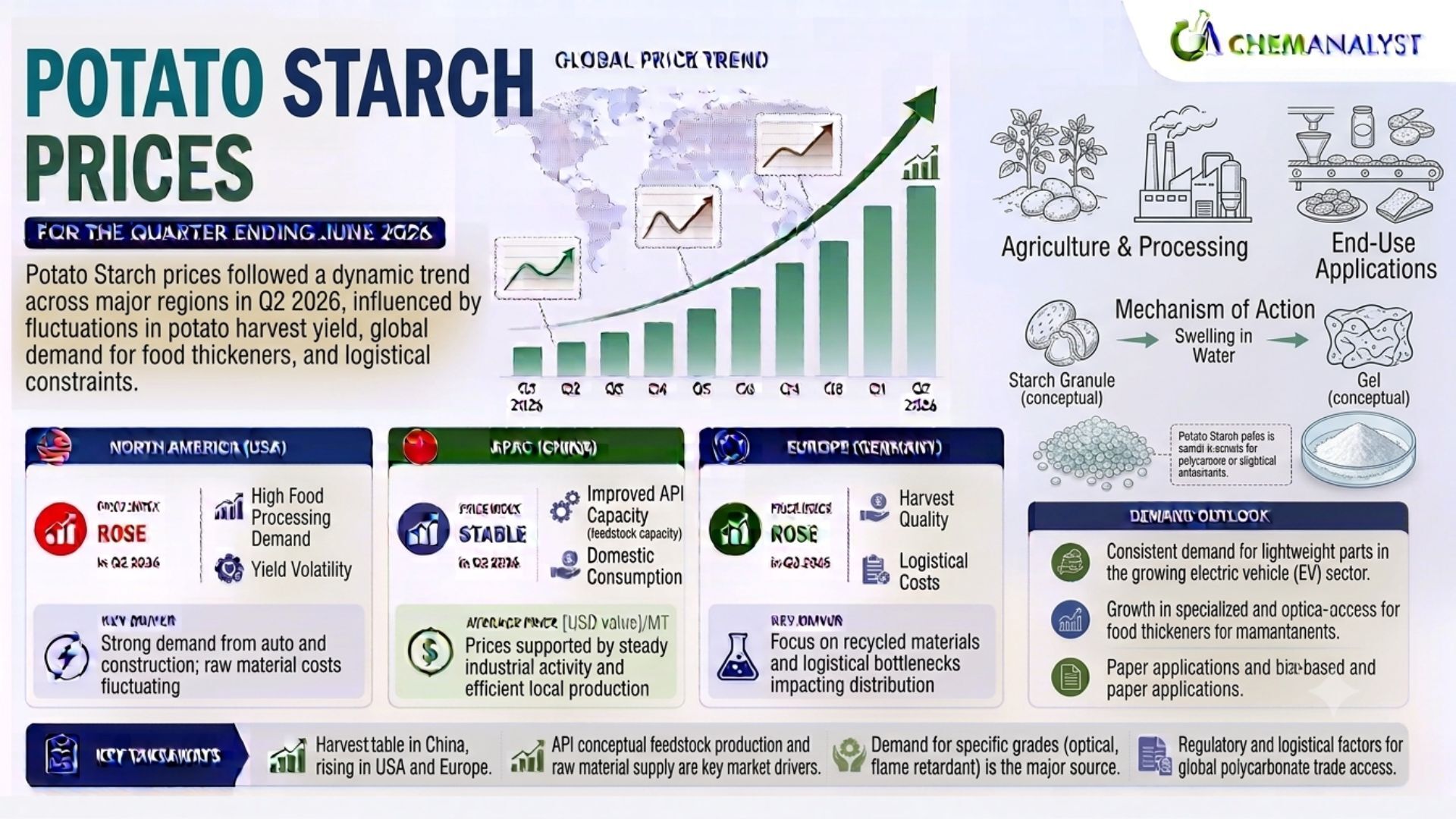
According to ChemAnalyst, the Potato starch prices recorded a modest upward movement across the major markets during the quarter ending June 2026. The market remained relatively stable compared with several other agricultural and food ingredients, although regional supply conditions, procurement patterns, raw potato availability, logistics and downstream consumption continued to influence pricing.
Potato starch is a versatile starch ingredient produced from potatoes and widely used across food, pharmaceutical, paper, textile and industrial applications. In the food sector, it is valued for its thickening, binding, water-retention and texture-enhancing properties. Demand from processed foods, bakery products, sauces, soups, confectionery and convenience foods provides an important foundation for the global potato starch market.
During Q2 2026, the Potato Starch Price Index increased in the United States, Indonesia and Germany. However, the relatively small quarterly movements indicate that supply and demand remained broadly balanced, with only moderate cost and availability pressures emerging in the assessed markets.
Potato Starch Prices in North America
In the United States, the Potato Starch Price Index increased by 1.74% quarter-over-quarter during Q2 2026, supported by modest tightness in the market.
The average Potato Starch price for the quarter was approximately USD 1073.00/MT per CFR New York.
The US market experienced a relatively restrained price increase compared with markets for many other agricultural commodities. Nevertheless, modest tightness provided enough support for prices to move higher during the quarter. When supply availability becomes slightly constrained, buyers can face greater competition for available volumes, particularly when downstream manufacturers need to maintain regular production schedules.
Potato starch demand in the United States is supported by a broad range of food-processing applications. Its ability to provide desirable texture and viscosity makes it useful in prepared foods, sauces, soups, bakery products, snacks and other processed food formulations. Industrial applications also contribute to overall consumption.
Procurement activity during the quarter remained an important price determinant. Buyers seeking to secure consistent supplies amid modestly tighter availability contributed to a firmer market balance. At the same time, the relatively limited size of the quarterly increase suggests that market participants were not facing severe shortages.
The 1.74% quarter-over-quarter increase therefore reflects a market where supply remained available but was somewhat tighter than in the preceding quarter.
Get Real Time Online for Potato Starch Prices: https://www.chemanalyst.com/Pricing-data/potato-starch-1486
Potato Starch Prices in APAC
Indonesia recorded a 0.63% quarter-over-quarter increase in the Potato Starch Price Index during Q2 2026. The average Potato Starch price was approximately USD 957.33/MT, mirroring CFR Tanjung Priok assessments.
The Indonesian market experienced only marginal price gains during the quarter. The modest movement indicates that the market remained relatively stable, with neither a significant supply disruption nor a substantial surge in downstream demand.
Indonesia's food-processing sector represents an important demand base for starch-based ingredients. Potato starch can be incorporated into processed food products where manufacturers require specific thickening, binding, or textural characteristics. Its functional properties make it relevant to a variety of formulations.
Import-related dynamics also influence the Indonesian market because international freight, sourcing costs and landed prices can affect the economics of imported potato starch. Changes in international supply conditions can therefore influence local purchasing decisions even when domestic demand remains relatively stable.
The 0.63% increase during Q2 2026 points toward marginal strengthening rather than a major change in market fundamentals. Buyers and sellers appeared to operate within a relatively balanced environment, with prices edging higher rather than experiencing a sharp movement.
Potato Starch Prices in Europe
Germany's Potato Starch Price Index increased by 0.7128% quarter-over-quarter during Q2 2026, reflecting balanced supply conditions.
The average Potato Starch price for the quarter was approximately USD 989.00/MT FOB Hamburg, as reported.
The German market recorded the smallest increase among the assessed regions. The limited price movement highlights the role of balanced supply in preventing significant upward pressure. When available material broadly matches consumption requirements, buyers typically face less urgency to compete for volumes, while suppliers have limited scope for substantial price increases.
Germany has a large and diversified food-processing industry, supporting steady demand for starch-based ingredients. Potato starch is used in food formulations as well as in several non-food applications, providing multiple sources of consumption.
The quarter's pricing environment was therefore characterized by relative stability. While prices edged upward, the 0.7128% quarter-over-quarter increase indicates that the market did not experience significant supply-demand imbalances.
FOB Hamburg assessments also reflect the importance of European trading and logistics conditions. Transportation expenses, sourcing economics and inventory management can influence transaction values even when fundamental demand remains steady.
Book A Demo for Potato Starch Price: https://www.chemanalyst.com/ChemAnalyst/PricingForm?Product=Potato%20Starch
Key Factors Influencing Potato Starch Prices in Q2 2026
Several factors contributed to the movement in Potato Starch prices during the quarter ending June 2026.
Supply Availability
Supply conditions remained one of the primary factors affecting regional prices. The US market experienced modest tightness, which supported its relatively stronger increase of 1.74%. In Germany, balanced supply conditions limited the upward movement to 0.7128%.
Potato Availability
Potato starch production depends on the availability and quality of potatoes used as the primary agricultural feedstock. Changes in cultivation conditions, harvesting outcomes, crop yields and raw potato procurement can influence production economics and ultimately affect starch prices.
Food Industry Demand
The food-processing industry remains a major source of potato starch consumption. Demand from sauces, bakery products, processed foods, snacks, soups and other applications can influence purchasing requirements. Stable consumption provides a foundation for prices, while stronger demand can tighten the supply-demand balance.
Import and Freight Economics
International markets such as Indonesia are affected by import economics. Freight rates, transportation availability, international supply and landed costs can influence purchasing decisions. Even modest changes in these components can affect CFR-based pricing.
Inventory and Procurement Strategies
Inventory levels can influence short-term price movements. When buyers maintain adequate stocks, purchasing urgency may remain limited. Conversely, lower inventories can encourage restocking activity and provide additional support to market prices.
Demand Outlook for Potato Starch
The demand outlook for potato starch remains closely linked to food-processing activity and the broader performance of industries that use starch as a functional ingredient.
Food manufacturers continue to utilize potato starch for its thickening, binding, stabilizing and texture-enhancing properties. Demand from processed foods and convenience-oriented products can therefore provide consistent support to the market.
Pharmaceutical and industrial applications also contribute to consumption. Potato starch can be used in specialized formulations and industrial processes, creating additional demand outside the food sector.
The future demand trajectory will depend on consumer food consumption, food manufacturing activity, formulation requirements, production costs and regional purchasing patterns.
Regional Comparison of Potato Starch Prices
The Q2 2026 data shows that the United States experienced the strongest price increase among the assessed markets, with the Potato Starch Price Index rising 1.74% quarter-over-quarter. Indonesia followed with a 0.63% increase, while Germany recorded a 0.7128% increase.
Although the numerical changes were relatively small, the underlying market conditions differed across regions. In the United States, modest tightness provided upward support. Indonesia experienced marginal gains within a relatively stable market environment, while Germany's balanced supply conditions limited price volatility.
The average assessed prices also varied by market and pricing basis. The United States stood at approximately USD 1073.00/MT CFR New York, Indonesia at USD 957.33/MT CFR Tanjung Priok and Germany at USD 989.00/MT FOB Hamburg.
These differences highlight the importance of regional logistics, trade flows, supply availability and assessment terms when comparing international Potato Starch prices.
Potato Starch Market Outlook for the Second Half of 2026
The Potato Starch market entered the second half of 2026 with a relatively stable but slightly firmer price structure. The moderate increases observed during Q2 suggest that the market was not experiencing severe volatility, although regional supply conditions remained important.
In the United States, continued tightness could provide further price support if downstream demand remains steady. In Indonesia, price direction is likely to remain sensitive to import costs, international supply and local purchasing activity. Germany's outlook will continue to depend on the balance between available supply and consumption requirements.
Agricultural conditions will remain another important consideration. Since potato availability directly influences starch production, changes in crop conditions and raw material costs can affect producer economics and supply expectations.
If supply remains balanced and downstream consumption develops steadily, prices could continue to move within a relatively controlled range. However, unexpected changes in potato availability, logistics, production costs, or international demand could introduce additional volatility.
Conclusion
Potato Starch prices recorded modest increases across the assessed markets during the quarter ending June 2026. The United States recorded a 1.74% quarter-over-quarter increase, with the average Potato Starch price reaching approximately USD 1073.00/MT CFR New York. Indonesia saw a 0.63% increase, with an average price of approximately USD 957.33/MT CFR Tanjung Priok.
Germany registered a 0.7128% quarter-over-quarter increase, with an average price of approximately USD 989.00/MT FOB Hamburg.
Overall, the Q2 2026 Potato Starch market remained comparatively stable, with modest tightness in the United States, marginal gains in Indonesia and balanced supply conditions in Germany. The market's future direction will depend on potato availability, production economics, food-processing demand, inventory levels, international trade and logistics costs.
For buyers and procurement teams, monitoring these factors will remain important for understanding future Potato Starch Prices, managing purchasing strategies and anticipating potential changes in regional supply-demand conditions.
ChemAnalsyt
Call +1 3322586602
420 Lexington Avenue, Suite 300, New York, NY, United States, 10170
Website: https://www.chemanalyst.com/
Email: sales@chemanalyst.com
この記事をシェア





