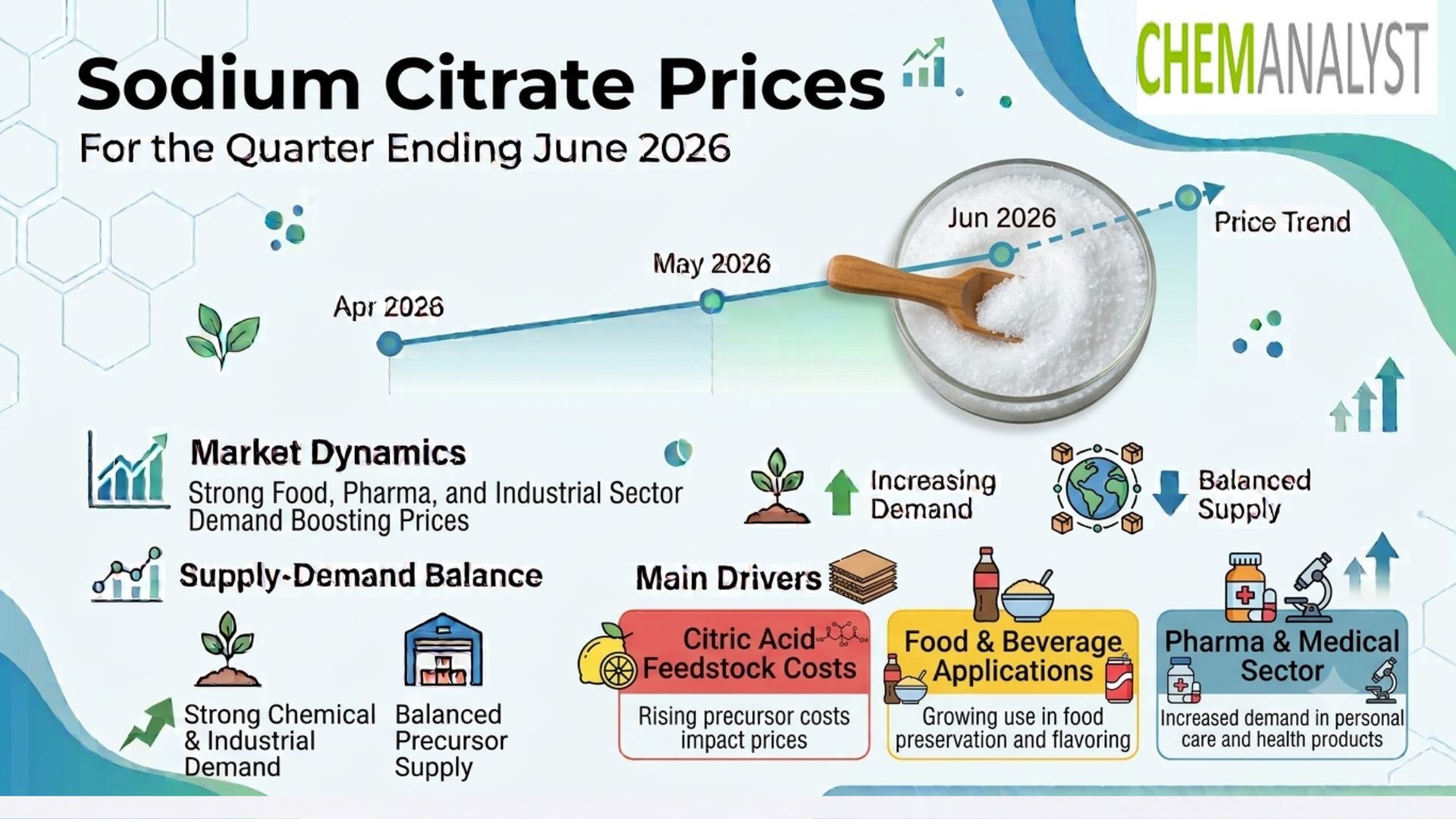
According to ChemAnalyst, the global Sodium Citrate Prices market recorded a firm upward trend during the quarter ending June 2026, with prices increasing across North America, APAC, India and Europe. The market was influenced by a combination of freight expenses, feedstock costs, export tightness, supply constraints, port congestion and firm import parity.
In the United States, the Sodium Citrate Price Index rose by 17.72% quarter-over-quarter, driven by freight and feedstock costs. The average Sodium Citrate price for the quarter was approximately USD 921.33/MT at CFR parity.
China also experienced a substantial increase, with the Sodium Citrate Price Index rising by 13.83% quarter-over-quarter in Q2 2026, driven by export tightness. The average Sodium Citrate price was approximately USD 782/MT, reflecting seller discipline.
India recorded a 15.22% quarter-over-quarter increase in its Sodium Citrate Price Index, driven by tight supply. The Sodium Citrate Spot Price remained firm as limited pipeline stocks and port congestion constrained supply.
In Germany, the Sodium Citrate Price Index increased by 16.81% quarter-over-quarter, driven by higher feedstock and freight costs. The average Sodium Citrate price was approximately USD 919.33/MT, reflecting firm import parity.
The broad-based increases across the assessed markets demonstrate that Q2 2026 was characterized by firm Sodium Citrate pricing and elevated supply-chain costs.
Sodium Citrate Prices in North America
The North American Sodium Citrate Price Trend strengthened significantly during Q2 2026.
In the United States, the Sodium Citrate Price Index increased by 17.72% quarter-over-quarter, primarily driven by freight and feedstock costs.
The average Sodium Citrate price reached approximately USD 921.33/MT at CFR parity during the quarter.
Freight costs can have a significant influence on imported and traded chemical products because transportation expenses contribute directly to landed costs. When freight expenses rise alongside feedstock costs, suppliers may seek to pass the additional expenses through to buyers.
The U.S. market therefore experienced substantial upward pricing pressure during Q2 2026, with both logistics and upstream input costs contributing to the increase.
Sodium Citrate Price Trend in the United States
The Sodium Citrate Price Trend in the USA remained strongly bullish during Q2 2026.
The 17.72% quarter-over-quarter increase in the Price Index represented one of the strongest regional movements during the quarter.
The average price of approximately USD 921.33/MT at CFR parity reflected the combined influence of freight and feedstock costs.
CFR pricing incorporates freight-related considerations into the delivered commercial assessment, making transportation conditions particularly relevant to the U.S. market.
For buyers, changes in international freight rates and feedstock costs can therefore have a direct impact on procurement budgets.
Freight and Feedstock Impact on Sodium Citrate Prices
Freight and feedstock were the principal factors influencing Sodium Citrate Prices in North America during Q2 2026.
Higher feedstock costs can increase the underlying production economics of Sodium Citrate, while increased freight expenses can raise the landed cost of imported material.
When both cost categories rise simultaneously, suppliers may implement higher offers to protect margins.
This combination contributed to the 17.72% quarter-over-quarter increase in the U.S. Sodium Citrate Price Index.
The average price of USD 921.33/MT CFR parity therefore reflected a market where logistics and upstream cost pressures were both significant.
Get Real Time Online for Sodium Citrate Prices: https://www.chemanalyst.com/Pricing-data/sodium-citrate-1485
Sodium Citrate Prices in APAC
The APAC Sodium Citrate Prices market also recorded strong upward movement during Q2 2026.
In China, the Sodium Citrate Price Index increased by 13.83% quarter-over-quarter, driven by export tightness.
The average Sodium Citrate price was approximately USD 782/MT, reflecting seller discipline.
Export tightness can reduce the quantity of material readily available for international buyers. When exporters manage volumes carefully, sellers may gain greater control over offers and become less willing to discount.
Seller discipline therefore played an important role in maintaining firmer Sodium Citrate pricing in China.
Sodium Citrate Price Trend in China
The Sodium Citrate Price Trend in China strengthened by 13.83% quarter-over-quarter during Q2 2026.
The increase was driven by export tightness, while the average Sodium Citrate price reached approximately USD 782/MT.
The market reflected seller discipline, indicating that suppliers maintained firm commercial positions rather than aggressively competing for buyers.
Export availability is an important consideration for China's Sodium Citrate market because international demand can influence domestic supplier allocation and export quotations.
The Q2 2026 increase consequently reflected a combination of tighter export availability and disciplined supplier pricing.
Export Tightness and Seller Discipline
Export tightness was central to China's Q2 2026 Sodium Citrate Price Trend.
When available export volumes become tighter, suppliers may prioritize existing commitments and maintain stronger offers for new orders.
Seller discipline can reinforce this effect by limiting discounting and supporting market price levels.
Together, these factors contributed to the 13.83% quarter-over-quarter increase in China's Sodium Citrate Price Index.
The average price of USD 782/MT reflected these firm market conditions.
Sodium Citrate Prices in India
India's Sodium Citrate Price Index rose by 15.22% quarter-over-quarter during Q2 2026.
The increase was driven by tight supply, with the domestic Sodium Citrate Spot Price remaining firm.
Limited pipeline stocks and port congestion constrained supply, creating additional pressure on buyers seeking prompt material.
When pipeline stocks are limited, buyers may have fewer immediately accessible volumes. Port congestion can further restrict the movement of imported cargoes, potentially creating temporary supply bottlenecks.
These conditions contributed to the firm Sodium Citrate Spot Price observed in India during the quarter.
Sodium Citrate Spot Price in India
The Indian Sodium Citrate Spot Price remained firm during Q2 2026.
Limited pipeline stocks and port congestion constrained available supply, supporting higher spot-market pricing.
The overall Sodium Citrate Price Index increased by 15.22% quarter-over-quarter, demonstrating the strength of the market during the quarter.
Spot markets can respond quickly to changes in physical availability. When inventories are limited and logistics are disrupted, buyers requiring prompt material may face higher offers.
The Indian market therefore experienced a supply-driven price increase despite the broader global market also being influenced by freight and feedstock conditions.
Pipeline Stocks and Port Congestion
Pipeline inventory conditions were an important factor influencing India's Sodium Citrate Prices.
Limited pipeline stocks reduced readily accessible material, while port congestion affected the flow of imported cargoes.
The combination created a tighter physical market and supported firm spot prices.
The 15.22% quarter-over-quarter increase in India's Price Index reflected these supply constraints.
For procurement teams, monitoring port conditions and pipeline inventories is therefore important because disruptions in either area can quickly influence spot-market availability.
Book A Demo for Sodium Citrate Price: https://www.chemanalyst.com/ChemAnalyst/PricingForm?Product=Sodium%20Citrate
Sodium Citrate Prices in Europe
The European Sodium Citrate Price Trend strengthened considerably during Q2 2026.
In Germany, the Sodium Citrate Price Index rose by 16.81% quarter-over-quarter, driven by higher feedstock and freight costs.
The average Sodium Citrate price for the quarter was approximately USD 919.33/MT, reflecting firm import parity.
Import parity is particularly relevant in markets where imported material plays an important role in supply. Changes in international prices and logistics costs can influence the level at which imported product becomes commercially viable.
Germany's Q2 2026 market therefore reflected a combination of higher upstream costs and increased freight-related pressure.
Sodium Citrate Price Trend in Germany
The Sodium Citrate Price Trend in Germany increased by 16.81% quarter-over-quarter during Q2 2026.
Higher feedstock and freight costs were the main drivers of the increase.
The average Sodium Citrate price reached approximately USD 919.33/MT, reflecting firm import parity.
The German market's upward movement was therefore closely connected with international supply-chain economics. When feedstock and transportation expenses increase, importers may face higher replacement costs and subsequently adjust purchasing offers.
Feedstock, Freight and Import Parity in Europe
Feedstock and freight costs played a significant role in Germany's Sodium Citrate Prices during Q2 2026.
Higher feedstock costs increased the upstream cost base, while higher freight expenses raised the cost of moving product into the European market.
The combined effect supported the 16.81% quarter-over-quarter increase in Germany's Sodium Citrate Price Index.
The average price of USD 919.33/MT reflected firm import parity and demonstrated how international logistics can influence European chemical pricing.
Sodium Citrate Demand Analysis
The Sodium Citrate demand outlook remained firm enough to support higher prices across the assessed regions during Q2 2026.
In the United States, freight and feedstock costs contributed to a 17.72% quarter-over-quarter increase.
China experienced a 13.83% increase, supported by export tightness and seller discipline.
India's 15.22% increase was driven by tight supply and constrained availability caused by limited pipeline stocks and port congestion.
Germany recorded a 16.81% increase, with higher feedstock and freight costs supporting firm import parity.
Although the supplied market data emphasizes cost and supply factors rather than specific downstream consumption figures, the broad-based regional increases indicate a generally firm market environment.
Sodium Citrate Supply Analysis
Supply conditions were particularly important in determining Q2 2026 Sodium Citrate Prices.
China faced export tightness, encouraging sellers to maintain disciplined offers.
India experienced limited pipeline stocks and port congestion, creating tighter spot availability.
The United States faced freight and feedstock cost pressures, which raised the commercial cost base.
Germany experienced similar feedstock and freight pressures, resulting in firmer import parity.
The regional pattern demonstrates that physical availability and logistics played a major role alongside upstream production costs.
Key Factors Influencing Sodium Citrate Prices
Several factors shaped the global Sodium Citrate Price Trend during Q2 2026.
Freight Costs
Higher freight expenses supported price increases in the United States and Germany.
Feedstock Costs
Rising feedstock costs contributed to higher U.S. and German Sodium Citrate prices.
Export Tightness
Export tightness supported China's 13.83% quarter-over-quarter price increase.
Seller Discipline
Disciplined seller offers helped maintain firm pricing in China.
Tight Supply
Tight supply drove India's 15.22% quarter-over-quarter increase.
Pipeline Stocks
Limited pipeline stocks reduced immediately available material in India.
Port Congestion
Port congestion constrained supply and supported India's firm spot pricing.
Import Parity
Firm import parity supported Germany's upward market movement.
Regional Sodium Citrate Price Comparison
The Q2 2026 Sodium Citrate Prices market can be summarized as follows:
United States: The Sodium Citrate Price Index increased by 17.72% quarter-over-quarter, driven by freight and feedstock. The average price was approximately USD 921.33/MT at CFR parity.
China: The Sodium Citrate Price Index increased by 13.83% quarter-over-quarter, driven by export tightness. The average price was approximately USD 782/MT, reflecting seller discipline.
India: The Sodium Citrate Price Index rose by 15.22% quarter-over-quarter, driven by tight supply. The Sodium Citrate Spot Price remained firm as limited pipeline stocks and port congestion constrained supply.
Germany: The Sodium Citrate Price Index increased by 16.81% quarter-over-quarter, driven by higher feedstock and freight costs. The average price was approximately USD 919.33/MT, reflecting firm import parity.
The comparison shows that every assessed market experienced upward movement during Q2 2026, although the specific drivers varied across regions.
Sodium Citrate Market Outlook
The Sodium Citrate market outlook remains closely linked to freight, feedstock, export availability, inventories, port conditions and import parity.
In the United States, continued freight and feedstock cost pressures could support firm pricing if these expenses remain elevated.
China's outlook will depend on export availability and supplier pricing discipline. Continued export tightness could maintain upward pressure on prices.
India's market will remain sensitive to pipeline stocks and port congestion. Improved cargo flows could ease physical tightness, while continued logistical constraints could support spot prices.
In Germany, feedstock and freight costs will remain important determinants of import parity and landed pricing.
Sodium Citrate Price Forecast
The Sodium Citrate Price Forecast will depend on how the current supply-chain and cost pressures evolve.
U.S. pricing could remain firm if freight and feedstock expenses continue to influence landed costs. China's pricing could remain supported if export tightness persists and sellers maintain disciplined offers.
In India, the direction of spot prices will depend heavily on inventory replenishment and the normalization of port flows. If pipeline stocks improve, some supply pressure could ease.
Germany's market will remain sensitive to feedstock and freight costs. Continued elevated import costs could maintain firm pricing, while lower logistics expenses could reduce upward pressure.
Market participants should closely monitor freight rates, feedstock costs, export availability, seller behavior, pipeline stocks, port congestion and import parity when evaluating future Sodium Citrate prices.
Sodium Citrate Price Trend: Key Takeaways
The Q2 2026 Sodium Citrate Price Trend can be summarized as follows:
The U.S. Sodium Citrate Price Index rose 17.72% quarter-over-quarter.
U.S. pricing was driven by freight and feedstock.
The average U.S. Sodium Citrate price was approximately USD 921.33/MT at CFR parity.
China's Sodium Citrate Price Index increased 13.83% quarter-over-quarter.
Export tightness supported China's price increase.
China's average price was approximately USD 782/MT.
Seller discipline contributed to China's firm pricing.
India's Sodium Citrate Price Index rose 15.22% quarter-over-quarter.
Tight supply drove India's quarterly increase.
Limited pipeline stocks and port congestion constrained supply.
India's Sodium Citrate Spot Price remained firm.
Germany's Sodium Citrate Price Index increased 16.81% quarter-over-quarter.
Higher feedstock and freight costs supported German pricing.
Germany's average Sodium Citrate price was approximately USD 919.33/MT.
Firm import parity supported the European market.
Conclusion
The global Sodium Citrate Prices market recorded a broad-based increase during the quarter ending June 2026. All four assessed markets—the United States, China, India and Germany—experienced upward movement in their respective Price Indexes.
In the United States, the Sodium Citrate Price Index rose by 17.72% quarter-over-quarter, driven by freight and feedstock. The average price was approximately USD 921.33/MT at CFR parity.
In China, the Price Index increased by 13.83% quarter-over-quarter, driven by export tightness. The average Sodium Citrate price was approximately USD 782/MT, reflecting seller discipline.
In India, the Price Index increased by 15.22% quarter-over-quarter, driven by tight supply. Limited pipeline stocks and port congestion constrained availability, keeping the Sodium Citrate Spot Price firm.
In Germany, the Price Index increased by 16.81% quarter-over-quarter, driven by higher feedstock and freight costs. The average price was approximately USD 919.33/MT, reflecting firm import parity.
Overall, Q2 2026 demonstrated a strong upward Sodium Citrate Price Trend, with freight, feedstock costs, export tightness, seller discipline, tight supply, pipeline inventories, port congestion and import parity emerging as the key market factors. Monitoring these variables will remain essential for manufacturers, distributors, traders and procurement professionals assessing future Sodium Citrate market conditions.
ChemAnalsyt
Call +1 3322586602
420 Lexington Avenue, Suite 300, New York, NY, United States, 10170
Website: https://www.chemanalyst.com/
Email: sales@chemanalyst.com
この記事をシェア





