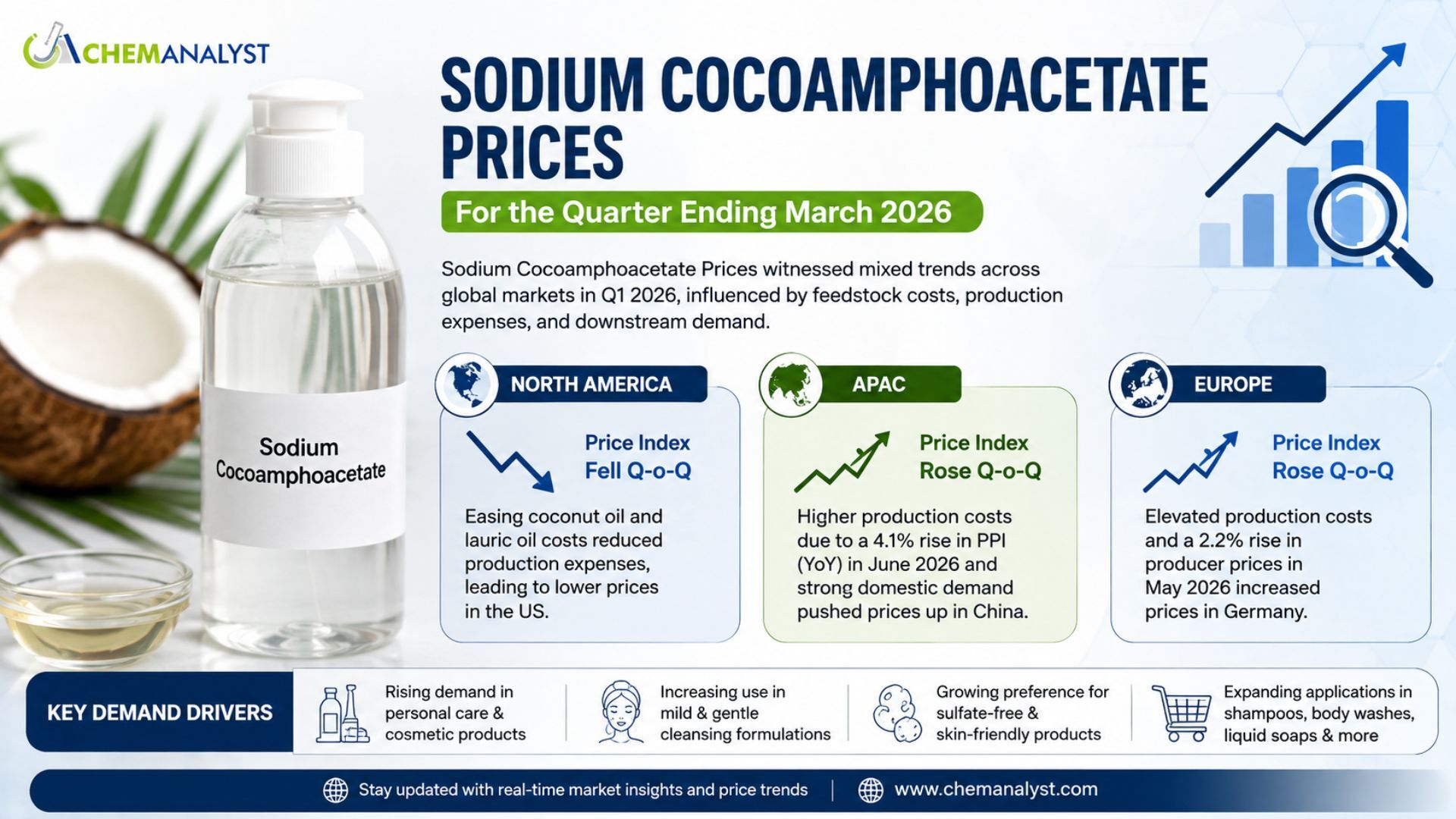
According to ChemAnalyst, the Sodium Cocoamphoacetate Prices market recorded mixed regional movements during the quarter ending June 2026. Price trends across North America, Asia-Pacific (APAC) and Europe were influenced by changes in feedstock costs, production expenses, manufacturing conditions and downstream demand. While the United States witnessed a decline in the Sodium Cocoamphoacetate Price Index, China and Germany recorded quarter-over-quarter increases during Q2 2026.
Sodium Cocoamphoacetate is an amphoteric surfactant widely used in personal care and cleansing formulations. Its mild characteristics and compatibility with different formulation systems support demand from shampoos, facial cleansers, liquid soaps, body washes and other cosmetic and personal care products. Consequently, changes in raw material availability and manufacturing economics can have a direct impact on Sodium Cocoamphoacetate Prices.
During Q2 2026, regional market conditions remained differentiated. In North America, easing coconut oil and lauric oil feedstock costs contributed to lower production expenses and subsequently pressured prices downward. In contrast, higher production costs and firm domestic demand supported price increases in China. European prices also moved upward, with higher producer prices contributing to increased manufacturing costs in Germany.
Sodium Cocoamphoacetate Prices in North America
In the United States, the Sodium Cocoamphoacetate Price Index fell quarter-over-quarter in Q2 2026, primarily due to easing feedstock costs. The decline indicates that lower input expenses provided manufacturers with greater flexibility in production economics during the quarter.
Feedstock costs remain an important component of Sodium Cocoamphoacetate production. Coconut-derived raw materials, particularly coconut oil and lauric oil, influence the overall cost structure because they are closely connected with the production of surfactant intermediates. During Q2 2026, these feedstock prices experienced downward pressure, reducing the cost burden faced by manufacturers.
The decline in production costs subsequently contributed to softer Sodium Cocoamphoacetate Prices in the United States. Lower raw material expenses can improve manufacturing margins and reduce the need for producers to pass higher input costs through to buyers. This created a relatively favorable procurement environment for downstream consumers during the quarter.
Demand from personal care and home-care applications continued to provide an underlying market base. Sodium Cocoamphoacetate is valued for its mild cleansing properties, making it suitable for formulations where manufacturers seek gentle surfactant systems. However, the reduction in production expenses was strong enough to influence the overall price direction during Q2 2026.
The US market therefore remained primarily cost-driven during the quarter, with feedstock economics playing a more significant role than demand-side pressure in determining the direction of the Sodium Cocoamphoacetate Price Index.
Factors Influencing Sodium Cocoamphoacetate Prices in the United States
The primary factor affecting Sodium Cocoamphoacetate Prices in the United States during Q2 2026 was the decline in feedstock costs. Coconut oil and lauric oil prices experienced downward pressure, which lowered the manufacturing cost associated with the product.
Lower feedstock costs can influence the market through several channels. Manufacturers may benefit from reduced procurement expenses, while buyers may receive more competitive offers as producers adjust prices according to changing cost structures. At the same time, stable downstream consumption can prevent prices from falling sharply even when production costs decline.
Therefore, the US market during Q2 2026 reflected the combined influence of lower production expenses and continuing demand from personal care and cleansing applications.
Get Real Time Online for Sodium Cocoamphoacetate Prices: https://www.chemanalyst.com/Pricing-data/sodium-cocoamphoacetate-2300
Sodium Cocoamphoacetate Prices in APAC
The Sodium Cocoamphoacetate Price Index in China rose quarter-over-quarter in Q2 2026, contrasting with the decline observed in the United States. The increase was driven by elevated production costs and robust domestic demand.
Manufacturing economics became more challenging during the quarter as higher input costs affected the cost base for producers. According to the provided market data, China's Producer Price Index increased by 4.1% year-over-year in June 2026, indicating higher producer-level costs across the manufacturing sector. This broader inflationary pressure on production inputs contributed to increased costs for Sodium Cocoamphoacetate manufacturers.
Higher production expenses can place upward pressure on market prices as producers seek to maintain operating margins. In addition, strong domestic demand provided further support to the market. When firm consumption coincides with higher manufacturing expenses, sellers generally have greater ability to maintain or increase quotations.
China's position as a major manufacturing and consumption market within APAC also makes its domestic industrial environment particularly important for Sodium Cocoamphoacetate Prices. Changes in production costs, purchasing activity and broader industrial inflation can influence both domestic availability and pricing sentiment.
The Q2 2026 trend therefore reflected a combination of elevated production expenses and healthy domestic demand, resulting in an increase in the regional Sodium Cocoamphoacetate Price Index.
Impact of China's Production Costs on Sodium Cocoamphoacetate Prices
Production costs remained a critical factor for the Chinese Sodium Cocoamphoacetate market during Q2 2026. The 4.1% year-over-year increase in PPI in June 2026 points toward a broader increase in producer-level costs.
For manufacturers, rising producer prices can affect expenses related to raw materials, processing, utilities, packaging, transportation and other manufacturing requirements. Even when individual feedstock markets experience different movements, broader cost inflation can contribute to higher overall production expenses.
The combination of these higher costs with robust domestic demand supported an upward movement in Sodium Cocoamphoacetate Prices in China. Buyers operating in downstream personal care and cleansing applications were consequently exposed to firmer market conditions during the quarter.
Sodium Cocoamphoacetate Prices in Europe
In Germany, the Sodium Cocoamphoacetate Price Index rose quarter-over-quarter in Q2 2026, with elevated production costs emerging as the principal factor behind the increase.
Production expenses for Sodium Cocoamphoacetate increased during the quarter as producer prices moved higher. The provided market data indicates that producer prices in Germany increased by 2.2% in May 2026. This increase contributed to a higher manufacturing cost environment and placed upward pressure on Sodium Cocoamphoacetate Prices.
Germany's industrial market is closely connected with broader European manufacturing conditions. Changes in producer prices can influence the cost of industrial inputs and affect manufacturers' pricing decisions. When production expenses increase, suppliers may adjust product quotations to compensate for higher operating costs.
For Sodium Cocoamphoacetate producers, the rise in producer prices during Q2 2026 therefore created a less favorable cost environment compared with the previous quarter. This contributed to the quarter-over-quarter increase in the German Price Index.
Book A Demo for Sodium Cocoamphoacetate Price: https://www.chemanalyst.com/ChemAnalyst/PricingForm?Product=Sodium%20Cocoamphoacetate
Demand Outlook for Sodium Cocoamphoacetate
Demand remains an important consideration for the future direction of Sodium Cocoamphoacetate Prices. The product is widely associated with personal care formulations where mild and effective cleansing characteristics are required. Applications include shampoos, facial cleansers, body washes, liquid soaps and other formulated cleansing products.
In markets such as China, robust domestic demand amplified the impact of higher production costs during Q2 2026. In the United States, meanwhile, softer feedstock costs had a greater influence on the price direction despite continued downstream applications.
Going forward, purchasing activity from personal care manufacturers, changes in formulation demand and consumer preference for mild cleansing products will remain relevant to the market. However, feedstock economics and manufacturing costs are expected to remain among the most important factors determining short-term price movements.
Feedstock Costs and Their Role in Sodium Cocoamphoacetate Prices
Feedstock prices have a direct influence on Sodium Cocoamphoacetate production economics. Coconut oil and lauric oil are particularly relevant because the product is derived from coconut-based fatty components.
The contrasting Q2 2026 trends in the United States and China demonstrate how regional production economics can produce different price outcomes. In the United States, downward pressure on coconut oil and lauric oil prices contributed to declining production costs and softer Sodium Cocoamphoacetate Prices. In China, broader producer-price inflation and robust demand supported higher prices.
Consequently, monitoring feedstock markets is essential for understanding future Sodium Cocoamphoacetate Price Trends. Significant changes in coconut-derived raw material costs can quickly affect producer margins and procurement strategies.
Global Sodium Cocoamphoacetate Price Trends in Q2 2026
The global Sodium Cocoamphoacetate market displayed a mixed price pattern during Q2 2026. North America moved lower, while APAC and Europe recorded increases.
The United States experienced declining prices as easing coconut oil and lauric oil costs reduced production expenses. China recorded higher prices as increased production costs combined with strong domestic demand. Germany also experienced upward price movement because of elevated manufacturing expenses and a 2.2% increase in producer prices in May 2026.
These developments highlight the importance of regional supply-demand conditions when evaluating Sodium Cocoamphoacetate Prices. A single global trend cannot fully explain market behavior because feedstock availability, manufacturing costs, demand intensity and economic conditions differ considerably between regions.
Sodium Cocoamphoacetate Prices Outlook
The outlook for Sodium Cocoamphoacetate Prices will largely depend on the direction of feedstock markets, producer-level inflation, manufacturing expenses and downstream demand.
In North America, continued weakness in coconut oil and lauric oil prices could maintain downward pressure on production costs if the trend persists. However, changes in downstream purchasing activity could moderate or reverse this effect.
In China, the combination of elevated production costs and robust domestic demand will remain important. If producer-level inflation continues to affect manufacturing inputs, Sodium Cocoamphoacetate Prices could remain supported. Similarly, firm demand from personal care and cleansing applications could provide additional price stability.
In Germany and the wider European market, producer-price movements will remain a key indicator for the direction of manufacturing costs. The 2.2% increase in German producer prices recorded in May 2026 contributed to the upward price movement during Q2, making industrial cost conditions an important factor to monitor.
Overall, the Sodium Cocoamphoacetate Prices market entered the second half of 2026 with divergent regional dynamics. North America benefited from lower feedstock costs, while APAC and Europe faced stronger production-cost pressures. Future price movements will depend on how these cost factors interact with downstream demand, feedstock availability and broader industrial pricing conditions.
Conclusion
The quarter ending June 2026 demonstrated significant regional differences in Sodium Cocoamphoacetate Prices. In the United States, the Price Index declined quarter-over-quarter as easing coconut oil and lauric oil costs reduced production expenses. China recorded an increase because of higher manufacturing costs and robust domestic demand, while Germany witnessed higher prices amid elevated production costs and a 2.2% rise in producer prices in May 2026.
The market outlook will continue to depend on the balance between feedstock costs, producer-price inflation, manufacturing expenses and demand from personal care and cleansing applications. Tracking these indicators will be essential for understanding upcoming Sodium Cocoamphoacetate Price Trends and anticipating changes in procurement costs across major global markets.
ChemAnalsyt
Call +1 3322586602
420 Lexington Avenue, Suite 300, New York, NY, United States, 10170
Website: https://www.chemanalyst.com/
Email: sales@chemanalyst.com
この記事をシェア





