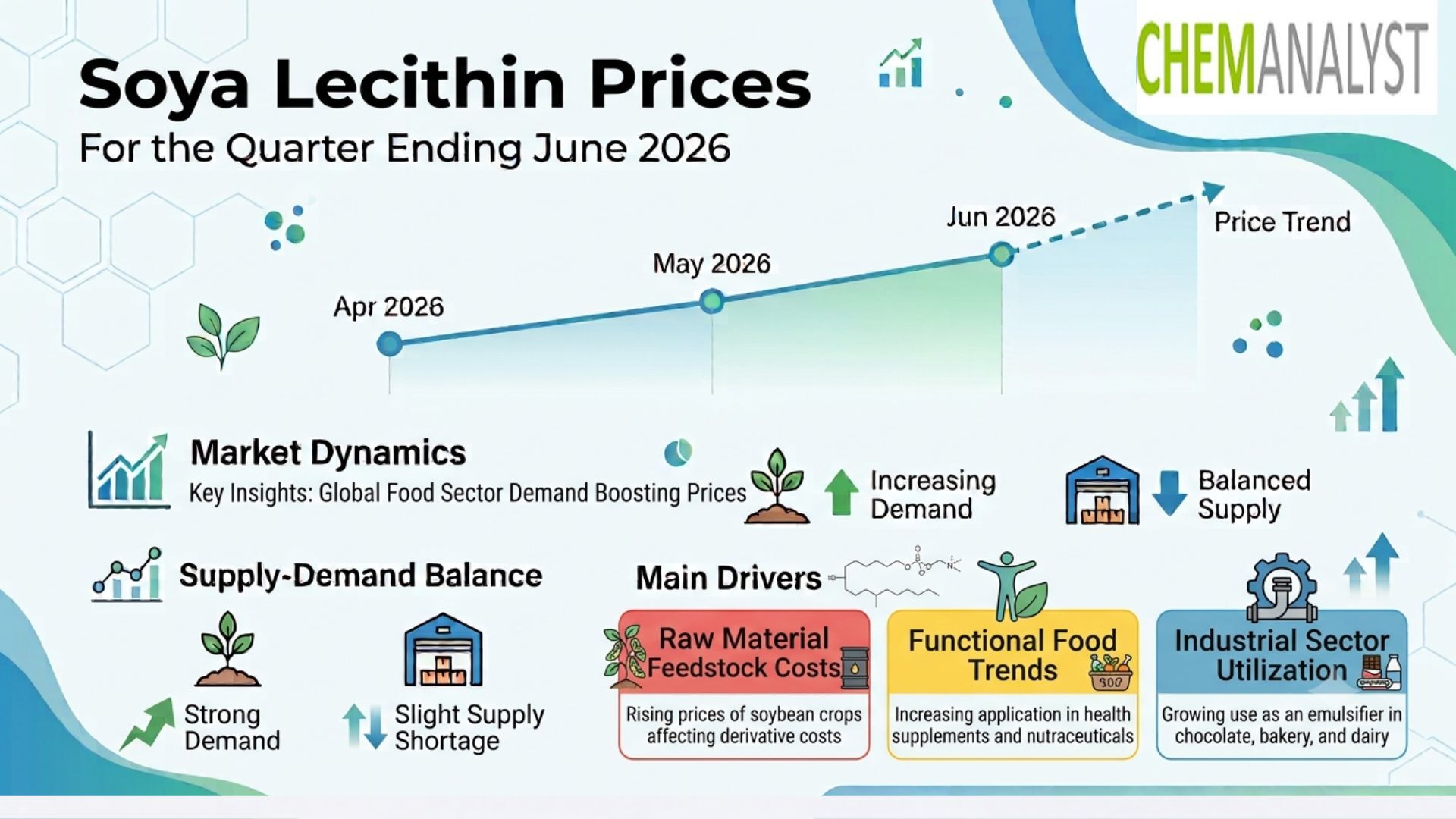
According to ChemAnalyst, the global Soya Lecithin Prices market remained firm to upward across major regions during the quarter ending June 2026. Market movements were influenced by healthy downstream demand, tighter supply conditions, firmer feedstock costs, freight premiums and changing export availability. While North America maintained a stable-to-firm pricing environment, China, India, the Netherlands and Turkey recorded increases in their respective Soya Lecithin Price Indexes.
In North America, the Soya Lecithin Price Index remained stable to firm during Q2 2026, supported by healthy demand from the food processing, animal nutrition and pharmaceutical industries. Soya Lecithin prices hovered around USD 1434/MT (CFR basis) during Q2 2026.
The APAC market recorded stronger upward movement. In China, the Soya Lecithin Price Index rose by 11.84% quarter-over-quarter, reflecting tighter supply conditions. The average Soya Lecithin price reached approximately USD 1165/MT, supported by robust exports.
India also experienced an increase, with the Soya Lecithin Price Index rising by 10.08% quarter-over-quarter, reflecting firmer feedstock costs. The Soya Lecithin Spot Price tightened as exporters withheld volumes, thinning Mumbai warehouses and supporting offers.
In Europe, the Netherlands recorded a 9.5754% quarter-over-quarter increase in the Soya Lecithin Price Index, driven by freight premiums. The average price was approximately USD 1247.33/MT, reported in Rotterdam.
Turkey's Soya Lecithin Price Index rose by 7.07% quarter-over-quarter, reflecting higher import offers. However, the Soya Lecithin Spot Price remained pressured as Brazilian and Indian crushers released late-harvest flexitank volumes.
These developments demonstrate that the Q2 2026 Soya Lecithin Price Trend was shaped by a combination of supply availability, feedstock costs, freight expenses, exports and downstream demand.
Soya Lecithin Prices in North America
The North American Soya Lecithin Price Trend remained stable to firm during Q2 2026.
The market was supported by healthy demand from several downstream industries, particularly food processing, animal nutrition and pharmaceuticals. These applications provide a diversified demand base for Soya Lecithin and helped maintain market stability during the quarter.
Soya Lecithin prices hovered around USD 1434/MT on a CFR basis during Q2 2026.
The relatively stable-to-firm movement indicates that supply and demand remained sufficiently balanced to prevent significant downward pressure. At the same time, healthy downstream consumption provided support to supplier offers.
For buyers, the North American market remained comparatively stable when measured against the sharper price increases observed in several Asian and European markets.
Soya Lecithin Demand in North America
Demand remained one of the major supporting factors for Soya Lecithin Prices in North America.
The food processing sector continued to represent an important source of demand, while animal nutrition and pharmaceutical industries also contributed to consumption. The presence of multiple downstream applications helped maintain a steady procurement environment.
The stable-to-firm Price Index during Q2 2026 suggests that healthy consumption was sufficient to support prices around USD 1434/MT CFR.
The diversified demand base is important for the Soya Lecithin market because changes in one downstream sector can potentially be balanced by procurement from other applications.
Get Real Time Online for Soya Lecithin Prices: https://www.chemanalyst.com/Pricing-data/soya-lecithin-1609
Soya Lecithin Prices in APAC
The APAC Soya Lecithin Prices market recorded stronger upward momentum during Q2 2026.
China and India both experienced quarter-over-quarter increases in their Soya Lecithin Price Indexes. The Chinese market was supported by tighter supply conditions and robust exports, while India's increase reflected firmer feedstock costs and reduced spot availability.
China recorded an 11.84% quarter-over-quarter increase in the Soya Lecithin Price Index. The average Soya Lecithin price was approximately USD 1165/MT, supported by robust exports.
India followed with a 10.08% quarter-over-quarter increase, as firmer feedstock costs and exporter volume withholding tightened the domestic spot market.
The APAC market therefore experienced stronger pricing pressure than North America during Q2 2026.
Soya Lecithin Price Trend in China
The Soya Lecithin Price Trend in China moved upward during Q2 2026.
The Soya Lecithin Price Index increased by 11.84% quarter-over-quarter, primarily reflecting tighter supply conditions. Robust exports provided additional support to the market.
The average Soya Lecithin price for the quarter was approximately USD 1165/MT.
Tighter supply can increase competition among buyers, particularly when export demand remains strong. In such an environment, suppliers may maintain firmer offers as available volumes become more limited.
The combination of tighter supply and robust exports therefore created a supportive pricing environment for Chinese Soya Lecithin during Q2 2026.
Soya Lecithin Prices in India
India's Soya Lecithin Price Index rose by 10.08% quarter-over-quarter during Q2 2026.
The increase reflected firmer feedstock costs, while the domestic spot market also tightened as exporters withheld volumes. This resulted in thinner availability at Mumbai warehouses and supported higher offers.
The Indian market demonstrates the importance of both feedstock economics and inventory availability in determining Soya Lecithin prices.
When exporters reduce readily available volumes, buyers may face tighter spot availability. If this occurs alongside higher feedstock costs, suppliers can maintain stronger pricing levels.
Soya Lecithin Spot Price in India
The Soya Lecithin Spot Price tightened during Q2 2026 as exporters withheld volumes.
The resulting reduction in available material at Mumbai warehouses supported supplier offers. This situation created a firmer spot-market environment despite the absence of a specific numerical spot-price assessment in the supplied data.
The development also highlights the importance of warehouse inventories and exporter behavior for India's Soya Lecithin market.
For procurement teams, monitoring warehouse stocks, export volumes and feedstock costs can provide important signals about potential changes in spot prices.
Soya Lecithin Prices in Europe
The European Soya Lecithin Price Trend also strengthened during Q2 2026.
In the Netherlands, the Soya Lecithin Price Index increased by 9.5754% quarter-over-quarter, driven by freight premiums. The average Soya Lecithin price was approximately USD 1247.33/MT, reported in Rotterdam.
Freight costs can have a significant impact on landed prices for internationally traded products. When transportation premiums increase, importers and distributors may face higher delivered costs, which can subsequently influence market offers.
The Netherlands' Q2 2026 price increase therefore reflected logistics-related cost pressure rather than solely a change in underlying product fundamentals.
Soya Lecithin Price Trend in the Netherlands
The Soya Lecithin Price Trend in the Netherlands remained upward during Q2 2026.
The Price Index increased by 9.5754% quarter-over-quarter, while the average price reached approximately USD 1247.33/MT in Rotterdam.
Freight premiums were identified as the main factor behind the increase. As Rotterdam represents a major trading and logistics hub, transportation and landed-cost dynamics can influence the pricing of imported Soya Lecithin.
The Q2 movement indicates that logistics remained an important component of European Soya Lecithin pricing.
Soya Lecithin Prices in Turkey
Turkey recorded a 7.07% quarter-over-quarter increase in the Soya Lecithin Price Index during Q2 2026.
The increase reflected higher import offers, demonstrating the importance of international supply costs to the Turkish market.
However, the Soya Lecithin Spot Price remained pressured as Brazilian and Indian crushers released late-harvest flexitank volumes.
This created a mixed market environment in Turkey. Higher import offers supported the Price Index, while additional late-harvest volumes introduced pressure into the spot market.
Soya Lecithin Spot Price and Import Dynamics in Turkey
Turkey's Soya Lecithin market was influenced by competing supply forces during Q2 2026.
Higher import offers contributed to a 7.07% quarter-over-quarter increase in the Price Index. At the same time, the release of late-harvest flexitank volumes from Brazilian and Indian crushers kept the spot market under pressure.
This divergence between import offers and spot availability demonstrates how different supply channels can influence price behavior simultaneously.
For market participants, tracking both import quotations and spot-volume availability is therefore essential for understanding the Turkish Soya Lecithin market.
Book A Demo for Soya Lecithin Price: https://www.chemanalyst.com/ChemAnalyst/PricingForm?Product=Soya%20Lecithin
Soya Lecithin Demand Analysis
The Soya Lecithin demand outlook remained supportive during Q2 2026, particularly in North America.
Food processing, animal nutrition and pharmaceutical industries generated healthy demand, helping maintain a stable-to-firm market environment.
In China, robust exports supported pricing alongside tighter supply conditions. In India, the available assessment emphasizes firmer feedstock costs and exporter volume withholding rather than a quantified change in downstream demand.
European pricing was more influenced by freight premiums in the Netherlands, while Turkey's market reflected higher import offers and changing spot availability.
Therefore, the Q2 2026 demand environment should be assessed regionally rather than through a single global indicator.
Soya Lecithin Supply Analysis
Supply availability was one of the most important factors influencing the Q2 2026 Soya Lecithin Price Trend.
China experienced tighter supply conditions, contributing to an 11.84% quarter-over-quarter increase in its Price Index.
India experienced tighter spot availability as exporters withheld volumes, thinning Mumbai warehouse inventories.
Turkey presented a different supply dynamic, with late-harvest flexitank volumes from Brazilian and Indian crushers putting pressure on spot prices.
These developments demonstrate that export availability, warehouse stocks and shipment volumes can significantly influence regional Soya Lecithin pricing.
Key Factors Influencing Soya Lecithin Prices
Several factors shaped Soya Lecithin Prices during Q2 2026.
Feedstock Costs
Firmer feedstock costs supported the increase in India's Soya Lecithin Price Index.
Supply Availability
Tighter supply conditions supported China's 11.84% quarter-over-quarter increase.
Export Demand
Robust exports provided additional support to China's market.
Downstream Demand
Healthy demand from food processing, animal nutrition and pharmaceutical industries supported North American prices.
Freight Premiums
Higher freight premiums drove the Netherlands' 9.5754% quarter-over-quarter Price Index increase.
Import Offers
Higher import offers supported Turkey's 7.07% quarter-over-quarter increase.
Warehouse Inventories
Thinning Mumbai warehouse availability contributed to tighter Soya Lecithin Spot Prices in India.
Flexitank Volumes
Late-harvest flexitank volumes from Brazilian and Indian crushers kept Turkey's spot market under pressure.
Regional Soya Lecithin Price Comparison
The Q2 2026 Soya Lecithin Prices market can be summarized across the assessed regions.
North America: The Price Index remained stable to firm, supported by healthy demand from food processing, animal nutrition and pharmaceutical industries. Prices hovered around USD 1434/MT CFR.
China: The Price Index increased 11.84% quarter-over-quarter, reflecting tighter supply conditions. The average price was approximately USD 1165/MT, supported by robust exports.
India: The Price Index increased 10.08% quarter-over-quarter, reflecting firmer feedstock costs. Exporter volume withholding tightened spot availability and supported offers.
Netherlands: The Price Index increased 9.5754% quarter-over-quarter, driven by freight premiums. The average price was approximately USD 1247.33/MT in Rotterdam.
Turkey: The Price Index increased 7.07% quarter-over-quarter, reflecting higher import offers. However, late-harvest flexitank volumes kept spot prices pressured.
The regional comparison shows a broadly firm global market, although individual pricing drivers varied significantly.
Soya Lecithin Market Outlook
The Soya Lecithin market outlook will depend on feedstock costs, export activity, supply availability, freight expenses and downstream consumption.
In North America, healthy demand from food processing, animal nutrition and pharmaceutical industries could continue supporting stable-to-firm pricing.
In China, future price movements will depend on supply availability and export activity. Continued tightness combined with robust exports could maintain upward pressure.
In India, feedstock costs and exporter inventory decisions will remain important. Changes in Mumbai warehouse availability could directly affect spot-market conditions.
In Europe, freight costs will remain a key variable, particularly for import-dependent markets such as the Netherlands.
In Turkey, the balance between higher import offers and incoming flexitank volumes will influence the direction of spot prices.
Soya Lecithin Price Forecast
The Soya Lecithin Price Forecast remains dependent on regional supply-demand fundamentals and cost movements.
North American prices may remain comparatively stable if downstream demand remains healthy and supply remains balanced.
Chinese prices could remain firm if tighter supply conditions persist alongside strong exports. The Q2 increase of 11.84% highlights the sensitivity of the market to changes in availability.
India's future price direction will depend on feedstock costs and exporter volume decisions. Continued withholding of volumes could keep spot availability tight.
In Europe, freight premiums will remain an important variable for landed prices. The Netherlands' 9.5754% quarter-over-quarter increase demonstrates the influence of logistics costs.
Turkey's outlook will depend on the balance between import costs and the availability of late-harvest flexitank volumes.
Soya Lecithin Price Trend: Key Takeaways
The Q2 2026 Soya Lecithin Price Trend can be summarized as follows:
North American Soya Lecithin prices remained stable to firm during Q2 2026.
North American prices hovered around USD 1434/MT CFR.
Healthy demand from food processing, animal nutrition and pharmaceutical industries supported North America.
China's Soya Lecithin Price Index rose 11.84% quarter-over-quarter.
China's average price was approximately USD 1165/MT.
Tighter supply conditions and robust exports supported China's market.
India's Soya Lecithin Price Index increased 10.08% quarter-over-quarter.
Firmer feedstock costs supported India's price increase.
Exporter volume withholding tightened Mumbai warehouse availability.
The Netherlands recorded a 9.5754% quarter-over-quarter increase.
The Netherlands' average price reached approximately USD 1247.33/MT in Rotterdam.
Freight premiums were the principal driver of the Dutch increase.
Turkey's Soya Lecithin Price Index rose 7.07% quarter-over-quarter.
Higher import offers supported Turkish prices.
Brazilian and Indian late-harvest flexitank volumes kept Turkey's spot market pressured.
Conclusion
The global Soya Lecithin Prices market remained firm across major regions during the quarter ending June 2026, although the intensity and drivers of price movements varied.
In North America, prices remained stable to firm at around USD 1434/MT CFR, supported by healthy demand from the food processing, animal nutrition and pharmaceutical industries.
In China, the Soya Lecithin Price Index increased by 11.84% quarter-over-quarter, with tighter supply conditions and robust exports supporting an average price of approximately USD 1165/MT.
In India, the Price Index rose by 10.08% quarter-over-quarter as firmer feedstock costs and exporter volume withholding tightened spot availability. Thinning Mumbai warehouse inventories supported supplier offers.
In the Netherlands, the Price Index increased by 9.5754% quarter-over-quarter, driven by freight premiums, while the average price reached approximately USD 1247.33/MT in Rotterdam.
In Turkey, the Price Index rose by 7.07% quarter-over-quarter due to higher import offers, although late-harvest flexitank volumes from Brazilian and Indian crushers kept the Soya Lecithin Spot Price under pressure.
Overall, the Q2 2026 Soya Lecithin Price Trend was shaped by downstream demand, feedstock costs, supply availability, export activity, freight premiums, import offers, warehouse inventories and flexitank volumes. Monitoring these factors will remain important for manufacturers, traders, distributors and procurement professionals evaluating future Soya Lecithin prices and market conditions.
ChemAnalsyt
Call +1 3322586602
420 Lexington Avenue, Suite 300, New York, NY, United States, 10170
Website: https://www.chemanalyst.com/
Email: sales@chemanalyst.com
この記事をシェア





