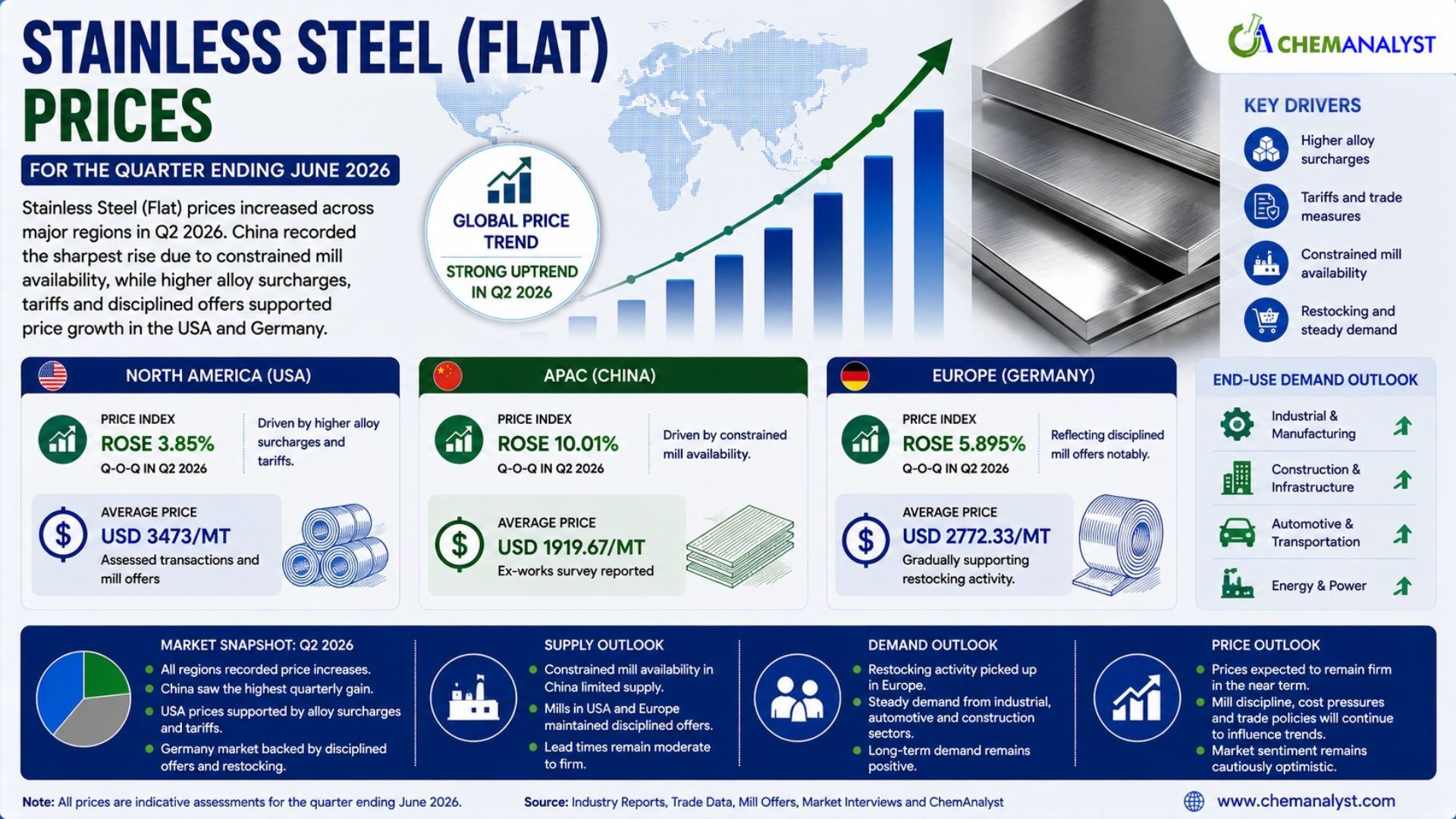
According to ChemAnalyst, the global Stainless Steel (Flat) Prices market strengthened across the major regions during the quarter ending June 2026. North America, APAC and Europe all recorded quarter-over-quarter increases, although the magnitude and underlying drivers differed by region. Higher alloy surcharges, tariff-related cost pressures, constrained mill availability, disciplined mill offers and improving restocking activity shaped the market during Q2 2026.
In the United States, the Stainless Steel (Flat) Price Index rose by 3.85% quarter-over-quarter, supported by higher alloy surcharges and tariffs. The average Stainless Steel price for the quarter was approximately USD 3473/MT, based on assessed transactions and mill offers.
The APAC market recorded the strongest increase among the assessed regions. In China, the Stainless Steel (Flat) Price Index increased by 10.01% quarter-over-quarter, driven by constrained mill availability. The average Stainless Steel (Flat) price reached approximately USD 1919.67/MT, based on an ex-works survey.
In Europe, Germany's Stainless Steel (Flat) Price Index rose by 5.895% quarter-over-quarter, reflecting disciplined mill offers. The average Stainless Steel price stood at approximately USD 2772.33/MT, with improving restocking activity gradually providing additional support.
Overall, the Q2 2026 market demonstrated broad-based price appreciation, with China registering the sharpest increase and the United States recording the highest reported average price among the supplied regional assessments.
Stainless Steel (Flat) Prices in North America
The North American Stainless Steel (Flat) Price Trend strengthened during Q2 2026. In the United States, the Price Index increased by 3.85% quarter-over-quarter, reflecting the combined influence of higher alloy surcharges and tariffs.
The average Stainless Steel price was approximately USD 3473/MT, based on assessed transactions and mill offers. The market therefore entered the second half of 2026 with a firmer pricing structure than in the preceding quarter.
Alloy surcharges are particularly important in stainless steel markets because fluctuations in alloy-related costs can directly affect producer pricing. Higher surcharges can raise the overall cost of finished stainless steel products, particularly when mills pass increased input expenses through to customers.
Tariff-related pressures also contributed to the firmer U.S. market environment. Together, these factors supported the 3.85% quarter-over-quarter increase in the Stainless Steel (Flat) Price Index.
Stainless Steel (Flat) Price Trend in the USA
The Stainless Steel (Flat) Price Trend in the USA reflected a moderate but clear upward movement during Q2 2026.
The 3.85% quarter-over-quarter increase indicates that market pricing strengthened without experiencing the sharper increase recorded in China. The average price of USD 3473/MT provides a reference point for the quarter based on assessed transactions and mill offers.
Higher alloy surcharges represented a significant cost-side factor. At the same time, tariffs added further pressure to market pricing, supporting stronger supplier offers.
The combination of these factors created a firmer procurement environment for buyers while encouraging mills to maintain stronger price levels.
Alloy Surcharges and Tariffs Impact on Stainless Steel Prices
Alloy surcharges and tariffs were among the most important factors affecting U.S. Stainless Steel (Flat) Prices during Q2 2026.
Stainless steel production relies on alloying elements that influence the final cost of the material. When alloy surcharges increase, mills may adjust selling prices to reflect the higher cost structure.
Tariffs can also affect market economics by influencing the cost of imported material and changing competitive conditions between domestic and overseas suppliers.
The combined impact of higher alloy surcharges and tariffs contributed to the 3.85% quarter-over-quarter increase in the U.S. Stainless Steel (Flat) Price Index.
Get Real Time Online for Stainless Steel (Flat) Prices: https://www.chemanalyst.com/Pricing-data/stainless-steel-1502
Stainless Steel (Flat) Prices in APAC
The APAC Stainless Steel (Flat) market recorded the strongest price increase among the assessed regions during Q2 2026.
In China, the Stainless Steel (Flat) Price Index rose by 10.01% quarter-over-quarter, primarily driven by constrained mill availability. The average Stainless Steel (Flat) price was approximately USD 1919.67/MT ex-works, based on the reported survey.
The sharp increase indicates that supply-side conditions were a major factor in China's stainless steel market during the quarter. When mill availability becomes constrained, buyers may face greater competition for available material, allowing producers to maintain firmer offers.
The Chinese market consequently experienced a substantially stronger quarterly price movement than North America and Europe.
Stainless Steel (Flat) Price Trend in China
The Stainless Steel (Flat) Price Trend in China moved significantly higher during Q2 2026.
The 10.01% quarter-over-quarter increase was linked to constrained mill availability. Limited availability can tighten the balance between supply and demand and provide producers with greater pricing power.
The average price of approximately USD 1919.67/MT ex-works reflected the market conditions during the quarter.
The movement demonstrates the importance of mill operating conditions and material availability in determining Stainless Steel (Flat) prices. Even without a quantified change in downstream demand, tighter availability can create upward price pressure when buyers seek to secure material.
Mill Availability and Chinese Stainless Steel Prices
Mill availability was the key factor behind China's Q2 2026 price movement.
When mills have limited availability, buyers may need to compete for fewer available volumes. This can encourage suppliers to maintain or increase offers, particularly when procurement requirements remain consistent.
The resulting 10.01% quarter-over-quarter increase was significantly higher than the movements recorded in the United States and Germany.
For market participants, monitoring mill availability will therefore remain important when assessing the future direction of Chinese Stainless Steel (Flat) Prices.
Stainless Steel (Flat) Prices in Europe
The European Stainless Steel (Flat) Price Trend also moved upward during Q2 2026.
In Germany, the Stainless Steel (Flat) Price Index increased by 5.895% quarter-over-quarter, reflecting disciplined mill offers. The average Stainless Steel price reached approximately USD 2772.33/MT.
The German market displayed a different dynamic compared with China. Rather than constrained mill availability being identified as the primary driver, disciplined mill offers played a notable role in maintaining firmer pricing.
At the same time, restocking activity gradually strengthened during the quarter, providing additional support to the market.
Stainless Steel (Flat) Price Trend in Germany
Germany's Stainless Steel (Flat) market recorded a 5.895% quarter-over-quarter increase during Q2 2026.
The average price of approximately USD 2772.33/MT reflected a gradually strengthening market environment. Disciplined mill offers helped maintain price firmness, while improving restocking activity provided additional demand-side support.
Restocking can become an important market signal because buyers may return to the market to replenish inventories after maintaining leaner stock levels. When several buyers increase procurement simultaneously, market availability can tighten and support supplier pricing.
The combination of disciplined offers and improving restocking activity therefore supported the German market during Q2 2026.
Book A Demo for Stainless Steel (Flat) Price: https://www.chemanalyst.com/ChemAnalyst/PricingForm?Product=Stainless%20Steel%20%28Flat%29
Restocking Activity and European Market Support
Restocking activity gradually supported the European Stainless Steel (Flat) market during Q2 2026.
When buyers replenish inventories, procurement volumes can increase even without a major structural change in final consumption. This can provide additional support to market prices and improve supplier sentiment.
In Germany, the average Stainless Steel price reached USD 2772.33/MT, while the Price Index increased by 5.895% quarter-over-quarter.
The improvement in restocking activity therefore complemented disciplined mill offers and contributed to the overall firm market environment.
Stainless Steel (Flat) Demand Analysis
The Stainless Steel (Flat) demand outlook remained supportive across the assessed regions, although the supplied data identifies different market drivers in each location.
In the United States, price growth was primarily associated with higher alloy surcharges and tariffs. In China, constrained mill availability was the principal factor behind the 10.01% quarter-over-quarter increase.
In Germany, improving restocking activity provided gradual support to prices alongside disciplined mill offers.
The available market data does not quantify a specific percentage change in global stainless steel demand. Therefore, the Q2 2026 price movements should primarily be interpreted through the stated supply, cost, trade and procurement factors.
Stainless Steel (Flat) Supply Analysis
Supply-side conditions played an important role in all three assessed markets.
China experienced constrained mill availability, resulting in the strongest quarterly increase of 10.01%.
In the United States, tariff conditions and higher alloy surcharges affected the market environment, supporting stronger pricing.
Germany experienced disciplined mill offers, while improving restocking activity gradually supported the market.
These developments demonstrate that Stainless Steel (Flat) Prices can respond to both physical availability and producer pricing strategies.
Key Factors Influencing Stainless Steel (Flat) Prices
Several factors influenced the global Stainless Steel (Flat) market during Q2 2026.
Alloy Surcharges
Higher alloy surcharges supported the U.S. market and contributed to the 3.85% quarter-over-quarter increase in the Price Index.
Tariffs
Tariffs added further cost and trade-related pressure to the North American market.
Mill Availability
Constrained mill availability was the key factor behind China's 10.01% quarter-over-quarter increase.
Mill Pricing Discipline
Disciplined mill offers contributed to Germany's 5.895% quarterly increase.
Restocking Activity
Gradually improving restocking activity provided additional support to the German market.
Regional Supply Conditions
Differences in mill availability and supplier behavior resulted in varying degrees of price appreciation across regions.
Regional Stainless Steel (Flat) Price Comparison
The Q2 2026 market can be summarized across the major assessed regions.
North America – USA: The Stainless Steel (Flat) Price Index rose by 3.85% quarter-over-quarter. The average price was approximately USD 3473/MT, based on assessed transactions and mill offers. Higher alloy surcharges and tariffs supported the increase.
APAC – China: The Price Index increased by 10.01% quarter-over-quarter. The average Stainless Steel (Flat) price reached approximately USD 1919.67/MT ex-works. Constrained mill availability was the principal driver.
Europe – Germany: The Price Index increased by 5.895% quarter-over-quarter. The average price was approximately USD 2772.33/MT, supported by disciplined mill offers and gradually improving restocking activity.
China recorded the largest percentage increase, while the United States reported the highest average price among the supplied regional assessments.
Stainless Steel (Flat) Market Outlook
The Stainless Steel (Flat) market outlook for the coming quarters will depend on mill availability, alloy surcharges, tariffs, producer pricing strategies and restocking activity.
In North America, changes in alloy-related costs and tariff conditions will remain important for determining future price direction. Continued cost pressure could maintain a firm pricing environment.
In China, mill availability will remain a critical factor. If supply remains constrained, prices could continue to experience upward pressure. Conversely, improved availability could reduce some of the recent market firmness.
In Germany, the outlook will depend on the continuation of disciplined mill offers and the strength of restocking activity. Continued procurement could provide further support to prices.
Stainless Steel (Flat) Price Forecast
The Stainless Steel (Flat) Price Forecast remains closely linked to regional supply and cost conditions.
For the United States, the Q2 average price of USD 3473/MT provides a benchmark for a market supported by higher alloy surcharges and tariffs. Any changes in these factors could influence future supplier offers.
For China, the USD 1919.67/MT ex-works average reflected constrained mill availability. Future price movements will depend heavily on whether mill availability improves or remains restricted.
For Germany, the average price of USD 2772.33/MT reflected disciplined mill offers and gradually improving restocking activity. Continued restocking could maintain a firm market environment.
Stainless Steel (Flat) Price Trend: Key Takeaways
The Q2 2026 Stainless Steel (Flat) Price Trend can be summarized as follows:
The U.S. Stainless Steel (Flat) Price Index increased by 3.85% quarter-over-quarter.
The average U.S. Stainless Steel price was approximately USD 3473/MT.
Higher alloy surcharges and tariffs supported the North American increase.
China's Stainless Steel (Flat) Price Index increased by 10.01% quarter-over-quarter.
The average Chinese price was approximately USD 1919.67/MT ex-works.
Constrained mill availability drove the Chinese increase.
Germany's Stainless Steel (Flat) Price Index increased by 5.895% quarter-over-quarter.
The average German Stainless Steel price was approximately USD 2772.33/MT.
Disciplined mill offers supported European price firmness.
Gradually improving restocking activity provided additional support in Germany.
China recorded the strongest percentage increase among the assessed markets.
Conclusion
The global Stainless Steel (Flat) Prices market experienced broad-based price increases during the quarter ending June 2026. Although each region was influenced by different factors, all three assessed markets recorded positive quarter-over-quarter movements.
In North America, the U.S. Stainless Steel (Flat) Price Index rose by 3.85%, with the average price reaching approximately USD 3473/MT. Higher alloy surcharges and tariffs were the principal factors supporting the market.
In APAC, China's Price Index recorded the strongest increase, rising by 10.01% quarter-over-quarter. The average price was approximately USD 1919.67/MT ex-works, with constrained mill availability driving the upward movement.
In Europe, Germany's Price Index rose by 5.895% quarter-over-quarter, while the average Stainless Steel price reached approximately USD 2772.33/MT. Disciplined mill offers and gradually improving restocking activity supported the market.
Overall, the Q2 2026 Stainless Steel (Flat) Price Trend was shaped by alloy surcharges, tariffs, mill availability, producer pricing discipline and restocking activity. Monitoring these factors will remain essential for buyers, suppliers, manufacturers and other market participants assessing future Stainless Steel (Flat) price movements and procurement conditions.
ChemAnalsyt
Call +1 3322586602
420 Lexington Avenue, Suite 300, New York, NY, United States, 10170
Website: https://www.chemanalyst.com/
Email: sales@chemanalyst.com
この記事をシェア





