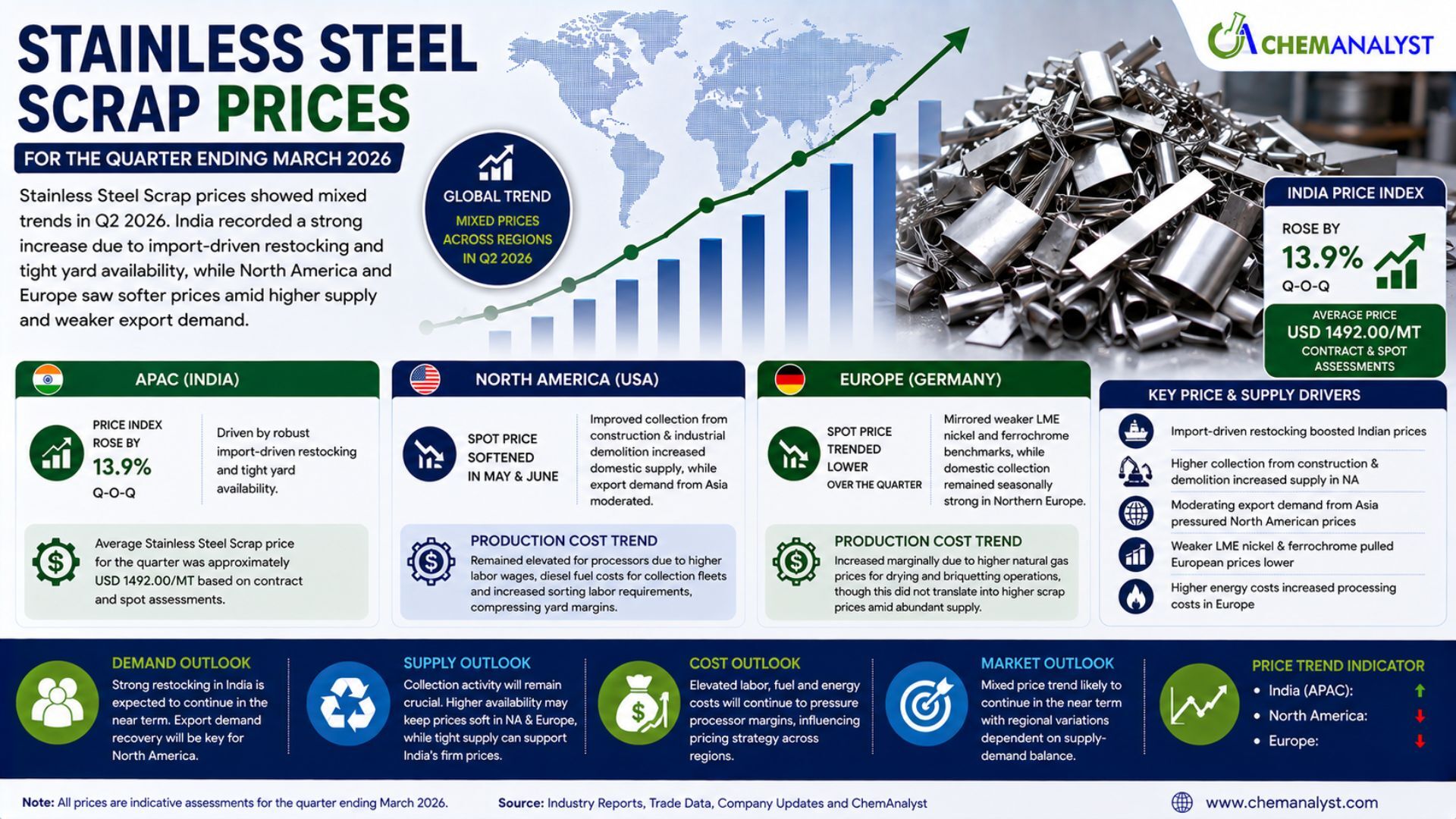
Accoridng to ChemAnalyst, the global Stainless Steel Scrap Prices market showed divergent regional trends during the quarter ending June 2026. While India recorded a strong increase in prices supported by robust import-driven restocking and tight yard availability, markets in North America and Europe experienced downward pressure on spot prices amid improving domestic supply and weaker benchmark conditions.
In India, the Stainless Steel Scrap Price Index rose by 13.9% quarter-over-quarter during Q2 2026. The increase reflected robust import-driven restocking and tight availability of material at collection yards. The average Stainless Steel Scrap price for the quarter was approximately USD 1492.00/MT, based on contract and spot assessments.
In North America, the Stainless Steel Scrap Spot Price softened throughout May and June. Improved collection rates from construction and industrial demolition projects increased domestic supply, while moderated export demand from Asia reduced additional demand support. Despite the decline in scrap values, processors continued to face elevated operating costs due to higher labor wages, diesel fuel expenses and increased sorting requirements.
Europe also witnessed a downward trend in Stainless Steel Scrap Spot Prices during Q2 2026. The movement mirrored weaker LME nickel and ferrochrome benchmarks, while seasonally strong domestic collection across Northern Europe increased available supply. Processing costs rose marginally because of higher natural gas prices used in drying and briquetting operations, but this cost pressure did not translate into higher scrap prices because supply remained abundant.
Overall, Q2 2026 demonstrated a clear regional divergence. India experienced significant price appreciation, whereas North America and Europe faced softer scrap values because of improving supply and weaker external demand or benchmark conditions.
Stainless Steel Scrap Prices in APAC
The APAC market, particularly India, experienced a significant upward movement during Q2 2026. India's Stainless Steel Scrap Price Index increased by 13.9% quarter-over-quarter, representing the strongest reported regional price increase during the quarter.
The rise was primarily associated with robust import-driven restocking and tight yard availability. When buyers increase restocking activity while material availability at yards remains constrained, competition for available scrap can strengthen prices.
The average Stainless Steel Scrap price in India was approximately USD 1492.00/MT during Q2 2026. This assessment was based on contract and spot market conditions.
Import activity played an important role in the Indian market. Import-driven restocking indicates that buyers were actively replenishing inventories, creating additional demand for stainless steel scrap. At the same time, tight yard availability limited readily accessible domestic material.
This combination of stronger procurement and constrained availability created a supportive pricing environment.
Import-Driven Restocking Supports Indian Prices
The Indian Stainless Steel Scrap market was characterized by strong restocking activity during Q2 2026. Import-driven procurement helped strengthen market sentiment and contributed to the 13.9% quarter-over-quarter increase in the Price Index.
Restocking can become an important market driver when buyers seek to secure material amid concerns about availability. When inventory replenishment coincides with limited yard availability, suppliers can receive stronger purchasing interest.
The average price of USD 1492.00/MT therefore reflected the firm market conditions observed across contract and spot assessments.
The Indian market's performance contrasted sharply with North America and Europe, where higher collection rates and abundant supply contributed to lower spot values.
Stainless Steel Scrap Supply and Yard Availability in India
Supply availability was an important factor influencing India's Stainless Steel Scrap price trend during Q2 2026.
Tight yard availability meant that the amount of readily accessible material was constrained. When this occurs alongside active restocking, buyers may compete for available volumes, providing support to scrap prices.
The supply situation therefore reinforced the impact of import-driven demand. Rather than a market characterized by excess material, India experienced a relatively tight availability environment during the quarter.
Going forward, changes in import requirements, inventory replenishment and yard availability will remain important factors in determining the direction of Stainless Steel Scrap Prices in India.
Get Real Time Online for Stainless Steel Scrap Prices: https://www.chemanalyst.com/Pricing-data/stainless-steel-scrap-3075
Stainless Steel Scrap Prices in North America
The North American Stainless Steel Scrap market followed a different trajectory during Q2 2026. The Stainless Steel Scrap Spot Price softened throughout May and June, reflecting improved domestic collection and moderated export demand.
Collection rates from construction and industrial demolition projects increased during the period. Higher collection activity added more material to the domestic supply pool, creating downward pressure on spot prices.
At the same time, export demand from Asia moderated, reducing an additional outlet for North American scrap. Weaker export demand can contribute to increased domestic availability when fewer volumes are directed toward international markets.
The combination of stronger collection and softer external demand resulted in a more readily available supply environment and contributed to declining spot values during May and June.
North American Stainless Steel Scrap Supply Dynamics
Domestic collection was a key driver of the North American market during Q2 2026.
Construction and industrial demolition projects generated increased scrap collection volumes, improving the availability of Stainless Steel Scrap in the domestic market. Higher collection rates can put pressure on prices when supply expands faster than immediate demand.
The moderation in Asian export demand added to this pressure. With fewer opportunities to move material into export markets, more scrap remained available within the domestic supply chain.
Consequently, the North American Stainless Steel Scrap Price Trend weakened despite processors facing elevated costs.
Stainless Steel Scrap Production Cost Trend in North America
An important feature of the North American market was the divergence between scrap values and processing costs.
The Stainless Steel Scrap Production Cost Trend remained elevated during Q2 2026. Processors faced higher labor wages, increased diesel fuel costs for collection fleets and greater sorting labor requirements.
These factors increased the cost of collecting and processing scrap. However, the higher operating expenses did not result in higher scrap prices because market values were simultaneously pressured by improved domestic supply and weaker Asian export demand.
This situation compressed processor and yard margins.
The market therefore demonstrated that higher processing costs do not necessarily translate into higher scrap prices. Pricing ultimately depends on the balance between supply, demand, benchmark movements and trade conditions.
Stainless Steel Scrap Prices in Europe
The European Stainless Steel Scrap market also experienced downward price pressure during Q2 2026.
The Stainless Steel Scrap Spot Price trended lower over the quarter, following weaker LME nickel and ferrochrome benchmarks. These benchmark movements contributed to a softer pricing environment for stainless steel scrap.
At the same time, domestic collection across Northern Europe remained seasonally strong. Strong collection activity increased the amount of material available to buyers and processors.
The combination of weaker benchmark conditions and abundant domestic supply created a challenging environment for Stainless Steel Scrap Prices.
Although processing costs increased marginally because of higher natural gas prices, the additional costs were not sufficient to reverse the downward spot-price trend.
Nickel and Ferrochrome Benchmarks Influence European Scrap Prices
The European market's Q2 2026 price movement was closely associated with weaker LME nickel and ferrochrome benchmarks.
Nickel and ferrochrome are important reference materials within the stainless steel value chain, meaning changes in their benchmark values can influence market sentiment around stainless steel products and scrap.
During Q2 2026, weaker benchmark conditions contributed to lower Stainless Steel Scrap Spot Prices.
The effect was reinforced by seasonally strong domestic collection across Northern Europe. As supply remained abundant, sellers faced a market in which higher processing expenses could not easily be transferred into scrap selling prices.
European Stainless Steel Scrap Production Cost Trend
The Stainless Steel Scrap Production Cost Trend in Europe increased marginally during Q2 2026.
Higher natural gas prices affected drying and briquetting operations, increasing processing expenses for market participants.
However, these higher costs did not result in higher scrap prices. The primary reason was the abundance of available material. When supply remains comfortable, processors and sellers may have limited ability to pass higher operating costs through to buyers.
As a result, European scrap processors faced a challenging margin environment, similar to the situation experienced by North American processors.
Book A Demo for Stainless Steel Scrap Price: https://www.chemanalyst.com/ChemAnalyst/PricingForm?Product=Stainless%20Steel%20Scrap
Key Factors Influencing Stainless Steel Scrap Prices
Several factors shaped the global Stainless Steel Scrap Prices market during Q2 2026.
Import-Driven Restocking
India experienced robust import-driven restocking, which supported the 13.9% quarter-over-quarter increase in its Price Index.
Yard Availability
Tight yard availability in India limited readily accessible supply and strengthened competition for available material.
Domestic Collection
North America benefited from improved collection rates from construction and industrial demolition projects, increasing domestic scrap availability.
Export Demand
Moderating Asian export demand reduced market support for North American scrap and contributed to softer spot prices.
Nickel and Ferrochrome Benchmarks
In Europe, weaker LME nickel and ferrochrome benchmarks contributed to declining scrap values.
Energy and Processing Costs
Higher diesel expenses, labor wages, sorting costs and natural gas prices increased processing expenses in North America and Europe.
Stainless Steel Scrap Demand Analysis
Demand conditions varied considerably by region during Q2 2026.
India experienced strong demand in the form of import-driven restocking. Active replenishment and tight yard availability created a supportive environment for sellers.
North America, in contrast, experienced softer export demand from Asia. This reduced an important source of external demand and contributed to increased domestic availability.
Europe's market was influenced more strongly by supply and benchmark conditions. Seasonally strong domestic collection resulted in abundant supply, limiting the ability of higher processing costs to support scrap prices.
The regional differences demonstrate why the global Stainless Steel Scrap demand outlook must be evaluated alongside local collection rates, trade activity and inventory requirements.
Stainless Steel Scrap Supply Analysis
Supply conditions were one of the most important determinants of Q2 2026 price movements.
India experienced tight yard availability, which restricted readily available material and supported higher prices.
North America saw improved collection from construction and industrial demolition activities, increasing domestic supply.
Northern Europe also experienced seasonally strong collection, resulting in abundant material availability.
The contrasting supply conditions explain much of the divergence between India's strong price increase and the softer markets in North America and Europe.
Regional Stainless Steel Scrap Price Comparison
The Q2 2026 market can be summarized through three distinct regional trends.
APAC: India's Stainless Steel Scrap Price Index increased 13.9% quarter-over-quarter, with the average price reaching approximately USD 1492.00/MT. Import-driven restocking and tight yard availability were the principal drivers.
North America: Stainless Steel Scrap Spot Prices softened during May and June. Improved collection from construction and industrial demolition projects increased domestic supply, while Asian export demand moderated.
Europe: Stainless Steel Scrap Spot Prices trended lower during the quarter. Weaker LME nickel and ferrochrome benchmarks and abundant supply outweighed marginal increases in processing costs.
India therefore recorded a distinctly stronger pricing environment than North America and Europe during Q2 2026.
Stainless Steel Scrap Market Outlook
The Stainless Steel Scrap market outlook remains highly dependent on regional supply and demand conditions.
In India, continued import-driven restocking and tight yard availability could continue supporting prices. However, any improvement in domestic availability could moderate upward pressure.
In North America, collection activity and export demand from Asia will remain important. Continued strong domestic collection combined with weak export demand could keep spot prices under pressure.
In Europe, the direction of nickel and ferrochrome benchmarks will remain important. At the same time, domestic collection and overall scrap availability will influence the balance between supply and demand.
Processing costs will remain an important consideration across North America and Europe. Nevertheless, Q2 2026 demonstrated that elevated processing costs alone may not be enough to push market prices higher when supply remains abundant.
Stainless Steel Scrap Price Forecast
The Stainless Steel Scrap Price Forecast for the coming period will depend on the interaction between collection rates, import requirements, export demand, benchmark metals and processing costs.
For India, the Q2 increase of 13.9% highlights the impact that restocking and tight yard availability can have on prices. If these conditions persist, the market could remain comparatively firm.
For North America, the outlook will depend on whether higher domestic collection continues and whether Asian export demand recovers. A combination of abundant domestic supply and limited export demand would continue to create downward pressure.
For Europe, nickel and ferrochrome benchmark movements will remain important indicators. If benchmark prices remain weak while collection stays seasonally strong, Stainless Steel Scrap Spot Prices could remain under pressure.
Meanwhile, elevated processing costs could continue affecting margins for yards and processors, particularly where labor, diesel, energy and sorting expenses remain high.
Conclusion
The global Stainless Steel Scrap Prices market showed significant regional divergence during the quarter ending June 2026.
In India, the Stainless Steel Scrap Price Index rose by 13.9% quarter-over-quarter, supported by robust import-driven restocking and tight yard availability. The average price was approximately USD 1492.00/MT based on contract and spot assessments.
In North America, Stainless Steel Scrap Spot Prices softened during May and June as improved collection from construction and industrial demolition projects increased domestic supply. Moderating Asian export demand added further downward pressure. At the same time, processors faced elevated labor, diesel and sorting costs, resulting in compressed yard margins.
In Europe, Stainless Steel Scrap Spot Prices trended lower, reflecting weaker LME nickel and ferrochrome benchmarks and seasonally strong domestic collection across Northern Europe. Although natural gas costs increased marginally and raised drying and briquetting expenses, abundant supply prevented these higher costs from translating into higher scrap prices.
Overall, Q2 2026 demonstrated that supply availability, import-driven restocking, export demand, benchmark metal prices and processing costs were the principal forces shaping the global Stainless Steel Scrap market. India remained the strongest market, while North America and Europe experienced softer price conditions. Going forward, monitoring collection activity, international trade flows, yard inventories, nickel and ferrochrome benchmarks and processing expenses will be essential for understanding the Stainless Steel Scrap Price Trend, market outlook and forecast.
ChemAnalsyt
Call +1 3322586602
420 Lexington Avenue, Suite 300, New York, NY, United States, 10170
Website: https://www.chemanalyst.com/
Email: sales@chemanalyst.com
この記事をシェア





