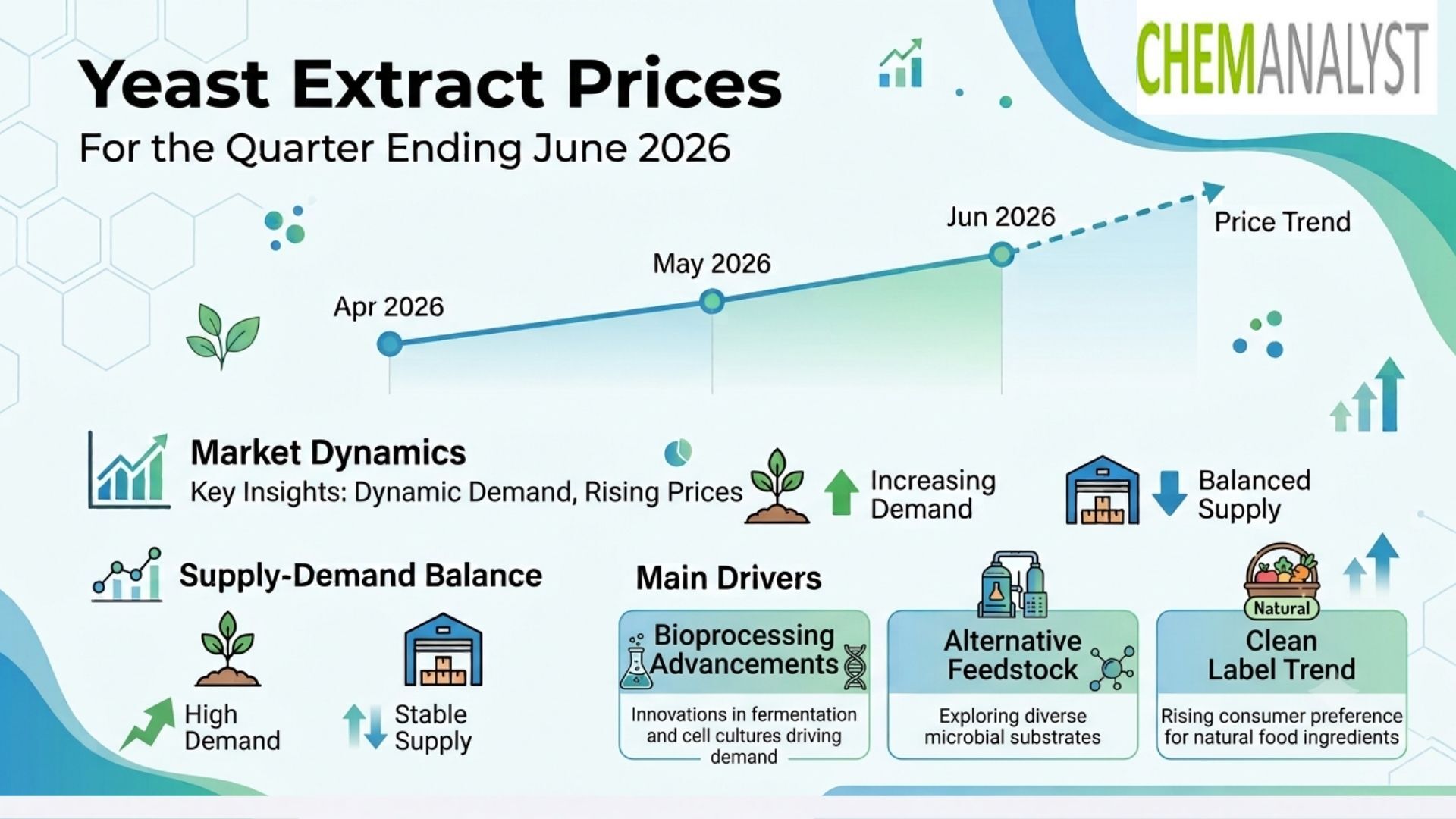
According to ChemAnalyst, the global Yeast Extract Prices market moved upward across North America, APAC and Europe during the second quarter of 2026. The market was influenced primarily by increasing production costs, higher producer-level inflation, raw-material price movements and firm manufacturing expenses. Although regional market dynamics differed, the common theme across the major markets was rising cost pressure on producers.
Yeast extract is a nutrient-rich ingredient produced from yeast and widely used in food, beverage, fermentation, biotechnology, nutritional products and flavor applications. It is valued for its nutritional content and savory flavor characteristics, making it an important ingredient in numerous industrial and food-processing applications. Consequently, Yeast Extract prices are influenced by downstream food and fermentation demand as well as the availability and cost of key raw materials and processing inputs.
During Q2 2026, the United States recorded a quarter-over-quarter increase in the Yeast Extract Price Index, driven by significant producer-level inflation. Production costs also increased as US raw sugar prices strengthened in April 2026 and remained firm through May.
China also experienced a quarter-over-quarter increase in its Yeast Extract Price Index. The upward movement was driven by significant increases in production costs. Despite the cost pressure, the average Yeast Extract FOB China Price Index stood at approximately USD 1650/MT during Q2 2026, reflecting stable export pricing.
Germany likewise recorded a quarter-over-quarter increase. Higher production expenses were the primary driver, with producer prices for industrial products rising 2.2% in May 2026.
Yeast Extract Prices in North America
The North American Yeast Extract market experienced an upward trend during Q2 2026. In the United States, the Yeast Extract Price Index rose quarter-over-quarter, primarily because of significant producer-level inflation.
Producer-level inflation can have a direct effect on manufacturing costs. When the prices of industrial inputs, energy, processing requirements, transportation and other production components increase, manufacturers may face pressure to revise their selling prices.
For Yeast Extract producers, raw-material costs are particularly important because changes in upstream agricultural and food-processing markets can affect the economics of production. During Q2 2026, US raw sugar prices strengthened in April 2026 and remained firm through May, contributing to higher Yeast Extract production costs.
Raw sugar is an important input within the broader sugar and fermentation value chain. Changes in sugar prices can therefore influence production economics for products derived from fermentation processes.
The firming of raw sugar prices during April and May increased cost pressure on US Yeast Extract manufacturers. When upstream costs remain elevated, producers may attempt to pass a portion of these increases through to customers, especially when the broader market is already experiencing producer-level inflation.
The combination of higher producer-level costs and strengthening raw sugar prices provided significant support to Yeast Extract prices in the United States during Q2 2026.
From a procurement perspective, buyers faced a market where upstream cost developments were important indicators of potential price changes. Companies with regular Yeast Extract requirements could benefit from monitoring sugar-market movements alongside supplier quotations.
Get Real Time Online for Yeast Extract Prices: https://www.chemanalyst.com/Pricing-data/yeast-extract-2570
Yeast Extract Prices in APAC
The Asia-Pacific market also recorded an upward movement during Q2 2026, with China experiencing a quarter-over-quarter increase in its Yeast Extract Price Index.
In China, the increase was driven by significant production cost increases. Higher manufacturing expenses placed upward pressure on the market, although export pricing remained comparatively stable.
The average Yeast Extract FOB China Price Index stood at approximately USD 1650/MT during Q2 2026, reflecting stable export pricing.
The distinction between increasing production costs and stable export pricing is important. Producers can experience rising manufacturing expenses without immediately passing the entire increase through to export customers. Competitive pressures, existing contracts, inventory positions and international demand can influence the extent of cost pass-through.
China's role as a major manufacturing and export market makes its Yeast Extract pricing conditions relevant to international buyers. FOB assessments provide an indication of the product value at the export point before buyers account for additional freight, insurance, duties and destination-related costs.
During Q2 2026, Chinese producers faced increasing production expenses, but the relatively stable export price environment suggested that suppliers and buyers were balancing these cost pressures.
The quarter-over-quarter increase in China's Yeast Extract Price Index nevertheless indicates that the underlying cost environment was becoming firmer. If production costs remain elevated, suppliers could face increasing pressure to adjust export and domestic quotations in subsequent procurement cycles.
For buyers, the Q2 2026 Chinese market highlighted the importance of monitoring both export prices and production-cost indicators. A stable FOB price does not necessarily mean that production costs are unchanged.
Yeast Extract Prices in Europe
Germany recorded an increase in its Yeast Extract Price Index during Q2 2026. The movement was primarily associated with increasing production costs.
Producer prices for industrial products increased 2.2% in May 2026, indicating that German manufacturers continued to operate within a higher-cost industrial environment.
Higher producer prices can affect the entire manufacturing chain by increasing expenses related to industrial inputs, processing, utilities, logistics and other production requirements. For Yeast Extract producers, these additional costs can place pressure on margins and create an incentive for price adjustments.
The German market's upward movement therefore reflected broader industrial cost developments rather than a single isolated market factor.
Yeast Extract has applications across food, flavor, fermentation and biotechnology industries. Changes in manufacturing activity across these downstream sectors can influence procurement requirements. However, during Q2 2026, the dominant factor highlighted in the German market was increasing production cost pressure.
For European buyers, the rise in German producer prices provided an important indicator of the wider cost environment. Continued producer-price inflation could result in further cost pass-through if manufacturers face sustained increases in their operating expenses.
Book A Demo for Yeast Extract Price: https://www.chemanalyst.com/ChemAnalyst/PricingForm?Product=Yeast%20Extract
Key Factors Influencing Yeast Extract Prices in Q2 2026
Several factors shaped the global Yeast Extract price trend during the second quarter of 2026.
Producer-Level Inflation
Producer-level inflation was a significant factor in the United States. Rising producer costs increased the expense associated with manufacturing and supported the upward movement in the US Yeast Extract Price Index.
Raw Sugar Prices
US raw sugar prices strengthened in April 2026 and remained firm through May. This increase contributed to higher Yeast Extract production costs and created additional upward pressure on the market.
Production Costs
Production costs increased across the United States, China and Germany. Higher manufacturing expenses provided a common upward influence on regional Yeast Extract prices.
Export Pricing
In China, the average Yeast Extract FOB China Price Index was approximately USD 1650/MT during Q2 2026. Export prices remained relatively stable even as production costs increased.
Industrial Producer Prices
Germany experienced a 2.2% increase in producer prices for industrial products in May 2026, contributing to higher manufacturing expenses and supporting the upward movement in Yeast Extract prices.
Yeast Extract Price Trend Analysis for Q2 2026
The Q2 2026 Yeast Extract market displayed a broadly firm pricing trend across the major regions.
In the United States, the Yeast Extract Price Index increased quarter-over-quarter. Significant producer-level inflation and higher raw sugar prices contributed to increased production expenses.
In China, the Price Index also increased quarter-over-quarter because of significant production-cost increases. Nevertheless, the average FOB China assessment remained approximately USD 1650/MT, indicating stable export pricing.
In Germany, the Yeast Extract Price Index rose as production expenses increased. The 2.2% increase in industrial producer prices in May 2026 reinforced the higher-cost environment.
These developments indicate that Q2 2026 was primarily characterized by cost-driven price support. While China maintained stable export pricing, the underlying increase in production costs suggested that suppliers continued to face margin pressure.
The market also demonstrates why Yeast Extract price analysis requires consideration of both upstream and downstream factors. Raw-material prices can influence production expenses, while industrial demand and procurement behavior determine how those costs are ultimately reflected in market prices.
Example of Yeast Extract Price Dynamics
Consider a food manufacturer that uses Yeast Extract as a flavor and nutritional ingredient.
A US buyer sourcing Yeast Extract during Q2 2026 could face higher supplier quotations because producer-level inflation increased production expenses. The strengthening of US raw sugar prices during April and May added further cost pressure.
A buyer sourcing from China could encounter a different situation. Although production costs increased significantly, the average FOB China price remained around USD 1650/MT. This could provide greater short-term pricing stability while still requiring the buyer to monitor future production-cost developments.
A German buyer could face higher quotations because industrial producer prices increased 2.2% in May. Higher producer prices could translate into increased manufacturing expenses for Yeast Extract suppliers.
This example demonstrates that the same product can experience different pricing conditions across regions depending on raw-material costs, production expenses and local market structures.
Yeast Extract Production Cost Trend
The Yeast Extract Production Cost Trend moved upward during Q2 2026.
In the United States, production costs increased as raw sugar prices strengthened in April and remained firm through May. This created additional pressure on manufacturers and contributed to the increase in the regional Price Index.
China also experienced higher production costs. Although the average FOB export price remained approximately USD 1650/MT, the increase in production expenses indicated that manufacturers were operating under greater cost pressure.
Germany experienced a similar cost-driven environment. Producer prices for industrial products increased 2.2% in May, increasing the cost base for manufacturers.
These developments show that production costs remained one of the most important factors influencing Yeast Extract pricing during Q2 2026.
For producers, sustained increases in input costs can reduce margins if selling prices remain unchanged. For buyers, rising production costs can signal potential future price increases and may therefore influence procurement planning.
Yeast Extract Prices Forecast
The outlook for Yeast Extract prices will depend on raw-material costs, producer-level inflation, industrial activity and downstream demand.
In the United States, raw sugar prices will remain an important variable. Continued firmness in sugar prices could maintain pressure on Yeast Extract production costs. If producer-level inflation remains elevated, suppliers could seek further price adjustments.
In China, the direction of production costs will be important for future export pricing. The Q2 2026 average of USD 1650/MT FOB China provides a useful reference point, but persistent cost increases could eventually place upward pressure on export quotations.
In Germany, future Yeast Extract prices will remain sensitive to producer-price movements and broader industrial costs. If manufacturing expenses continue to increase, suppliers could attempt to pass these costs through to downstream customers.
Procurement teams should therefore monitor sugar prices, industrial producer prices, manufacturing expenses and downstream demand when evaluating future market conditions.
Procurement Considerations for Yeast Extract
The Q2 2026 market highlights the importance of proactive procurement planning for Yeast Extract buyers.
Raw-material markets should be monitored closely because changes in agricultural commodities can influence production costs. The movement in US raw sugar prices during April and May provides an example of how upstream price developments can affect downstream ingredients.
Buyers should also compare domestic and imported supply options. China's approximately USD 1650/MT FOB export assessment can provide an international benchmark, although actual landed costs will vary depending on freight, insurance, duties and other destination-related expenses.
Inventory management is another important consideration. Maintaining sufficient stocks can provide protection against short-term supplier price increases, while excessive inventory can increase carrying costs.
Finally, procurement teams should distinguish between temporary price movements and persistent cost changes. If higher production costs remain in place for several months, suppliers may have greater incentive to adjust prices.
Conclusion
The second quarter of 2026 witnessed a broadly firm trend in the global Yeast Extract Prices market. The United States, China and Germany all recorded quarter-over-quarter increases in their respective Yeast Extract Price Indexes, although the underlying market drivers differed.
In the United States, significant producer-level inflation pushed the Price Index higher, while strengthening raw sugar prices in April 2026 and firm conditions through May increased Yeast Extract production costs.
In China, the Yeast Extract Price Index increased because of significant production-cost increases. However, the average Yeast Extract FOB China Price Index stood at approximately USD 1650/MT during Q2 2026, reflecting stable export pricing.
Germany also recorded an increase, driven by higher production costs. Producer prices for industrial products increased 2.2% in May 2026, reinforcing the upward cost environment.
Overall, Q2 2026 demonstrated that Yeast Extract price trends were closely connected to raw-material costs, producer-level inflation and broader industrial expenses. Going forward, movements in sugar prices, production costs, producer prices, export conditions and downstream demand will remain important indicators for manufacturers, suppliers, distributors and procurement teams tracking Yeast Extract prices, market trends and the future pricing outlook.
ChemAnalsyt
Call +1 3322586602
420 Lexington Avenue, Suite 300, New York, NY, United States, 10170
Website: https://www.chemanalyst.com/
Email: sales@chemanalyst.com
この記事をシェア





