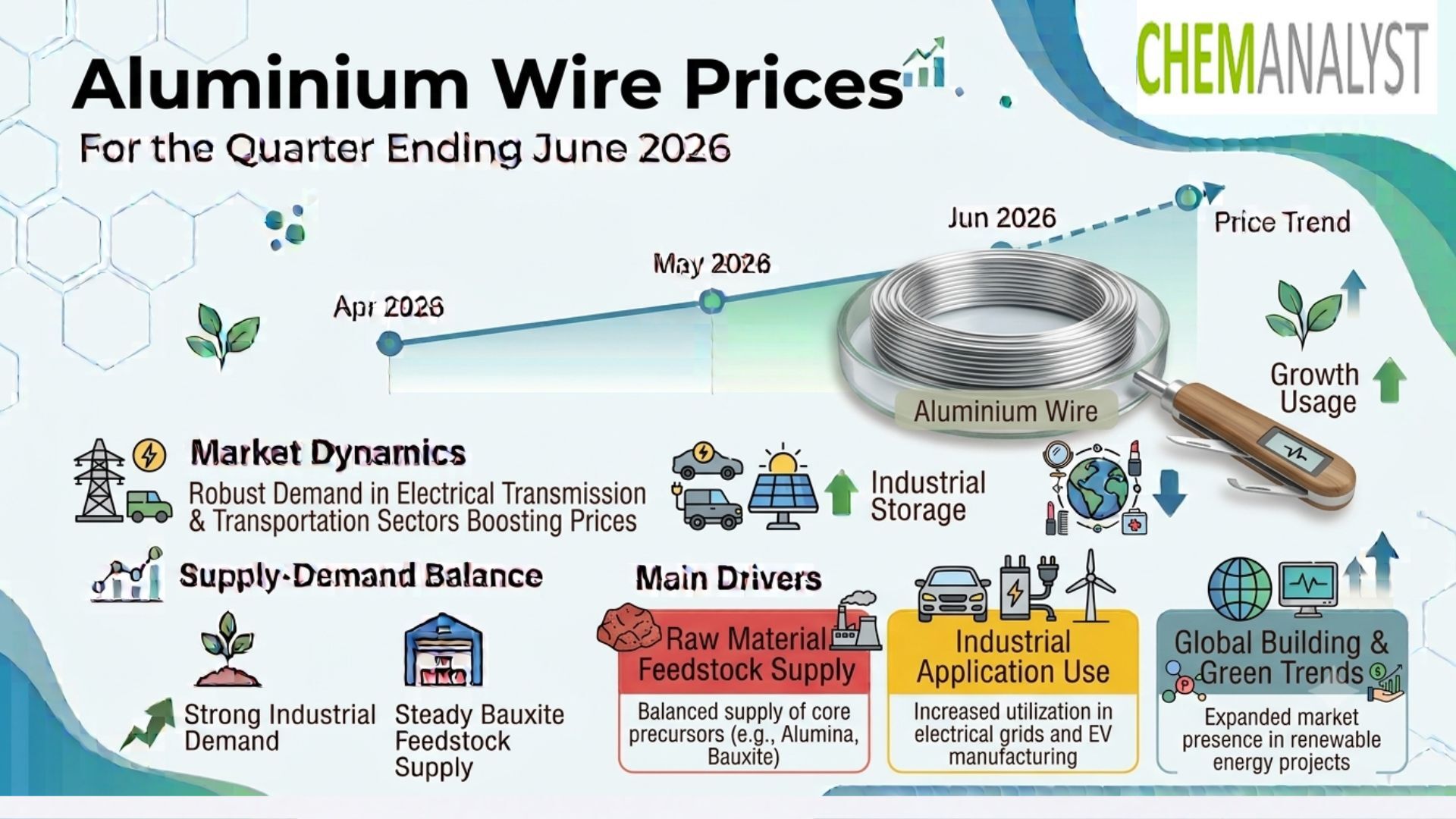
According to ChemAnalyst, the global Aluminium Wire Prices market experienced a generally firm trend during the quarter ending June 2026, although the degree of movement varied across regions. Tightening supply, extended domestic mill lead times, inventory clearance, import availability, energy costs and changing export activity all contributed to regional price movements during the second quarter.
Aluminium wire remains an important downstream aluminium product used in electrical and power transmission applications, construction, automotive components, telecommunications and industrial manufacturing. As a processed aluminium product, its pricing is influenced by the cost and availability of primary aluminium, energy requirements, conversion costs, logistics and downstream demand.
During Q2 2026, North American spot prices strengthened notably in May and June as domestic mill lead times extended and buyers rushed to secure coverage ahead of the summer maintenance season. In South Korea, the Aluminium Wire Price Index increased by 1.94% quarter-over-quarter, reflecting supply tightening. Thailand and China also recorded moderate increases of 0.69% and 0.54%, respectively.
Meanwhile, the European market experienced steadily firmer spot pricing amid constrained primary ingot availability and higher natural gas costs for secondary smelters. Production costs in Europe also moved upward as power purchase agreements were renegotiated at higher rates and carbon allowance costs surged.
Aluminium Wire Prices in North America
The North American Aluminium Wire Spot Price strengthened notably during May and June 2026. Domestic mill lead times extended during the period, encouraging buyers to secure additional coverage ahead of the summer maintenance season.
Aluminium Wire prices hovered around USD 4998/MT on a CFR basis during Q2 2026.
The extension of mill lead times was an important factor influencing buyer behavior. Longer lead times can increase procurement uncertainty, particularly for manufacturers that depend on consistent deliveries to maintain production schedules. As buyers sought to secure material earlier, purchasing activity provided additional support to spot-market pricing.
The approach of the summer maintenance season also encouraged market participants to evaluate their inventory positions. Planned maintenance can temporarily affect production availability, making advance procurement an important strategy for downstream consumers.
The combination of extended lead times and precautionary buying therefore created a firmer pricing environment in North America during the latter portion of the quarter. While prices remained influenced by broader aluminium market fundamentals, short-term availability and procurement requirements played a significant role in the strengthening of spot prices.
Get Real Time Online for Aluminium Wire Prices: https://www.chemanalyst.com/Pricing-data/aluminium-wire-1361
Aluminium Wire Prices in APAC
The Asia-Pacific market recorded moderate upward movements during Q2 2026, with supply conditions differing across individual countries.
In South Korea, the Aluminium Wire Price Index rose by 1.94% quarter-over-quarter, reflecting supply tightening. The average Aluminium Wire price was approximately USD 4010/MT on a CFR Busan basis during the quarter.
The increase in South Korea highlights the influence of physical availability on regional pricing. When supply becomes tighter, buyers may need to compete for available material, particularly when inventories are not sufficient to absorb changes in supply.
CFR Busan pricing also reflects the delivered economics of material entering the Korean market. Therefore, the benchmark provides insight into the combined impact of the product price and associated transportation considerations.
South Korea's comparatively stronger increase among the reported APAC markets indicates that local supply conditions were more supportive of pricing during Q2 2026.
Aluminium Wire Prices in Thailand
Thailand recorded a smaller quarterly increase. The Aluminium Wire Price Index rose by 0.69% quarter-over-quarter, supported by stable imports.
Despite the quarterly increase in the Price Index, the Aluminium Wire Spot Price softened, as ample Asian shipments and Chinese export quotations pressured offers.
This combination demonstrates the difference between broader quarterly pricing and short-term spot-market dynamics. Stable imports helped maintain material availability in Thailand, while abundant regional shipments limited the potential for sustained price increases.
Chinese export quotations were another important influence. Competitive export offers can place pressure on sellers in neighboring markets because buyers have the option of sourcing material from alternative regional suppliers.
As a result, Thai buyers encountered a market in which supply remained accessible, preventing significant upward movement in spot offers. The modest 0.69% quarter-over-quarter increase nevertheless indicates that the overall quarterly pricing environment remained slightly firmer.
Aluminium Wire Prices in China
China recorded another modest quarterly increase during Q2 2026. The Aluminium Wire Price Index rose by 0.54% quarter-over-quarter, reflecting softer export bookings.
However, the Aluminium Wire Spot Price eased as the Price Index showed exporters cutting offers to clear inventory.
The Chinese market therefore presented a mixed pricing environment. While the quarterly Price Index remained marginally higher, weaker export bookings encouraged sellers to reduce offers. Inventory considerations became particularly important as exporters sought to clear available material.
Lower export bookings can increase competition among sellers, particularly when inventories accumulate. In such circumstances, exporters may become more willing to adjust quotations to stimulate buying interest and accelerate inventory turnover.
The Chinese market's performance also influenced other Asian markets. Competitive Chinese export quotations placed pressure on Thai offers, illustrating how developments in one major exporting market can affect pricing conditions throughout the wider APAC region.
Aluminium Wire Prices in Europe
The European Aluminium Wire Spot Price firmed steadily during Q2 2026. The increase was driven by constrained primary ingot availability and higher natural gas costs for secondary smelters across the region.
Primary aluminium availability is an important component of downstream wire production economics. When access to primary ingot becomes constrained, downstream processors can face higher raw-material replacement costs. This can subsequently affect conversion margins and selling prices.
Energy costs were another important consideration. Secondary smelters rely heavily on energy-intensive operations, making natural gas and electricity costs significant components of production economics.
The combination of constrained primary ingot availability and higher natural gas costs therefore created a supportive environment for European Aluminium Wire Spot Prices during the quarter.
Aluminium Wire Production Cost Trend in Europe
The Aluminium Wire Production Cost Trend moved upward in Q2 2026. Power purchase agreements were renegotiated at higher rates, while carbon allowance costs surged, putting additional pressure on European converter margins.
Energy is a major cost component throughout the aluminium processing chain. Higher electricity procurement costs can raise the cost of converting aluminium into downstream products such as wire. When these expenses increase, producers may attempt to pass some of the additional costs through to customers.
Carbon allowance costs added another layer of pressure. Higher carbon-related expenses increase the operating cost burden for energy-intensive industrial producers and can squeeze margins when downstream prices do not rise at the same pace.
For European converters, the simultaneous increase in power procurement costs and carbon allowance expenses resulted in a challenging cost environment. The upward movement in production costs consequently supported firmer Aluminium Wire pricing.
Book A Demo for Aluminium Wire Price: https://www.chemanalyst.com/ChemAnalyst/PricingForm?Product=Aluminium%20Wire
Key Factors Influencing Aluminium Wire Prices in Q2 2026
Several factors shaped the global Aluminium Wire Prices market during Q2 2026.
Supply Availability
Supply tightening was a major factor in South Korea, where the Aluminium Wire Price Index increased by 1.94% quarter-over-quarter. Constrained availability can increase competition among buyers and support higher prices.
Mill Lead Times
North American mill lead times extended during May and June. This encouraged buyers to secure material ahead of the summer maintenance season and contributed to stronger spot pricing.
Export Demand and Bookings
China experienced softer export bookings during the quarter. Exporters responded by cutting offers to clear inventory, resulting in softer spot pricing despite the quarterly Price Index increasing by 0.54%.
Regional Imports
Stable imports supported Thailand's market by ensuring adequate availability. However, abundant Asian shipments limited sellers' ability to increase spot offers.
Primary Aluminium Availability
European spot prices were supported by constrained primary ingot availability. Limited upstream material can increase the replacement cost faced by downstream converters.
Energy Costs
Higher natural gas costs for secondary smelters and increased power purchase agreement rates raised European production expenses.
Carbon Allowance Costs
Surging carbon allowance costs added further pressure to European converter margins, contributing to an upward movement in production costs.
Regional Comparison of Aluminium Wire Price Trends
The Q2 2026 Aluminium Wire Prices market showed different dynamics across regions.
North America experienced stronger spot pricing toward the end of the quarter because of extended mill lead times and buyers securing coverage before summer maintenance. Prices hovered around USD 4998/MT CFR.
South Korea recorded the strongest reported APAC Price Index increase at 1.94% quarter-over-quarter, with an average price of approximately USD 4010/MT CFR Busan.
Thailand's Price Index increased by 0.69%, although spot prices softened because of ample Asian shipments and competitive Chinese export quotations.
China posted a 0.54% quarter-over-quarter increase, while spot prices eased as exporters reduced offers to clear inventory.
Europe experienced steadily firmer spot pricing, supported by constrained primary ingot availability and higher energy-related production costs.
These regional differences demonstrate that aluminium wire pricing is influenced by a combination of global aluminium fundamentals and local supply-chain conditions.
Example: How Lead Times Can Affect Aluminium Wire Prices
Consider a North American buyer preparing for the summer maintenance season. If domestic mill lead times extend, the buyer may become concerned about securing sufficient material for upcoming production requirements.
Instead of waiting for spot availability to tighten further, the buyer may place orders earlier and increase coverage. When multiple buyers follow the same strategy, near-term demand can increase and contribute to stronger spot prices.
This example demonstrates why procurement timing can become an important component of Aluminium Wire pricing. Market participants need to consider not only the current price but also lead times, planned maintenance, inventory requirements and expected supply availability.
Impact on Procurement and Supply Chain Planning
The Q2 2026 market conditions highlight the importance of proactive procurement strategies for aluminium wire buyers.
In North America, extended lead times demonstrate the value of securing coverage before anticipated maintenance periods. Buyers that wait until supply becomes tighter may face less favorable spot-market conditions.
In Asia, procurement teams should closely monitor regional export quotations and import flows. Thailand's experience shows how ample regional shipments can limit price increases, while South Korea demonstrates how supply tightening can support higher prices.
European buyers face an additional challenge because production costs are influenced by energy and carbon-related expenses. Monitoring power procurement conditions, natural gas costs, primary aluminium availability and carbon allowance expenses can provide valuable insight into future pricing risks.
Aluminium Wire Prices Outlook
The outlook for Aluminium Wire Prices will depend on the interaction between raw-material availability, production costs, regional demand, inventories, trade flows and logistics.
North American pricing may remain sensitive to mill lead times and maintenance-related supply conditions. If buyers continue securing material in advance, near-term demand could provide support to spot prices.
In APAC, supply conditions are likely to remain an important differentiator. Tightening availability could support prices in markets such as South Korea, while abundant regional shipments and competitive Chinese offers could continue limiting increases in Thailand and other import-dependent markets.
China's pricing direction will depend partly on export bookings and inventory levels. Continued weak bookings could encourage further offer reductions as exporters prioritize inventory clearance.
Europe will remain sensitive to primary ingot availability and energy costs. Higher power procurement rates and carbon allowance expenses could continue to place pressure on converter margins and production costs.
Conclusion
The global Aluminium Wire Prices market maintained a generally firm tone during the quarter ending June 2026, although regional developments varied considerably.
North American Aluminium Wire Spot Prices strengthened notably in May and June as domestic mill lead times extended and buyers rushed to secure coverage ahead of the summer maintenance season. Prices hovered around USD 4998/MT CFR during Q2 2026.
In South Korea, the Aluminium Wire Price Index increased by 1.94% quarter-over-quarter, with an average price of approximately USD 4010/MT CFR Busan, reflecting supply tightening.
Thailand recorded a 0.69% quarterly increase, although spot prices softened because of ample Asian shipments and Chinese export quotations. China's Price Index rose by 0.54%, while exporters reduced offers to clear inventory amid softer export bookings.
Europe experienced steadily firmer spot prices as constrained primary ingot availability and higher natural gas costs affected the market. Meanwhile, the Aluminium Wire Production Cost Trend moved upward as power purchase agreements were renegotiated at higher rates and carbon allowance costs surged.
Overall, Q2 2026 demonstrated that monitoring Aluminium Wire Prices requires a comprehensive view of supply availability, mill lead times, aluminium feedstock costs, energy expenses, trade flows, inventories and regional procurement behavior. These factors will remain important for manufacturers, distributors and buyers assessing market conditions and planning future aluminium wire purchases.
ChemAnalsyt
Call +1 3322586602
420 Lexington Avenue, Suite 300, New York, NY, United States, 10170
Website: https://www.chemanalyst.com/
Email: sales@chemanalyst.com
この記事をシェア





