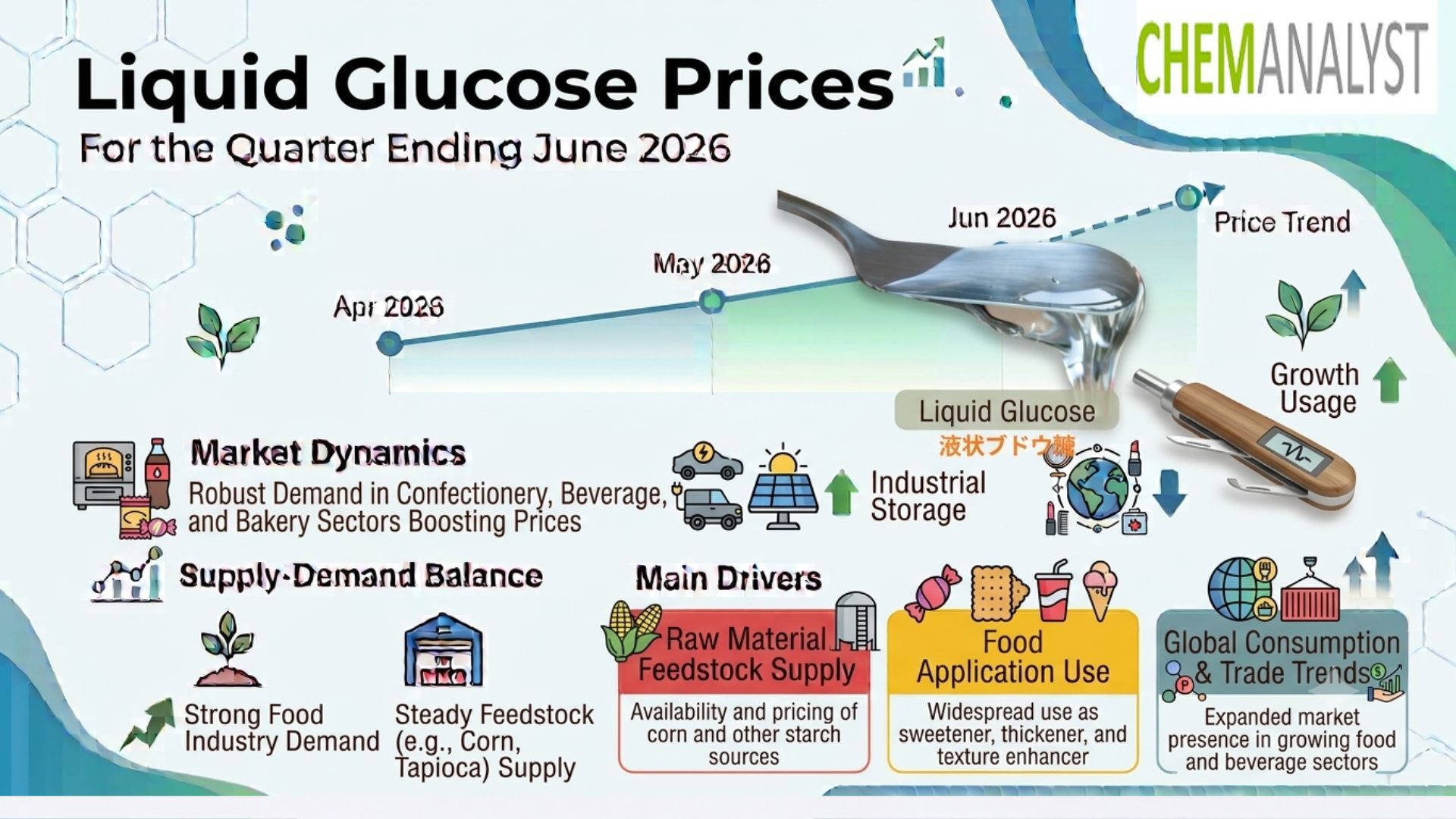
According to ChemAnalyst, thee global Liquid Glucose Prices market remained broadly stable during the quarter ending June 2026, although individual regions experienced modest movements based on corn and maize availability, import flows, production conditions, starch feedstock costs and downstream demand. While North America and Europe largely maintained steady pricing, selected Asian markets recorded small quarterly increases or declines.
Liquid glucose is an important carbohydrate ingredient produced primarily through the hydrolysis of starch. It is widely used across food and beverage manufacturing, confectionery, bakery products, processed foods, pharmaceuticals and several industrial applications. As a starch-derived product, its pricing is closely connected to the availability and cost of agricultural feedstocks, particularly corn and maize.
During Q2 2026, the global market showed relatively balanced fundamentals. North American prices hovered around USD 520/MT on an FOB basis, while Indonesia recorded an average price of approximately USD 455/MT for CFR Jakarta deliveries. Vietnam and India experienced only marginal quarterly movements of 0.07% and 0.48%, respectively.
The overall market environment indicated that supply remained sufficient in several regions, although localized feedstock tightness and changing import flows created small variations in regional pricing.
Liquid Glucose Prices in North America
In North America, the Liquid Glucose Price Index remained largely stable quarter-over-quarter during Q2 2026. Adequate corn availability and balanced production across the region supported stable market conditions.
Liquid Glucose prices hovered around USD 520/MT on an FOB basis during the quarter. The stability of the North American market was primarily linked to the availability of corn, which serves as an important feedstock for starch-based glucose production.
Adequate corn availability helped manufacturers maintain consistent production levels and limited the need for significant price adjustments. When agricultural feedstocks are sufficiently available, producers generally face less pressure to increase processing costs, allowing downstream glucose prices to remain comparatively steady.
Balanced production was another important factor. Stable operating conditions helped align supply with demand from food, beverage, pharmaceutical and other downstream industries.
For buyers, the relatively stable Q2 environment provided greater visibility for procurement planning. However, because liquid glucose remains closely linked to agricultural commodities, future movements in corn availability and feedstock costs will remain important indicators for the market.
Get Real Time Online for Liquid Glucose Prices: https://www.chemanalyst.com/Pricing-data/liquid-glucose-1593
Liquid Glucose Prices in APAC
The Asia-Pacific market recorded relatively mild price movements during Q2 2026. In Indonesia, the Liquid Glucose Price Index fell by 1.02% quarter-over-quarter, reflecting abundant import arrivals.
The average Liquid Glucose price in Indonesia was approximately USD 455/MT for CFR Jakarta deliveries.
The increase in imported material availability created downward pressure on the local market. When imports arrive in sufficient volumes, domestic buyers have greater access to alternative supply sources, reducing the urgency to secure material and limiting sellers' ability to push prices higher.
The Indonesian market therefore demonstrated the influence of international trade flows on domestic pricing. Even if production costs remain relatively stable, a rise in import arrivals can soften local prices by improving product availability.
The decline was relatively modest, indicating that the market remained broadly balanced rather than experiencing a major oversupply situation. Buyers benefited from sufficient availability, while suppliers continued to operate within an environment of manageable demand.
Liquid Glucose Prices in Vietnam
Vietnam recorded a marginal increase during Q2 2026. The Liquid Glucose Price Index rose by 0.07% quarter-over-quarter, reflecting balanced import inflows.
The Liquid Glucose Spot Price remained soft, as steady Chinese and Thai export offers tempered upward movement nearby.
Vietnam's market performance demonstrates how competitive regional supply can limit price increases even when domestic market conditions are relatively balanced. Chinese and Thai suppliers remained important sources of imported material and consistent export offers provided buyers with sufficient purchasing alternatives.
The near-flat movement of 0.07% indicates that the market experienced limited price volatility during the quarter. Balanced import inflows helped prevent significant supply shortages, while competitive export offers restricted the potential for a stronger upward trend.
For Vietnamese buyers, monitoring export offers from major regional suppliers remains important because changes in those offers can quickly affect domestic procurement economics.
Liquid Glucose Prices in India
India experienced a slightly firmer market during Q2 2026. The Liquid Glucose Price Index rose by 0.48% quarter-over-quarter, reflecting tighter maize availability.
Maize availability is an important consideration for starch-based glucose production. When feedstock availability tightens, manufacturers can experience increased competition for raw materials, potentially raising production costs and influencing downstream pricing.
Despite the quarterly increase, the Indian Liquid Glucose Spot Price eased in June as the Price Index softened with reduced summer offtake.
This development demonstrates the impact of seasonal demand on pricing. While tighter maize availability provided some upward cost pressure, reduced summer offtake limited the ability of sellers to sustain stronger price increases toward the end of the quarter.
The Indian market therefore experienced two competing forces during Q2 2026: tighter feedstock availability supported prices, while softer seasonal demand moderated the market toward the end of the period.
For procurement teams, this combination highlights the importance of tracking both raw-material availability and downstream consumption. A tightening feedstock market does not necessarily translate into sustained price increases when demand simultaneously weakens.
Liquid Glucose Prices in Europe
The European Liquid Glucose Price Index remained stable to slightly firm quarter-over-quarter during Q2 2026. The market was supported by balanced supply and resilient demand from food and pharmaceutical manufacturers.
Liquid Glucose Spot Price remained firm as producers managed inventories efficiently despite moderate fluctuations in starch feedstock costs.
The European market benefited from an equilibrium between available supply and downstream consumption. Food manufacturers continued to represent an important source of demand, while pharmaceutical applications also contributed to the market's resilience.
Efficient inventory management helped producers navigate moderate fluctuations in starch feedstock costs without creating significant disruptions in availability. Maintaining balanced inventories can reduce the need for aggressive price movements and provide greater stability for both producers and buyers.
The stable-to-firm trend in Europe therefore reflected a market where supply-chain management and resilient downstream demand offset some of the volatility associated with agricultural feedstock costs.
Book A Demo for Liquid Glucose Price: https://www.chemanalyst.com/ChemAnalyst/PricingForm?Product=Liquid%20Glucose
Key Factors Influencing Liquid Glucose Prices in Q2 2026
Several factors influenced the global Liquid Glucose Prices market during the quarter ending June 2026.
Corn and Maize Availability
Agricultural feedstock availability remained one of the most important pricing factors. Adequate corn availability supported stable pricing in North America, while tighter maize availability contributed to the modest increase recorded in India.
Import Arrivals
Import volumes had a noticeable impact on Asian markets. Indonesia experienced abundant import arrivals, contributing to a 1.02% quarter-over-quarter decline in its Liquid Glucose Price Index.
Regional Export Offers
Vietnam's pricing environment was influenced by steady Chinese and Thai export offers. Competitive regional supply helped keep spot prices soft despite balanced import inflows.
Seasonal Demand
Seasonal consumption patterns also affected pricing. In India, reduced summer offtake caused the Liquid Glucose Spot Price to ease in June, moderating the impact of tighter maize availability.
Starch Feedstock Costs
Changes in starch feedstock costs remained relevant to European pricing. Although moderate fluctuations occurred during the quarter, efficient inventory management and balanced supply prevented major price disruptions.
Downstream Food and Pharmaceutical Demand
Demand from food and pharmaceutical manufacturers helped maintain market stability, particularly in Europe. These industries represent important end-use segments for liquid glucose and can provide a relatively resilient demand base.
Regional Comparison of Liquid Glucose Price Trends
The Q2 2026 Liquid Glucose Prices landscape was characterized by relatively limited volatility compared with markets experiencing substantial supply-demand imbalances.
North America remained largely stable, with prices around USD 520/MT FOB, supported by adequate corn availability and balanced production.
Indonesia experienced the most notable decline among the reported Asian markets, with its index falling 1.02% quarter-over-quarter due to abundant import arrivals. Vietnam recorded an almost flat increase of 0.07%, while India registered a 0.48% increase because of tighter maize availability.
Europe remained stable to slightly firm, supported by balanced supply, resilient food and pharmaceutical demand and effective inventory management.
The regional differences demonstrate that liquid glucose pricing depends heavily on local feedstock conditions, import requirements, freight economics, inventory positions and downstream consumption.
Example: How Feedstock and Demand Can Affect Liquid Glucose Prices
Consider the Indian market during Q2 2026. Tighter maize availability created upward pressure on liquid glucose production costs and contributed to a 0.48% quarter-over-quarter increase in the Price Index.
However, when summer offtake declined, downstream demand became softer. This reduced the ability of suppliers to maintain stronger pricing momentum, causing the Liquid Glucose Spot Price to ease in June.
This example illustrates why buyers should evaluate both supply-side and demand-side indicators. Higher feedstock costs can support prices, but weaker consumption can counterbalance that pressure.
Impact on Procurement and Supply Chain Planning
The Q2 2026 market conditions offer several considerations for liquid glucose buyers. Procurement teams should closely monitor corn and maize availability because agricultural feedstocks can influence production economics and regional pricing.
Import-dependent buyers should also track shipment arrivals and international export offers. Indonesia's price decline demonstrates how abundant imports can increase supply availability and reduce market prices. Similarly, Vietnam's stable pricing environment shows how competitive regional export offers can limit domestic price increases.
Inventory planning is another important consideration. Efficient inventory management helped European producers maintain relatively firm prices despite moderate fluctuations in starch feedstock costs.
Buyers may therefore benefit from combining price monitoring with feedstock, freight, import and inventory indicators. Such an approach provides a more comprehensive view of the factors affecting the actual procurement cost of liquid glucose.
Liquid Glucose Prices Outlook
The outlook for Liquid Glucose Prices will remain closely linked to agricultural feedstock availability, production levels, import flows, downstream demand and regional trade conditions.
North American pricing could remain relatively stable if corn availability and production remain balanced. In Asia, changes in import arrivals and export offers could create modest price movements, particularly in markets dependent on regional supply.
India's market will remain sensitive to maize availability and seasonal demand. A combination of tighter feedstock supply and stronger downstream consumption could create upward pressure, whereas reduced offtake could limit increases.
In Europe, resilient demand from food and pharmaceutical manufacturers may continue to support the market, while producer inventory management could help reduce the impact of moderate feedstock cost fluctuations.
Overall, the market outlook suggests that significant price movements will depend on whether feedstock and demand conditions move materially away from the balanced environment observed during Q2 2026.
Conclusion
The global Liquid Glucose Prices market remained relatively stable during the quarter ending June 2026, although regional markets showed modest differences.
North America's prices hovered around USD 520/MT FOB, supported by adequate corn availability and balanced production. Indonesia recorded a 1.02% quarter-over-quarter decline, with an average price of approximately USD 455/MT CFR Jakarta, as abundant import arrivals improved availability.
Vietnam's Price Index increased by 0.07%, while steady Chinese and Thai export offers kept the Liquid Glucose Spot Price soft. India's Price Index increased by 0.48% due to tighter maize availability, although reduced summer offtake caused the spot price to ease in June.
Europe remained stable to slightly firm, supported by balanced supply, resilient demand from food and pharmaceutical manufacturers and efficient inventory management despite moderate starch feedstock cost fluctuations.
Going forward, monitoring Liquid Glucose Prices, agricultural feedstocks, import flows, export offers, inventories and downstream demand will remain essential for manufacturers, distributors and procurement teams seeking to manage costs and anticipate market movements.
ChemAnalsyt
Call +1 3322586602
420 Lexington Avenue, Suite 300, New York, NY, United States, 10170
Website: https://www.chemanalyst.com/
Email: sales@chemanalyst.com
この記事をシェア





