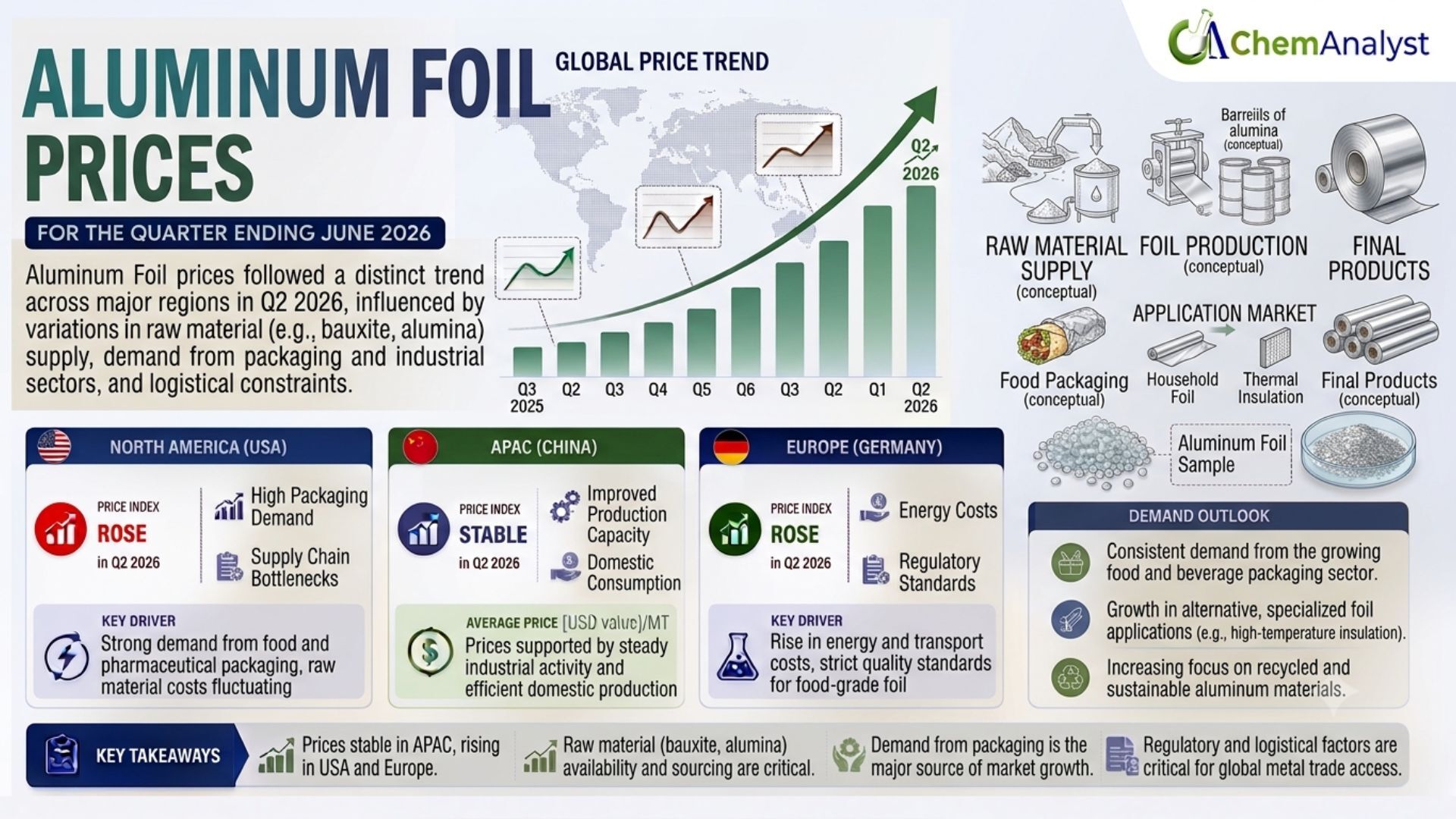
According to ChemAnalyst, the Aluminum Foil prices moved upward across the major markets during the quarter ending June 2026, supported by higher production costs, robust downstream demand, rising alumina expenses, constrained supply and elevated industrial electricity prices. The market experienced a broadly firm pricing environment in North America, Asia Pacific and Europe, although the underlying drivers varied between regions.
Aluminum foil is an important value-added aluminum product used across food packaging, pharmaceuticals, household applications, electronics, insulation, construction and industrial sectors. Its combination of lightweight characteristics, barrier properties, flexibility, thermal conductivity and recyclability makes it an important material across numerous end-use industries.
During Q2 2026, rising manufacturing costs emerged as a major influence on Aluminum Foil prices. In the United States, higher producer-level inflation and robust demand supported an increase in the price index. China experienced higher production costs alongside rising alumina expenses, while Germany faced elevated industrial electricity prices and constrained supply.
Aluminum Foil Prices in North America
In the United States, the Aluminum Foil Price Index rose during Q2 2026, driven by rising production costs and robust demand.
Aluminum Foil production costs increased during the quarter, influenced by a 6.5% year-over-year rise in the Producer Price Index (PPI) in May 2026.
The increase in producer-level inflation indicates a broader rise in prices across the production economy. For aluminum foil manufacturers, higher producer costs can affect multiple components of the manufacturing process, including energy, processing, transportation, labor and other industrial inputs.
Robust demand provided an additional source of support. Aluminum foil is consumed extensively by the packaging, food processing, pharmaceutical and industrial sectors. Packaging remains a particularly important application because aluminum foil provides effective barriers against light, moisture, oxygen and other external influences.
When downstream demand remains strong while production costs are increasing, producers have greater scope to pass higher costs through the supply chain. This dynamic contributed to the upward movement in the US Aluminum Foil Price Index during Q2 2026.
The market therefore experienced both cost-push and demand-side support. Higher production expenses raised the cost base for manufacturers, while robust purchasing requirements helped sustain market prices.
Get Real Time Online for Aluminum Foil Prices: https://www.chemanalyst.com/Pricing-data/aluminum-foil-2516
Aluminum Foil Prices in APAC
China recorded a quarter-over-quarter increase in the Aluminum Foil Price Index during Q2 2026, driven by rising production costs.
The average Aluminium Foil price for the quarter was approximately USD 6050/MT FOB China.
Production costs increased during Q2 2026, influenced by a 4.1% PPI rise in June 2026 and rising alumina costs.
Alumina is a critical upstream material in the aluminum production chain, making changes in alumina prices an important consideration for aluminum-related products. Higher alumina costs can increase upstream production expenses and eventually place pressure on downstream aluminum product prices.
The increase in China's producer-level inflation further reinforced the cost-side pressure. A 4.1% year-over-year PPI increase in June indicated a firm factory-gate pricing environment toward the end of the quarter.
China's extensive aluminum production and processing industry also makes domestic cost movements relevant to international foil markets. Changes in raw material costs, energy expenses and manufacturing economics can influence both domestic transactions and export offers.
The combination of rising production costs and higher alumina expenses therefore supported an increase in Aluminum Foil prices during Q2 2026. The average price of USD 6050/MT FOB China provides a reference point for the quarter and reflects the firmer cost environment faced by producers.
Aluminum Foil Prices in Europe
Germany's Aluminum Foil Price Index rose during Q2 2026, driven by increased production costs and constrained supply.
Production costs increased during the quarter due to elevated industrial electricity prices in Germany.
Energy represents an important component of aluminum processing costs because aluminum production and downstream conversion require substantial electricity. Higher industrial electricity prices can therefore increase the cost of producing and processing aluminum products, including foil.
The impact of elevated electricity costs was compounded by constrained supply. When material availability becomes tighter while production costs are rising, suppliers may face greater pressure to increase offers. Buyers, meanwhile, may become more focused on securing sufficient material, particularly when foil is required for continuous manufacturing and packaging operations.
Germany's industrial economy provides demand across multiple aluminum-consuming sectors. Packaging, pharmaceuticals, electrical applications, automotive components, construction materials and industrial products can all contribute to demand for aluminum foil and related products.
The Q2 2026 German market consequently experienced upward price pressure from both sides of the market. Higher electricity expenses increased production costs, while constrained supply limited material availability.
Book A Demo for Aluminum Foil Price: https://www.chemanalyst.com/ChemAnalyst/PricingForm?Product=Aluminum%20Foil
Key Factors Influencing Aluminum Foil Prices in Q2 2026
Several interconnected factors shaped Aluminum Foil prices during the quarter ending June 2026.
Production Costs
Higher production costs were a common factor across all three assessed markets. The United States experienced broader producer-level inflation, China faced higher PPI and alumina costs and Germany encountered elevated industrial electricity prices.
When production costs rise, manufacturers generally face pressure to protect operating margins. This can result in higher offers, particularly when downstream demand remains sufficiently strong.
Alumina Costs
Rising alumina costs were particularly important in China. Since alumina is a key upstream component in the aluminum production chain, changes in its cost can influence the economics of aluminum production and downstream products.
The increase in alumina expenses added another layer of cost pressure to China's Aluminum Foil market during Q2 2026.
Industrial Electricity Prices
Germany's market demonstrated the importance of electricity costs. Aluminum production and processing are energy-intensive activities, meaning industrial electricity prices can have a meaningful influence on manufacturing economics.
Elevated electricity prices during Q2 increased the production cost burden for German manufacturers and contributed to the upward movement in Aluminum Foil prices.
Robust Downstream Demand
Strong demand supported the US market during Q2 2026. Aluminum foil's wide range of applications provides a diversified demand base, reducing dependence on any single industry.
Food packaging, pharmaceutical packaging, household foil, electronics, insulation and industrial applications all contribute to overall consumption.
Supply Constraints
Constrained supply was an important factor in Germany. When supply becomes less readily available, buyers may increase procurement efforts to secure material, creating additional upward pressure on market prices.
Aluminum Foil Demand Outlook
The demand outlook for Aluminum Foil remains closely connected with the performance of packaging, food processing, pharmaceuticals, electronics, construction and industrial manufacturing.
Packaging represents a particularly important demand segment because aluminum foil offers a combination of barrier protection, lightweight characteristics and flexibility. Growth in packaged food and pharmaceutical products can therefore support continued foil consumption.
Pharmaceutical packaging is another important application. Aluminum foil is used in packaging formats where protection from moisture, light, oxygen and contamination is important. Continued pharmaceutical production can therefore provide stable demand.
Industrial and electronics applications can also contribute to consumption. Aluminum foil's thermal and electrical characteristics make it useful in specialized applications beyond conventional packaging.
Future demand will depend on manufacturing activity, consumer goods production, packaging requirements, pharmaceutical output and inventory strategies among downstream buyers.
Aluminum Foil Supply Chain and Procurement Trends
Supply-chain conditions remained an important consideration for Aluminum Foil buyers during Q2 2026. Procurement costs are influenced not only by the base foil price but also by upstream aluminum and alumina costs, energy expenses, transportation, supply availability and regional market conditions.
China's experience demonstrates the importance of upstream raw materials. Rising alumina costs contributed to higher production expenses, while Germany's market highlighted the influence of industrial electricity prices.
In the United States, robust demand increased the ability of producers to pass higher costs through the supply chain. In Germany, constrained supply strengthened the impact of higher production costs.
For procurement teams, monitoring upstream aluminum and alumina conditions alongside energy prices and regional inventory levels can provide useful signals regarding future Aluminum Foil price movements.
Regional Aluminum Foil Market Dynamics
The Q2 2026 market showed a broadly positive price direction across the assessed regions, although each market was influenced by different combinations of cost and demand factors.
The United States experienced higher prices because of rising production costs and robust demand. The 6.5% year-over-year PPI increase in May 2026 provided evidence of the broader producer-cost pressure affecting the market.
China's Aluminum Foil Price Index also increased quarter-over-quarter. Its market was influenced by rising production costs, a 4.1% PPI increase in June 2026 and rising alumina costs. The average Aluminium Foil price stood at approximately USD 6050/MT FOB China during Q2 2026.
Germany also experienced an upward price movement. Elevated industrial electricity prices increased production costs, while constrained supply provided additional support to market values.
These regional differences demonstrate that Aluminum Foil prices are influenced by a combination of global aluminum fundamentals and market-specific factors.
Aluminum Foil Market Outlook for the Second Half of 2026
The Aluminum Foil market entered the second half of 2026 with a firm price environment. Production costs remain a key factor to monitor, particularly in markets where energy and upstream material expenses are elevated.
In the United States, continued robust demand could support prices if production costs remain high. However, any moderation in industrial inflation or weakening in downstream demand could reduce upward pressure.
In China, alumina costs and producer-level inflation will remain important indicators. If upstream costs remain elevated, foil producers may continue facing pressure to maintain higher selling prices.
Germany's outlook will depend on the balance between industrial electricity costs, supply availability and downstream demand. Persistent supply constraints could maintain upward pressure, while improved availability could moderate price growth.
The broader outlook will therefore depend on whether cost pressures remain stronger than changes in demand. A combination of elevated production expenses and robust consumption would provide the strongest support for higher Aluminum Foil prices.
Conclusion
Aluminum Foil prices moved higher across major markets during the quarter ending June 2026. The United States experienced an increase in its Aluminum Foil Price Index, supported by rising production costs and robust demand. Production costs were influenced by a 6.5% year-over-year increase in PPI in May 2026.
China also recorded a quarter-over-quarter increase, with rising production costs, a 4.1% PPI increase in June 2026 and higher alumina costs supporting the market. The average Aluminium Foil price during the quarter was approximately USD 6050/MT FOB China.
Germany experienced upward price movement because of increased production costs and constrained supply. Elevated industrial electricity prices increased the cost burden for aluminum foil producers and contributed to a firmer market.
Overall, the Q2 2026 Aluminum Foil market was shaped by production-cost inflation, alumina expenses, energy prices, robust downstream demand and supply availability. Going forward, aluminum and alumina costs, industrial electricity prices, manufacturing activity, inventory levels and packaging demand will remain the key factors influencing Aluminum Foil Prices during the second half of 2026.
ChemAnalsyt
Call +1 3322586602
420 Lexington Avenue, Suite 300, New York, NY, United States, 10170
Website: https://www.chemanalyst.com/
Email: sales@chemanalyst.com
この記事をシェア





