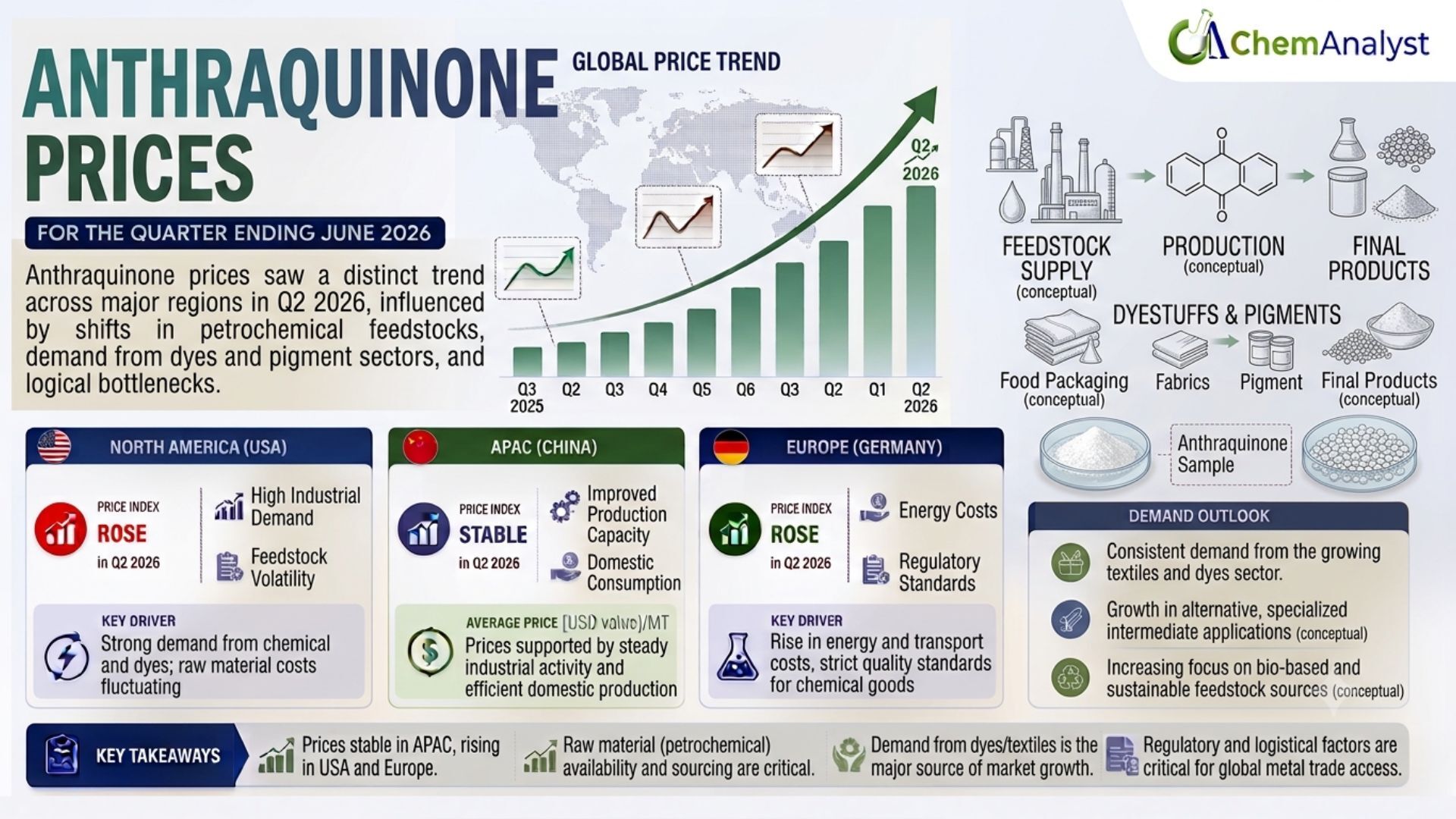
According to ChemAnalyst, the Anthraquinone prices followed divergent regional trends during the quarter ending June 2026. While China experienced a decline in its Anthraquinone Price Index because of weak domestic demand and excess supply, the United States and Germany recorded upward movements. The contrasting market conditions demonstrate how regional supply-demand balances and producer-cost inflation can have different effects on Anthraquinone prices.
Anthraquinone is an aromatic organic compound used in several industrial and chemical applications, including dyes and pigments, specialty chemical synthesis and pulp and paper-related processes. Its role as an intermediate means that market conditions across downstream industries can influence purchasing activity and pricing.
During Q2 2026, China's market was characterized by excess availability and subdued domestic consumption, creating downward pressure on prices. In contrast, elevated producer inflation in the United States and rising industrial production costs in Germany supported higher price levels.
Get Real Time Online for Anthraquinone Prices: https://www.chemanalyst.com/Pricing-data/anthraquinone-2325
Anthraquinone Prices in APAC
In China, the Anthraquinone Price Index fell quarter-over-quarter during Q2 2026, primarily because of weak domestic demand and excess supply.
The average Anthraquinone price for the quarter was approximately USD 6550/MT FOB China.
The Chinese market experienced a clear supply-demand imbalance during the quarter. When available supply exceeds immediate purchasing requirements, suppliers generally face greater competition for buyers. This can lead to lower offers as producers and traders attempt to maintain sales volumes and reduce inventories.
Weak domestic demand was therefore an important factor behind the decline. Lower purchasing activity from downstream consumers reduced the ability of suppliers to pass production costs through the market. Even if production expenses remain comparatively firm, subdued consumption can create downward pressure when material availability is high.
Excess supply further reinforced the bearish market conditions. Higher availability gives buyers greater choice and reduces procurement urgency. Buyers can postpone purchases, negotiate more aggressively, or compare offers from multiple suppliers when inventories are sufficient.
The average price of USD 6550/MT FOB China reflects the prevailing market conditions during Q2 2026. The quarter-over-quarter decline indicates that demand-side weakness and excess material outweighed potential cost-related support.
The Chinese market therefore remained under pressure despite Anthraquinone's established role in several downstream chemical applications.
Anthraquinone Prices in North America
In the United States, the Anthraquinone Price Index rose quarter-over-quarter during Q2 2026, driven by elevated producer inflation.
Anthraquinone production costs increased during the quarter, influenced by a 5.5% rise in producer prices in June 2026.
The increase in producer prices indicates a broader inflationary environment at the manufacturing level. Higher producer prices can affect chemical manufacturers through increased expenses associated with production, industrial services, energy, logistics and other operating inputs.
For Anthraquinone producers and suppliers, higher production costs can place pressure on margins. When downstream demand is sufficiently stable, producers may seek to recover these additional expenses through higher selling prices.
The US market therefore demonstrated a cost-driven pricing dynamic during Q2 2026. Unlike China, where excess supply and weak domestic demand dominated market direction, the United States experienced stronger upward pressure from producer-level inflation.
Demand from downstream chemical applications also remains relevant. Anthraquinone's use in specialty chemical processes, dyes, pigments and other industrial applications provides a foundation for recurring consumption. Stable purchasing requirements can help suppliers implement cost-based price adjustments.
The quarter's upward movement consequently reflected the interaction between production economics and market demand, with elevated producer inflation providing the principal support for higher Anthraquinone prices.
Anthraquinone Prices in Europe
Germany's Anthraquinone Price Index rose during Q2 2026, driven by rising production costs.
Anthraquinone production costs increased during the quarter, with producer prices for industrial products rising 2.2% in May 2026.
The increase in industrial producer prices created additional cost pressure for chemical manufacturers. Producer prices are an important indicator of industrial pricing conditions because they can capture changes in the costs and selling values associated with manufactured goods.
Germany's chemical industry is integrated with a broad industrial ecosystem, meaning changes in industrial production costs can influence specialty chemical economics. Higher costs for industrial inputs and associated manufacturing activities can eventually be reflected in chemical selling prices.
The 2.2% increase in producer prices for industrial products in May 2026 therefore contributed to the firmer Anthraquinone market environment.
Unlike China, Germany did not experience the same combination of excess supply and weak domestic demand described in the APAC market. Instead, rising production costs provided upward pressure on pricing.
The German market illustrates how cost inflation can influence specialty chemical prices even when demand conditions are not experiencing a major surge. When producers face higher expenses, maintaining sustainable margins may require adjustments to selling prices.
Book A Demo for Anthraquinone Price: https://www.chemanalyst.com/ChemAnalyst/PricingForm?Product=Anthraquinone
Key Factors Influencing Anthraquinone Prices in Q2 2026
Several factors contributed to regional movements in Anthraquinone prices during Q2 2026.
Supply-Demand Balance
Supply and demand remained the most important differentiating factors across the assessed markets. China experienced excess supply alongside weak domestic demand, creating downward pressure. The resulting imbalance allowed buyers to negotiate from a stronger position.
In the United States and Germany, cost-side factors had a greater influence on price direction.
Producer Inflation
Producer-level inflation supported price increases in the United States. Producer prices rose 5.5% in June 2026, increasing pressure on chemical production costs.
When producer inflation remains elevated, manufacturers may seek to pass a portion of the additional cost burden through their selling prices, particularly when demand remains sufficiently stable.
Industrial Production Costs
Germany experienced higher Anthraquinone prices because of rising production costs. Producer prices for industrial products increased 2.2% in May 2026, contributing to a firmer manufacturing cost environment.
The relationship between industrial producer prices and specialty chemical pricing can be particularly relevant when chemical manufacturers depend on energy, industrial services, transportation and other cost-intensive inputs.
Domestic Demand
Weak domestic demand was a major factor behind China's price decline. Lower consumption reduces purchasing urgency and can leave producers with higher inventories.
When suppliers compete for limited orders in an oversupplied market, prices can weaken even if production costs remain stable.
Excess Supply
Excess supply further contributed to the decline in China's Anthraquinone Price Index. Greater availability gives buyers more sourcing options and can encourage suppliers to offer competitive prices to secure sales.
Anthraquinone Demand Outlook
The demand outlook for Anthraquinone remains closely connected with its downstream industrial applications. Consumption can be influenced by activity in dyes and pigments, specialty chemical manufacturing and other industries that use Anthraquinone or its derivatives.
China's demand outlook will depend on whether domestic industrial activity strengthens enough to absorb existing supply. A recovery in purchasing activity could gradually reduce excess inventories and provide support to prices. Conversely, continued weak consumption could keep the market under pressure.
In the United States and Europe, demand will remain an important factor in determining whether higher production costs can continue to be passed through to buyers. Stable downstream consumption would provide suppliers with greater pricing flexibility, while weakening industrial demand could limit cost pass-through.
Inventory conditions will also remain important. High inventories can reduce purchasing urgency, whereas tighter stocks may encourage restocking and strengthen demand.
Anthraquinone Supply Chain and Procurement Trends
The Q2 2026 market highlights the importance of supply-chain management in determining Anthraquinone prices. Buyers need to consider not only the quoted chemical price but also regional availability, inventory levels, production economics, freight and procurement timing.
In China, excess supply gave buyers greater negotiating power. Procurement teams could compare multiple offers and potentially delay purchases when immediate requirements were limited.
In the United States and Germany, rising production costs created a different procurement environment. Buyers may face greater pressure to secure material before further cost increases are passed through the supply chain.
For procurement teams, monitoring regional supply-demand balances and producer-price indicators can provide useful signals about potential market changes. A combination of rising production costs and improving demand could strengthen prices, while oversupply and weak consumption could create continued downward pressure.
Regional Anthraquinone Market Dynamics
The Q2 2026 market showed a clear contrast between APAC, North America and Europe.
China recorded a quarter-over-quarter decline in its Anthraquinone Price Index because of weak domestic demand and excess supply. The average price stood at approximately USD 6550/MT FOB China.
The United States experienced a quarter-over-quarter increase, supported by elevated producer inflation. Production costs were influenced by a 5.5% rise in producer prices in June 2026.
Germany also recorded an increase in the Anthraquinone Price Index. Rising production costs were supported by a 2.2% increase in producer prices for industrial products in May 2026.
These developments demonstrate that global Anthraquinone prices do not necessarily move uniformly. Regional market structures, supply availability, industrial activity and inflationary conditions can produce significantly different outcomes.
Anthraquinone Market Outlook for the Second Half of 2026
The Anthraquinone market entered the second half of 2026 with a mixed regional outlook.
In China, future price direction will depend heavily on the balance between domestic demand and available supply. If downstream consumption improves and excess inventories decline, prices could stabilize or recover. However, persistent oversupply could continue to weigh on market values.
In the United States, producer inflation will remain an important factor. Continued increases in production costs could provide further support to Anthraquinone prices, provided downstream demand remains sufficiently stable.
Germany's outlook will similarly depend on industrial cost conditions. If producer prices remain elevated, chemical manufacturers could continue facing cost pressures. However, weaker industrial activity could restrict the ability to pass those costs fully through the supply chain.
Overall, supply-demand conditions in China and producer-cost trends in the United States and Germany will remain key indicators for the direction of global Anthraquinone prices.
Conclusion
Anthraquinone prices followed divergent regional trends during the quarter ending June 2026. China experienced a decline in its Anthraquinone Price Index because of weak domestic demand and excess supply, with the average price reaching approximately USD 6550/MT FOB China.
The United States recorded a quarter-over-quarter increase, supported by elevated producer inflation. Anthraquinone production costs increased alongside a 5.5% rise in producer prices in June 2026.
Germany also experienced an upward movement in its Anthraquinone Price Index as production costs increased. Producer prices for industrial products rose 2.2% in May 2026, adding cost pressure to the market.
Overall, Q2 2026 demonstrated the contrasting influence of supply-demand conditions and producer inflation on Anthraquinone prices. Oversupply and weak consumption weighed on the Chinese market, while rising production costs supported prices in the United States and Germany. Going forward, domestic demand, inventory levels, supply availability, producer inflation and industrial activity will remain the key factors shaping Anthraquinone Prices during the second half of 2026.
ChemAnalsyt
Call +1 3322586602
420 Lexington Avenue, Suite 300, New York, NY, United States, 10170
Website: https://www.chemanalyst.com/
Email: sales@chemanalyst.com
この記事をシェア





