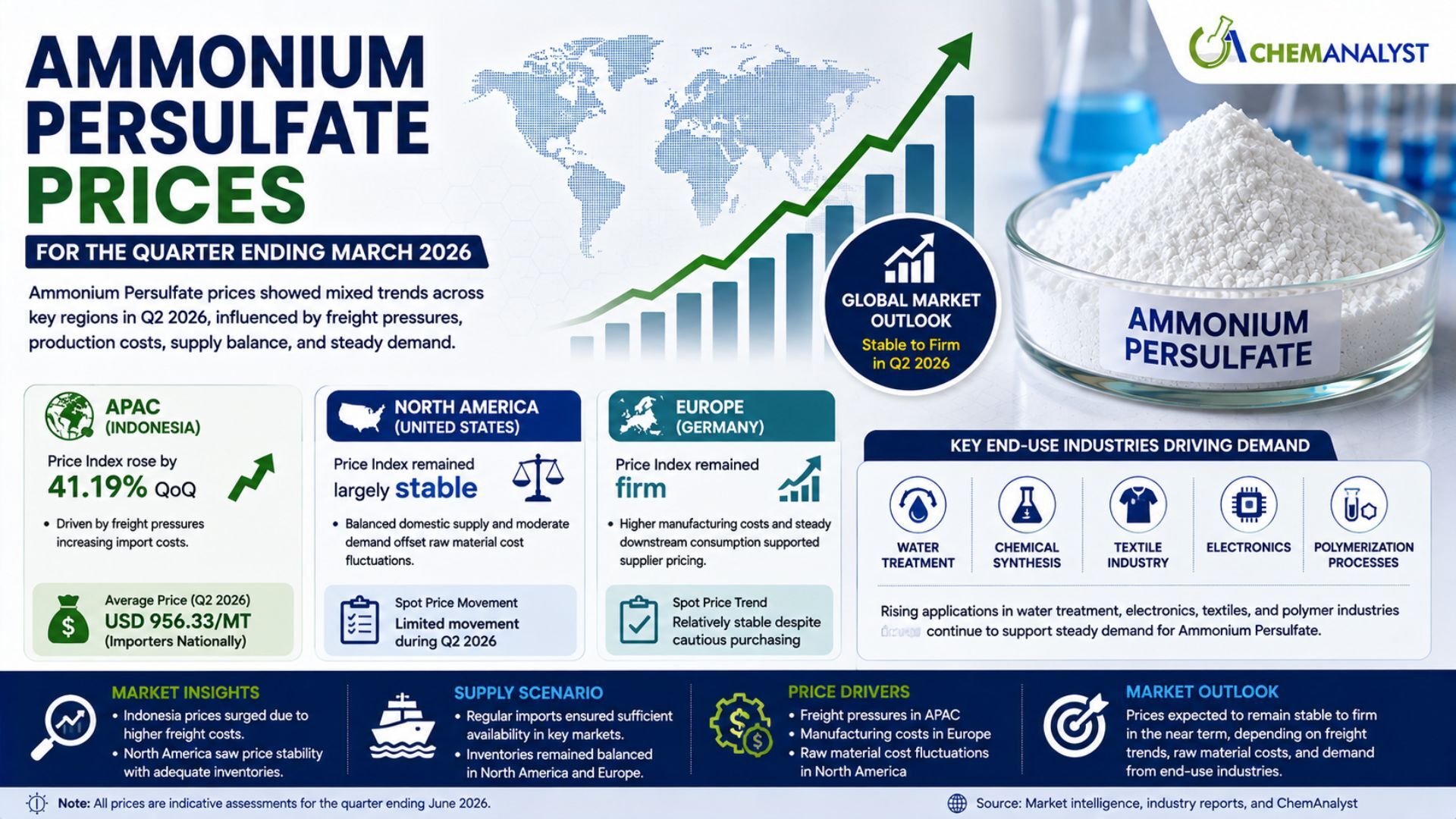
According to ChemAnalyst, the global Ammonium Persulfate prices market showed divergent regional trends during the quarter ending June 2026. While the APAC market experienced a sharp increase, North America remained largely stable and Europe maintained a firm but relatively steady pricing environment. Freight costs, manufacturing expenses, downstream consumption, inventory availability and import flows were among the key factors shaping market conditions during Q2 2026.
Ammonium Persulfate is an inorganic compound widely used as an oxidizing agent and initiator across several industrial applications. It finds use in polymerization processes, chemical manufacturing, electronics, water treatment, textiles and other specialized industrial applications. As a result, its market dynamics are influenced by industrial activity, raw-material costs, transportation expenses and the balance between supply and demand.
In Indonesia, the Ammonium Persulfate Price Index rose by 41.19% quarter-over-quarter during Q2 2026, primarily due to freight pressures. The average Ammonium Persulfate price for the quarter was approximately USD 956.33/MT for importers nationally.
In North America, the Ammonium Persulfate Price Index remained largely stable during Q2 2026. Balanced domestic supply and moderate downstream demand offset fluctuations in raw-material costs. Adequate inventories and regular imports also limited significant price movement.
The European market remained firm during Q2 2026. Higher manufacturing costs and stable downstream consumption supported supplier pricing, while balanced inventories and regular import availability prevented substantial spot-market volatility.
Overall, the Q2 2026 market demonstrated a clear regional divergence, with freight pressure dominating the APAC market while supply-demand balance and inventory availability helped stabilize prices in North America and Europe.
Ammonium Persulfate Prices in APAC
The Asia-Pacific Ammonium Persulfate market recorded the strongest price movement among the assessed regions during Q2 2026. In Indonesia, the Ammonium Persulfate Price Index rose by 41.19% quarter-over-quarter, driven primarily by freight pressures.
The average Ammonium Persulfate price for the quarter was approximately USD 956.33/MT for importers nationally.
Freight costs can have a substantial impact on imported chemical products because transportation expenses form an important component of landed costs. When freight rates increase, importers may face higher overall procurement expenses even when the underlying product price remains relatively unchanged.
The sharp increase in Indonesia's Price Index therefore reflected the impact of transportation-related costs on the delivered market. Importers faced higher expenses as freight pressures increased the cost of bringing material into the country.
Import-dependent markets are particularly sensitive to changes in logistics costs. The availability of imported material, shipping rates, insurance expenses, port charges and delivery conditions can collectively affect the final price paid by buyers.
During Q2 2026, the strong increase in the Indonesian Ammonium Persulfate Price Index highlighted the importance of freight economics in determining regional pricing.
For buyers, the market environment emphasized the need for effective procurement planning. Importers may need to consider transportation conditions alongside supplier quotations when evaluating total procurement costs.
The APAC Ammonium Persulfate price trend was therefore strongly upward during Q2 2026, with freight pressures serving as the principal factor behind the increase in Indonesia.
Get Real Time Online for Ammonium Persulfate Prices: https://www.chemanalyst.com/Pricing-data/ammonium-persulfate-3094
Ammonium Persulfate Prices in North America
The North American Ammonium Persulfate market remained comparatively stable during Q2 2026. The Ammonium Persulfate Price Index remained largely stable, as balanced domestic supply and moderate downstream demand offset fluctuations in raw-material costs.
The stability of the market was also reflected in spot prices. The Ammonium Persulfate Spot Price showed limited movement through the quarter, supported by adequate inventories and regular imports.
Balanced supply conditions can reduce the impact of short-term cost fluctuations. When buyers have sufficient access to material and suppliers maintain adequate inventories, there is less urgency to secure additional volumes at significantly higher prices.
Moderate downstream demand also contributed to the stable market environment. While downstream industries continued to consume Ammonium Persulfate, demand was not strong enough to create significant supply pressure.
Regular imports provided another stabilizing factor. Consistent material inflows helped maintain market availability and reduced the possibility of supply shortages.
The North American market therefore demonstrated how supply-demand balance and inventory availability can counteract fluctuations in raw-material costs.
For procurement teams, the stable market environment allowed buyers to maintain more predictable purchasing strategies. Rather than responding to rapid price increases, buyers could continue sourcing material according to normal consumption requirements.
Overall, the Ammonium Persulfate price trend in North America remained stable during Q2 2026, supported by balanced supply, moderate demand, adequate inventories and regular imports.
Ammonium Persulfate Prices in Europe
The European Ammonium Persulfate market remained firm during Q2 2026. The Ammonium Persulfate Price Index remained firm, supported by higher manufacturing costs and stable downstream consumption.
Higher manufacturing costs provided suppliers with support for maintaining their pricing levels. When production expenses increase, manufacturers may seek to preserve margins through firm selling prices, particularly when downstream demand remains stable.
Despite cautious purchasing activity, the European Ammonium Persulfate Spot Price stayed relatively stable during the quarter. Balanced inventories and regular import availability helped prevent significant price fluctuations.
Cautious procurement means buyers may avoid building excessive inventories and instead purchase according to immediate or near-term requirements. Such purchasing behavior can limit sudden demand-driven price increases.
However, stable downstream consumption provided a foundation for the firm market environment. Regular consumption from industrial users helped maintain baseline demand even while buyers remained cautious.
The availability of imports also contributed to market stability. Regular import flows ensured that buyers continued to have access to material, reducing the possibility of acute supply shortages.
The European market consequently remained firm but relatively stable. Higher manufacturing costs supported supplier pricing, while balanced inventories and regular imports limited excessive spot-market volatility.
Book A Demo for Ammonium Persulfate Price: https://www.chemanalyst.com/ChemAnalyst/PricingForm?Product=Ammonium%20Persulfate
Key Factors Influencing Ammonium Persulfate Prices
Several factors influenced Ammonium Persulfate prices across regional markets during Q2 2026.
Freight Costs
Freight pressures were the dominant factor in Indonesia. The 41.19% quarter-over-quarter increase in the Indonesian Price Index demonstrated the significant influence of transportation costs on imported chemical prices.
Higher freight expenses can increase landed costs for importers and subsequently affect market quotations.
Manufacturing Costs
Manufacturing costs were an important factor in Europe. Higher production expenses supported firm supplier pricing and limited downward price pressure.
Raw-Material Costs
Fluctuations in raw-material costs influenced the North American market, although balanced supply and moderate demand offset their impact on overall prices.
Inventory Levels
Inventory availability played an important stabilizing role in North America and Europe. Adequate inventories reduced the likelihood of supply-driven price spikes.
Import Availability
Regular imports supported market stability in both North America and Europe. Consistent inflows helped ensure that buyers had adequate access to material.
Downstream Demand
Downstream consumption remained moderate in North America and stable in Europe. These demand conditions helped create relatively balanced markets during Q2 2026.
Ammonium Persulfate Demand Analysis
Demand for Ammonium Persulfate is connected to its use across chemical, polymer, electronics, textile, water-treatment and other industrial applications. Changes in industrial activity can therefore influence procurement requirements.
In North America, moderate downstream demand contributed to market stability. Buyers continued to purchase material, but demand was not strong enough to create significant supply pressure.
In Europe, stable downstream consumption supported firm supplier pricing. Although purchasing remained cautious, regular consumption helped maintain the underlying market balance.
The APAC market was more strongly influenced by freight costs than by the demand conditions described in the supplied assessment. The substantial increase in Indonesia's Price Index primarily reflected higher transportation-related pressure.
The relationship between demand and available supply remains important for the future market. Strong downstream consumption combined with limited availability could provide additional support to prices, while weaker demand and comfortable inventories could moderate price momentum.
Ammonium Persulfate Production Cost Trend
The Ammonium Persulfate production cost trend varied across the three major regions during Q2 2026.
In North America, fluctuations in raw-material costs were observed, but balanced domestic supply and moderate downstream demand helped offset their impact on market prices.
In Europe, higher manufacturing costs supported firm supplier pricing. Producers faced increased cost pressure while downstream consumption remained stable.
In Indonesia, freight pressures rather than manufacturing costs were the dominant factor behind the sharp increase in the Price Index. For importers, transportation expenses directly influenced the overall landed cost of Ammonium Persulfate.
The regional differences demonstrate that production costs are only one component of the final market price. Logistics, imports, inventories and downstream demand can also significantly influence delivered pricing.
Ammonium Persulfate Supply Analysis
Supply conditions remained relatively comfortable in North America and Europe during Q2 2026.
In North America, balanced domestic supply and regular imports ensured sufficient market availability. Adequate inventories further reduced the risk of short-term shortages.
Europe similarly benefited from balanced inventories and regular import availability. These conditions helped keep spot prices relatively stable despite firm supplier pricing.
Indonesia presented a different market situation because freight pressures significantly increased the cost of imported material. Even when physical availability is adequate, higher logistics costs can raise the price paid by importers.
The supply outlook will therefore depend not only on production capacity but also on transportation conditions, import flows, inventories and regional purchasing patterns.
Regional Ammonium Persulfate Price Comparison
The Q2 2026 market displayed different pricing patterns across the assessed regions.
In Indonesia, the Ammonium Persulfate Price Index increased by 41.19% quarter-over-quarter, driven by freight pressures. The average price was approximately USD 956.33/MT for importers nationally.
In North America, the Ammonium Persulfate Price Index remained largely stable. Balanced domestic supply and moderate downstream demand offset raw-material cost fluctuations. Adequate inventories and regular imports also kept spot prices relatively stable.
In Europe, the Price Index remained firm due to higher manufacturing costs and stable downstream consumption. The Ammonium Persulfate Spot Price stayed relatively stable as balanced inventories and regular imports supported market availability.
The comparison shows that logistics were particularly influential in APAC, while supply-demand balance and manufacturing costs were more important in North America and Europe.
Ammonium Persulfate Market Outlook
The outlook for Ammonium Persulfate prices will depend on freight conditions, manufacturing costs, raw-material expenses, inventory levels, imports and downstream demand.
In APAC, freight costs will remain an important consideration for importers. Any continued increase in transportation expenses could keep landed prices elevated.
In North America, balanced supply and moderate demand could continue supporting stable market conditions. Adequate inventories and regular imports may limit substantial price fluctuations unless there is a major change in raw-material or demand conditions.
In Europe, higher manufacturing costs could continue supporting firm supplier pricing. However, regular imports and balanced inventories could prevent significant spot-price increases.
Procurement strategies will therefore remain region-specific, with importers in freight-sensitive markets paying particular attention to logistics costs and buyers in stable markets focusing on inventory and demand conditions.
Ammonium Persulfate Price Trend Forecast
The Ammonium Persulfate price trend forecast remains dependent on the evolution of logistics, supply, demand and production economics.
In Indonesia and the wider APAC import market, freight rates will be a critical indicator. Continued freight pressure could maintain upward pricing momentum, while easing logistics costs could reduce some of the landed-cost pressure.
In North America, the market may remain relatively stable if domestic supply, imports, inventories and downstream demand continue to remain balanced. Changes in raw-material costs could influence the market, but sufficient availability may limit their effect.
In Europe, firm supplier pricing could continue if manufacturing costs remain elevated. At the same time, regular imports and balanced inventories could keep spot-market movements relatively contained.
Future price direction will ultimately depend on whether cost pressures translate into tighter supply or are absorbed by producers and offset by comfortable inventories.
Conclusion
The global Ammonium Persulfate prices market displayed divergent regional conditions during Q2 2026. APAC experienced a significant increase, North America remained largely stable and Europe maintained a firm but relatively steady market.
In Indonesia, the Ammonium Persulfate Price Index rose by 41.19% quarter-over-quarter, primarily due to freight pressures. The average Ammonium Persulfate price for the quarter was approximately USD 956.33/MT for importers nationally.
In North America, the Price Index remained largely stable as balanced domestic supply and moderate downstream demand offset fluctuations in raw-material costs. Adequate inventories and regular imports ensured sufficient availability, limiting movement in the Ammonium Persulfate Spot Price.
In Europe, the Price Index remained firm as higher manufacturing costs and stable downstream consumption supported supplier pricing. Despite cautious purchasing, balanced inventories and regular import availability kept the Ammonium Persulfate Spot Price relatively stable.
Overall, Q2 2026 demonstrated the importance of regional supply-demand conditions, freight costs, manufacturing expenses, inventory levels and import availability in shaping the global Ammonium Persulfate price trend. Going forward, market participants will need to monitor freight rates, raw-material costs, production economics, downstream consumption and inventory positions to assess future price movements.
ChemAnalsyt
Call +1 3322586602
420 Lexington Avenue, Suite 300, New York, NY, United States, 10170
Website: https://www.chemanalyst.com/
Email: sales@chemanalyst.com
この記事をシェア





