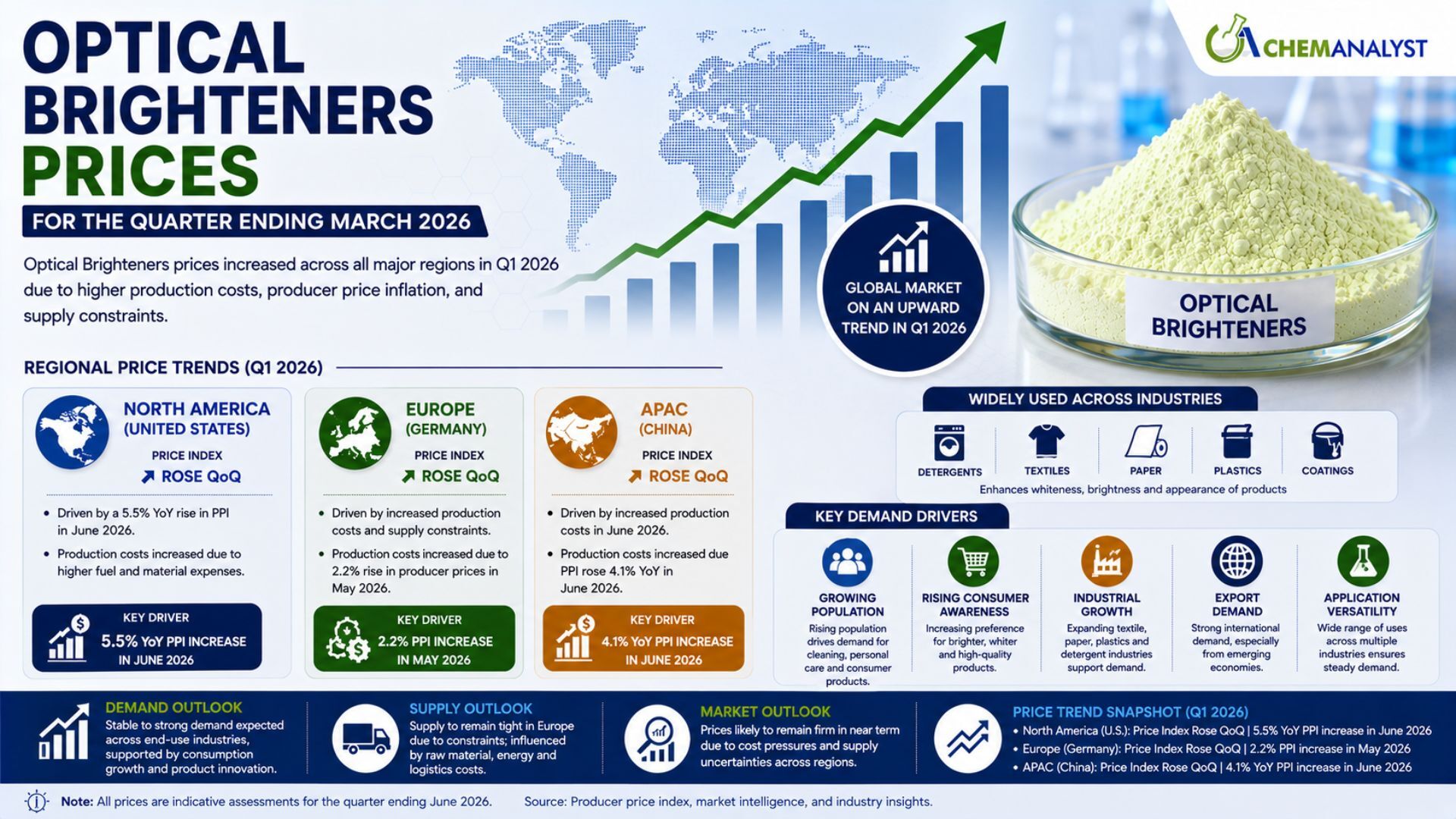
According to ChemAnalyst, the global Optical Brighteners prices market recorded an upward trend across North America, Europe and Asia-Pacific during the quarter ending June 2026. Rising production costs, higher material and fuel expenses, producer price inflation and supply constraints contributed to a firmer pricing environment across the major regional markets.
Optical brighteners, also known as fluorescent whitening agents, are widely used in detergents, textiles, paper, plastics, coatings and other industrial applications. These materials improve the perceived brightness and whiteness of products by absorbing ultraviolet light and re-emitting it as visible blue light. Their demand is therefore closely connected to activity across consumer goods and industrial manufacturing sectors.
During Q2 2026, the United States recorded an increase in the Optical Brighteners Price Index, supported by a 5.5% year-over-year rise in PPI in June 2026. Higher fuel and material expenses also contributed to increased production costs.
In Germany, the Optical Brighteners Price Index rose during the quarter, driven by increased production costs and supply constraints. Producer prices increased by 2.2% in May 2026, adding pressure to manufacturing expenses.
China also recorded a quarter-over-quarter increase in the Optical Brighteners Price Index. The market was influenced by increased production costs, while China's PPI increased by 4.1% year-over-year in June 2026.
The synchronized upward movement across these major markets demonstrates the importance of production economics and supply availability in determining the global Optical Brighteners price trend during Q2 2026.
Optical Brighteners Prices in North America
The North American Optical Brighteners market experienced an upward movement during Q2 2026. In the United States, the Optical Brighteners Price Index rose in Q2 2026, driven by a 5.5% year-over-year increase in PPI in June 2026.
The increase in producer prices contributed to a higher overall production-cost environment for manufacturers. Optical brightener production requires various raw materials, processing inputs, energy and transportation resources, making producers sensitive to changes in industrial costs.
During the quarter, Optical Brighteners production costs increased due to higher fuel and material expenses. Rising fuel expenses can affect manufacturing and transportation costs, while higher material expenses can increase the overall cost of producing finished optical brightener products.
These cost pressures created a supportive environment for higher supplier quotations. When production costs rise, manufacturers may attempt to recover increased expenses through higher selling prices, particularly when market demand remains steady.
The U.S. market therefore experienced a firm Optical Brighteners price trend during Q2 2026. The combination of higher producer prices, increased fuel expenses and material-cost pressure contributed to the upward movement.
For buyers, the market environment emphasized the importance of procurement planning and inventory management. Manufacturers using optical brighteners in downstream applications needed to monitor supplier offers and production costs while determining purchasing volumes.
Get Real Time Online for Optical Brighteners Prices: https://www.chemanalyst.com/Pricing-data/optical-brighteners-2390
Optical Brighteners Prices in Europe
The European Optical Brighteners market also recorded an upward movement during Q2 2026. In Germany, the Optical Brighteners Price Index rose in Q2 2026, driven by increased production costs and supply constraints.
The European market faced additional cost pressure from producer-price inflation. Producer prices increased by 2.2% in May 2026, contributing to higher manufacturing expenses.
Supply constraints further supported the upward movement in prices. When supply becomes less readily available, buyers can face increased competition for available material. This can provide suppliers with greater pricing leverage, particularly when downstream procurement remains stable.
Higher production costs and supply constraints therefore worked together to create a firmer market environment in Germany.
The impact of producer-price inflation was particularly relevant for manufacturers because optical brightener production depends on industrial raw materials, energy and other production inputs. An increase in producer prices can affect the cost structure throughout the manufacturing process.
European buyers consequently remained sensitive to supply availability and supplier quotations during the quarter. Procurement strategies focused on maintaining sufficient material availability while managing the impact of higher costs.
Overall, the German Optical Brighteners price trend remained upward during Q2 2026, supported by increased production costs and tighter supply conditions.
Optical Brighteners Prices in APAC
The Asia-Pacific Optical Brighteners market also experienced an increase during Q2 2026. In China, the Optical Brighteners Price Index rose quarter-over-quarter, driven by increased production costs in June 2026.
The Chinese market was also influenced by producer-price inflation. China's PPI increased by 4.1% year-over-year in June 2026, contributing to a higher production-cost environment.
Rising producer prices can increase manufacturing expenses for chemical producers through higher costs associated with industrial inputs and production operations. This can subsequently affect supplier quotations and market prices.
China's role in the broader chemical supply chain also makes its production economics important for regional and international buyers. Changes in Chinese production costs can influence export quotations and the availability of material in overseas markets.
During Q2 2026, the increase in production costs therefore provided upward support to the Chinese Optical Brighteners market.
The APAC Optical Brighteners price trend remained firm as manufacturers adjusted to the changing cost environment. Buyers continued to monitor production conditions, supplier availability and market quotations when planning procurement.
Key Factors Influencing Optical Brighteners Prices
Several factors contributed to the upward movement in Optical Brighteners prices during Q2 2026.
Producer Price Inflation
Producer-price inflation was an important factor in all three assessed regions. The United States recorded a 5.5% year-over-year PPI increase in June 2026, while China's PPI increased by 4.1% year-over-year in June 2026. Germany recorded a 2.2% increase in producer prices in May 2026.
These increases contributed to a higher industrial production-cost environment.
Fuel Costs
In the United States, higher fuel expenses contributed to increased Optical Brighteners production costs. Fuel costs can affect both manufacturing operations and transportation, making them an important component of the overall supply chain.
Material Costs
Higher material expenses also contributed to production-cost increases in North America. Changes in raw-material pricing can directly affect manufacturer margins and supplier quotations.
Supply Constraints
Germany experienced supply constraints during Q2 2026. Reduced availability can create upward pressure on prices when buyer demand remains stable.
Production Costs
Higher production costs were a common theme across the United States, Germany and China. Rising costs created a supportive environment for firmer market quotations.
Book A Demo for Optical Brighteners Price: https://www.chemanalyst.com/ChemAnalyst/PricingForm?Product=Optical%20Brighteners
Optical Brighteners Demand Analysis
Demand for optical brighteners is linked to several downstream industries, including detergents, textiles, paper, plastics and coatings. These applications create a diversified demand base for manufacturers.
The textile industry uses optical brighteners to improve the visual whiteness and brightness of fabrics. Similarly, detergent manufacturers use fluorescent whitening agents to enhance the perceived brightness of washed textiles.
Paper manufacturing represents another important application area. Optical brighteners can be incorporated into paper products to improve their visual appearance.
Demand from these industries can influence procurement requirements and market conditions. When downstream production activity remains strong, buyers may maintain regular purchasing schedules, supporting market consumption.
During Q2 2026, the upward movement in Optical Brighteners prices was more closely associated with production-cost and supply-side factors in the supplied regional assessments. Nevertheless, stable downstream demand can amplify the impact of supply constraints by preventing inventories from building rapidly.
The balance between consumption and available supply will therefore remain an important factor in determining future Optical Brighteners price movements.
Optical Brighteners Production Cost Trend
The Optical Brighteners production cost trend remained upward during Q2 2026.
In the United States, higher fuel and material expenses increased production costs. The broader producer-price environment also strengthened, with PPI rising 5.5% year-over-year in June 2026.
In Germany, production costs increased amid a 2.2% rise in producer prices in May 2026. Supply constraints added another layer of pressure to the market.
In China, production costs increased as PPI rose 4.1% year-over-year in June 2026. The increase in producer prices contributed to higher manufacturing expenses and supported the upward movement in the Optical Brighteners Price Index.
The common pattern across the three regions was therefore higher production costs, although the individual factors varied by market.
Optical Brighteners Supply Trend
Supply conditions played a particularly important role in the European market during Q2 2026. Germany experienced supply constraints, which contributed to the increase in the Optical Brighteners Price Index.
In North America and APAC, the supplied market data primarily highlighted production-cost increases. However, production costs can also influence supply decisions because higher manufacturing expenses may affect producer margins and operating strategies.
For buyers, maintaining adequate inventories becomes particularly important when supply availability becomes uncertain. Procurement teams may need to monitor supplier lead times and market availability more closely during periods of cost inflation.
The global Optical Brighteners supply environment therefore remained sensitive to production costs, material availability and regional supply conditions during Q2 2026.
Regional Optical Brighteners Price Comparison
The Q2 2026 market showed an upward pricing direction across North America, Europe and APAC.
In the United States, the Optical Brighteners Price Index rose during Q2 2026. The increase was supported by a 5.5% year-over-year PPI rise in June 2026, while higher fuel and material expenses increased production costs.
In Germany, the Optical Brighteners Price Index also rose. Increased production costs and supply constraints supported the increase, while producer prices rose 2.2% in May 2026.
In China, the Optical Brighteners Price Index increased quarter-over-quarter. Higher production costs were the primary driver, while PPI increased 4.1% year-over-year in June 2026.
Although the specific drivers differed, all three regions experienced a firm market direction during Q2 2026.
Optical Brighteners Market Outlook
The outlook for Optical Brighteners prices will depend on production costs, raw-material expenses, fuel prices, supply availability and downstream demand.
In North America, future market conditions will remain sensitive to producer-price inflation and changes in fuel and material expenses. If production costs remain elevated, suppliers could maintain firm quotations.
In Europe, supply availability will remain an important factor. If supply constraints persist alongside steady downstream demand, prices could remain supported.
In China, producer-price movements and production costs will remain key indicators. The 4.1% year-over-year increase in PPI in June 2026 highlights the importance of the broader industrial cost environment.
Demand from textile, detergent, paper, plastics and other industries will also influence the market. Strong downstream procurement could provide additional support, while weaker purchasing activity could moderate price pressure.
Optical Brighteners Price Trend Forecast
The Optical Brighteners price trend forecast remains dependent on the balance between production costs and downstream demand.
In the United States, continued producer-price inflation or higher fuel and material costs could support firm market conditions. A moderation in these expenses could reduce cost pressure on producers.
In Germany, the future direction will depend on whether supply constraints ease. Improved availability could reduce upward price pressure, while continued tightness could support higher quotations.
In China, the direction of producer prices and manufacturing expenses will remain important. Persistent cost inflation could continue supporting the Optical Brighteners market.
Overall, the market is expected to remain sensitive to industrial cost indicators, supply availability and downstream procurement behavior.
Conclusion
The global Optical Brighteners prices market recorded an upward trend across North America, Europe and APAC during the quarter ending June 2026. Rising production costs were a common factor across all three markets, while regional supply conditions and industrial price movements further influenced market direction.
In the United States, the Optical Brighteners Price Index rose in Q2 2026, driven by a 5.5% year-over-year PPI increase in June 2026. Higher fuel and material expenses also contributed to increased production costs.
In Germany, the Optical Brighteners Price Index rose during Q2 2026 due to increased production costs and supply constraints. Producer prices increased by 2.2% in May 2026, adding pressure to manufacturers.
In China, the Optical Brighteners Price Index rose quarter-over-quarter, driven by increased production costs. The country's PPI increased by 4.1% year-over-year in June 2026, contributing to the higher cost environment.
Overall, Q2 2026 was characterized by firm Optical Brighteners price trends, with producer inflation, fuel expenses, material costs and supply constraints shaping market conditions. Going forward, buyers and suppliers will need to monitor production economics, supply availability, downstream demand and industrial price indicators to assess the direction of the global Optical Brighteners market.
ChemAnalsyt
Call +1 3322586602
420 Lexington Avenue, Suite 300, New York, NY, United States, 10170
Website: https://www.chemanalyst.com/
Email: sales@chemanalyst.com
この記事をシェア





