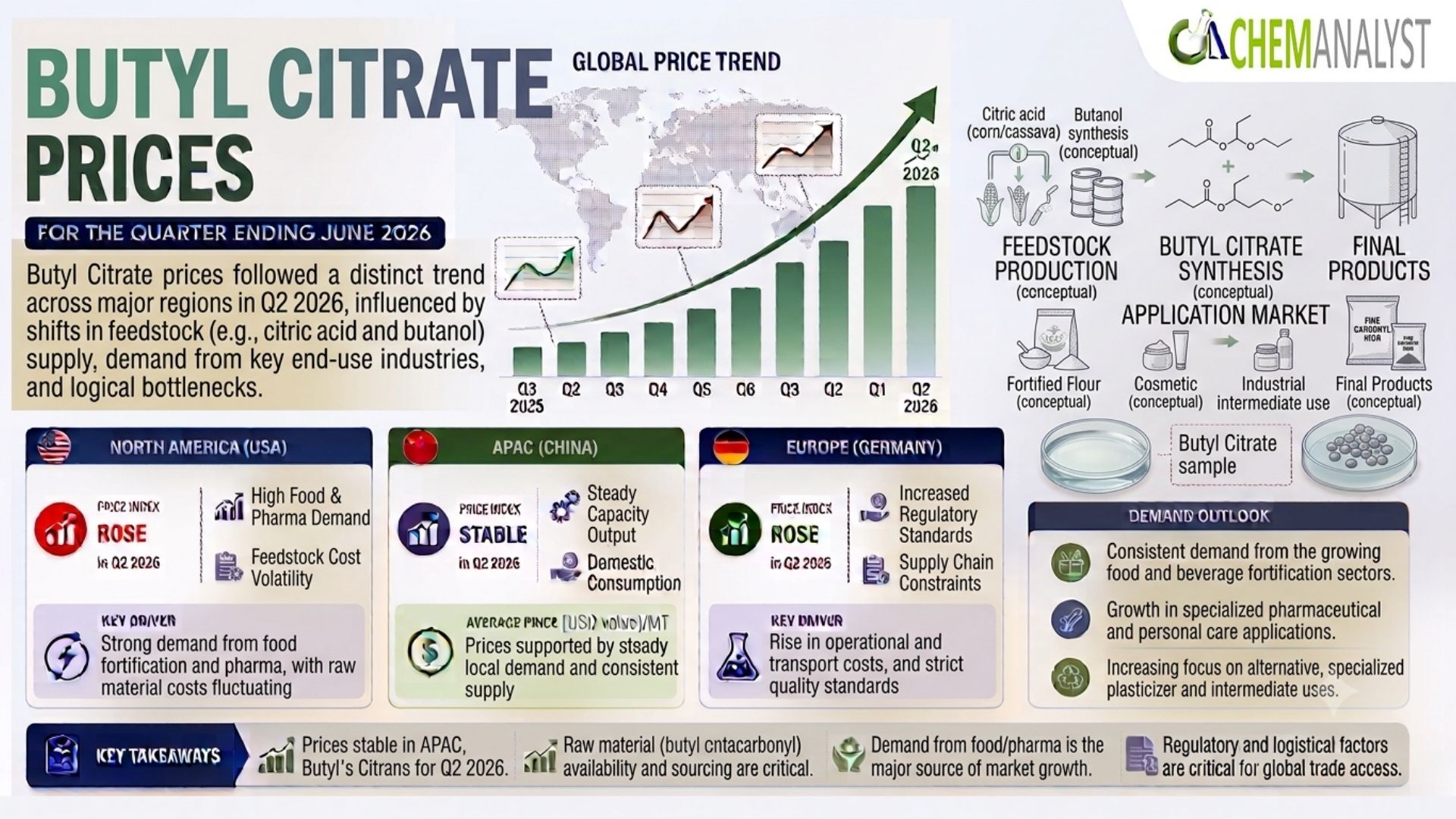
According to ChemAnalyst, the Butyl Citrate prices moved upward across the major assessed markets during the quarter ending June 2026. The United States, Germany and China all recorded quarter-over-quarter increases in their respective Butyl Citrate Price Indexes, with production costs emerging as a common factor behind the firmer market environment.
In the United States, pricing was supported by a combination of 91.2 consumer confidence and 4.2% unemployment, while higher producer-level costs added further pressure. Germany experienced rising prices amid elevated production expenses, with producer prices increasing during May 2026. China similarly faced significant production-cost pressure, supported by a 4.1% year-over-year increase in the Producer Price Index in June 2026.
Butyl Citrate is an important specialty chemical and plasticizer used in applications where flexibility, compatibility and formulation performance are required. It can be utilized across coatings, adhesives, inks, plastics and other specialty formulations. As a result, its pricing can be influenced by both manufacturing costs and the performance of downstream industrial sectors.
The Q2 2026 market demonstrated how broader economic indicators and producer-cost inflation can influence specialty chemical prices. Although the underlying drivers varied between regions, higher production costs remained an important source of upward pressure.
Butyl Citrate Prices in North America
In the United States, the Butyl Citrate Price Index rose quarter-over-quarter during Q2 2026, supported by 91.2 consumer confidence and 4.2% unemployment.
Butyl Citrate production costs increased in June 2026, influenced by a 5.5% year-over-year rise in the Producer Price Index.
The increase in the Butyl Citrate Price Index reflects a combination of market confidence and elevated producer-side costs. A consumer confidence reading of 91.2 indicated a supportive economic environment for downstream consumption, while an unemployment rate of 4.2% provided additional context for the broader labor-market conditions.
Although Butyl Citrate is primarily an industrial chemical, broader economic conditions can influence downstream manufacturing activity and purchasing behavior. When economic sentiment remains comparatively firm, industrial users may maintain or increase procurement requirements for specialty chemical inputs.
Production costs represented another major source of upward pressure. The 5.5% year-over-year increase in the Producer Price Index in June 2026 indicated a significant rise in producer-level pricing conditions. For chemical manufacturers, higher producer costs can affect expenses associated with raw materials, utilities, transportation, processing and other industrial inputs.
When these costs rise, suppliers may attempt to pass a portion of the additional expense through to buyers. The ability to implement such increases depends on demand conditions, inventory levels and the competitive landscape.
The US market therefore entered the second half of 2026 after experiencing a firm Q2 pricing environment. Continued demand from downstream industrial applications, combined with elevated production costs, could remain supportive of Butyl Citrate prices.
Butyl Citrate Prices in Europe
In Germany, the Butyl Citrate Price Index rose quarter-over-quarter during Q2 2026, driven by elevated production costs.
Butyl Citrate production costs climbed sharply during Q2 2026, influenced by a 2.2% rise in producer prices in May 2026.
Germany's market reflected the impact of rising industrial production expenses on specialty chemical pricing. Producer prices are an important indicator of manufacturing conditions because they provide insight into changes occurring at the producer level before costs potentially move through downstream supply chains.
The 2.2% increase in producer prices in May 2026 contributed to a higher production-cost environment for chemical manufacturers. Rising expenses can place pressure on producer margins, particularly when selling prices do not immediately adjust in line with costs.
In such circumstances, suppliers may seek to increase Butyl Citrate offers to compensate for higher manufacturing expenses. If downstream demand remains stable, the market can absorb some of these increases without significantly reducing procurement volumes.
Germany's extensive industrial and manufacturing base also makes specialty chemical demand sensitive to broader industrial conditions. Butyl Citrate's applications in coatings, inks, adhesives, plastics and related formulations connect its market performance to several downstream sectors.
The quarter-over-quarter increase in the German Butyl Citrate Price Index therefore reflected a market environment where production economics became increasingly important. Elevated costs provided upward momentum even without evidence of a major supply shortage.
Get Real Time Online for Butyl Citrate Prices: https://www.chemanalyst.com/Pricing-data/butyl-citrate-2490
Butyl Citrate Prices in APAC
China's Butyl Citrate Price Index rose during Q2 2026, primarily because of significant production cost pressures.
Butyl Citrate production costs increased during Q2 2026, influenced by a 4.1% year-over-year rise in PPI in June 2026.
The increase in China's Producer Price Index highlights the broader cost pressure faced by manufacturers toward the end of the quarter. Rising producer prices can affect chemical manufacturing economics by increasing expenses associated with upstream materials and industrial operations.
Butyl Citrate producers may respond to higher costs by adjusting selling prices, particularly when market conditions provide sufficient demand support. The Q2 2026 increase therefore reflected the transmission of broader producer inflation into the specialty chemical market.
China's importance as a manufacturing and chemical-production hub means changes in its production costs can also influence export competitiveness and international supply chains. Higher domestic production expenses can affect export offers and the economics of shipments to overseas buyers.
The 4.1% year-over-year PPI increase in June 2026 consequently served as an important indicator of the cost environment surrounding Butyl Citrate production.
Future price direction in China will depend on whether production costs remain elevated and how downstream demand develops. If cost pressures persist, suppliers may continue seeking higher prices. Conversely, softer demand or improved cost conditions could limit further increases.
Book A Demo for Butyl Citrate Price: https://www.chemanalyst.com/ChemAnalyst/PricingForm?Product=Butyl%20Citrate
Key Factors Influencing Butyl Citrate Prices in Q2 2026
Several factors shaped the global Butyl Citrate market during Q2 2026.
Producer Price Inflation
Producer inflation was a common driver across the assessed markets. The United States recorded a 5.5% year-over-year PPI increase in June 2026, Germany experienced a 2.2% rise in producer prices in May 2026 and China's PPI increased 4.1% year-over-year in June 2026.
These figures demonstrate that manufacturers in all three markets faced elevated producer-level pricing conditions.
Production Costs
Higher production costs were directly associated with price increases in all three regions. When manufacturing expenses rise, suppliers generally face pressure to protect operating margins.
The extent of cost pass-through depends on demand, competition, inventories and supply availability. During Q2 2026, market conditions allowed increased costs to contribute to higher Butyl Citrate prices.
Consumer Confidence
The United States market was supported by 91.2 consumer confidence. Consumer confidence can provide insight into broader economic sentiment and potential consumption patterns.
Although Butyl Citrate is an industrial chemical rather than a direct consumer product, stronger economic sentiment can indirectly support downstream manufacturing and demand for chemical inputs.
Employment Conditions
The US unemployment rate stood at 4.2%, providing another indicator of the country's economic environment during Q2 2026.
Employment conditions can influence overall economic activity, consumption and business confidence. Combined with the reported consumer confidence level, the US indicators provided a supportive backdrop for market activity.
Downstream Industrial Demand
Butyl Citrate demand is connected to multiple industrial applications. Coatings, adhesives, inks, plastics and other specialty formulations can influence purchasing requirements.
Stable downstream production can help suppliers pass higher costs through the market, while weaker manufacturing activity could limit pricing power.
Butyl Citrate Demand Outlook
The demand outlook for Butyl Citrate remains closely linked to industrial manufacturing and specialty formulation industries.
Coatings and inks are important application areas where plasticizers and specialty additives can influence formulation performance. Demand from these sectors can therefore affect Butyl Citrate procurement requirements.
Adhesives and plastics also provide potential demand channels. Changes in construction, manufacturing, packaging and industrial production can indirectly influence consumption.
In the United States, broader economic indicators such as 91.2 consumer confidence and 4.2% unemployment provide a relatively supportive backdrop. Continued downstream activity could maintain demand for specialty chemical inputs.
Germany's demand outlook will depend on industrial activity and the ability of manufacturers to absorb higher production costs. China's market will similarly depend on the interaction between production expenses and downstream demand.
If industrial consumption remains stable while production costs remain elevated, Butyl Citrate prices could retain their firm tone.
Butyl Citrate Supply Chain and Procurement Trends
Supply-chain economics remained an important consideration during Q2 2026. Buyers need to evaluate production costs, supplier offers, inventories, transportation expenses and downstream demand when planning Butyl Citrate procurement.
Higher producer prices across the United States, Germany and China suggest that procurement teams may need to account for continued cost pressure when developing purchasing budgets.
Buyers with predictable consumption requirements can benefit from monitoring producer-price trends and securing supply according to their production schedules. However, maintaining excessive inventories can increase exposure if market conditions later weaken.
Suppliers, meanwhile, may continue evaluating the extent to which higher production costs can be passed through to downstream customers. The ability to maintain higher prices will depend on demand and competitive supply conditions.
Regional Butyl Citrate Market Dynamics
The Q2 2026 market showed a consistent upward direction across the United States, Germany and China.
In the United States, the Butyl Citrate Price Index rose quarter-over-quarter, supported by 91.2 consumer confidence and 4.2% unemployment. Production costs increased as the Producer Price Index rose 5.5% year-over-year in June 2026.
In Germany, the Butyl Citrate Price Index also increased quarter-over-quarter. Elevated production costs and a 2.2% rise in producer prices in May 2026 contributed to the firmer market environment.
In China, the Butyl Citrate Price Index rose during Q2 2026 because of significant production-cost pressure. The 4.1% year-over-year increase in PPI in June 2026 highlighted the inflationary environment affecting producers.
The regional comparison shows that although all three markets moved upward, the underlying economic factors were not identical. The US market benefited from supportive economic indicators alongside cost inflation, while Germany and China were more directly influenced by production-cost increases.
Butyl Citrate Market Outlook for the Second Half of 2026
The Butyl Citrate market entered the second half of 2026 with a firm pricing environment. Future market direction will depend on producer inflation, production costs, downstream demand and broader economic activity.
In the United States, sustained producer-cost pressure could continue supporting Butyl Citrate prices. Demand conditions will also remain important, with consumer confidence and employment trends providing indicators of the broader economic environment.
Germany's outlook will be closely connected to industrial production costs. Continued increases in producer prices could encourage suppliers to maintain firmer offers, while easing cost pressure could reduce upward momentum.
China's market will remain sensitive to manufacturing economics. If PPI and production costs remain elevated, suppliers may continue seeking price increases. However, weaker downstream demand could limit the ability to pass all additional costs through the market.
Across all regions, downstream consumption will remain critical. Stable requirements from coatings, adhesives, plastics, inks and specialty formulations could provide sufficient support for prices, while weaker industrial activity could moderate demand.
Conclusion
Butyl Citrate prices increased across the major assessed markets during the quarter ending June 2026, with rising production costs serving as a common source of upward pressure.
In the United States, the Butyl Citrate Price Index rose quarter-over-quarter, supported by 91.2 consumer confidence and 4.2% unemployment. Production costs increased as the Producer Price Index rose 5.5% year-over-year in June 2026.
Germany also recorded a quarter-over-quarter increase in its Butyl Citrate Price Index. Elevated production costs and a 2.2% rise in producer prices in May 2026 contributed to the upward movement.
China experienced an increase in its Butyl Citrate Price Index as significant production-cost pressures affected the market. The 4.1% year-over-year PPI increase in June 2026 provided evidence of the broader cost inflation affecting producers.
Overall, Q2 2026 demonstrated the influence of producer inflation and industrial economics on Butyl Citrate Prices. During the second half of 2026, market participants will closely monitor production costs, producer-price inflation, downstream industrial demand, consumer confidence, employment conditions and broader manufacturing activity to assess the next phase of the Butyl Citrate market.
ChemAnalsyt
Call +1 3322586602
420 Lexington Avenue, Suite 300, New York, NY, United States, 10170
Website: https://www.chemanalyst.com/
Email: sales@chemanalyst.com
この記事をシェア





