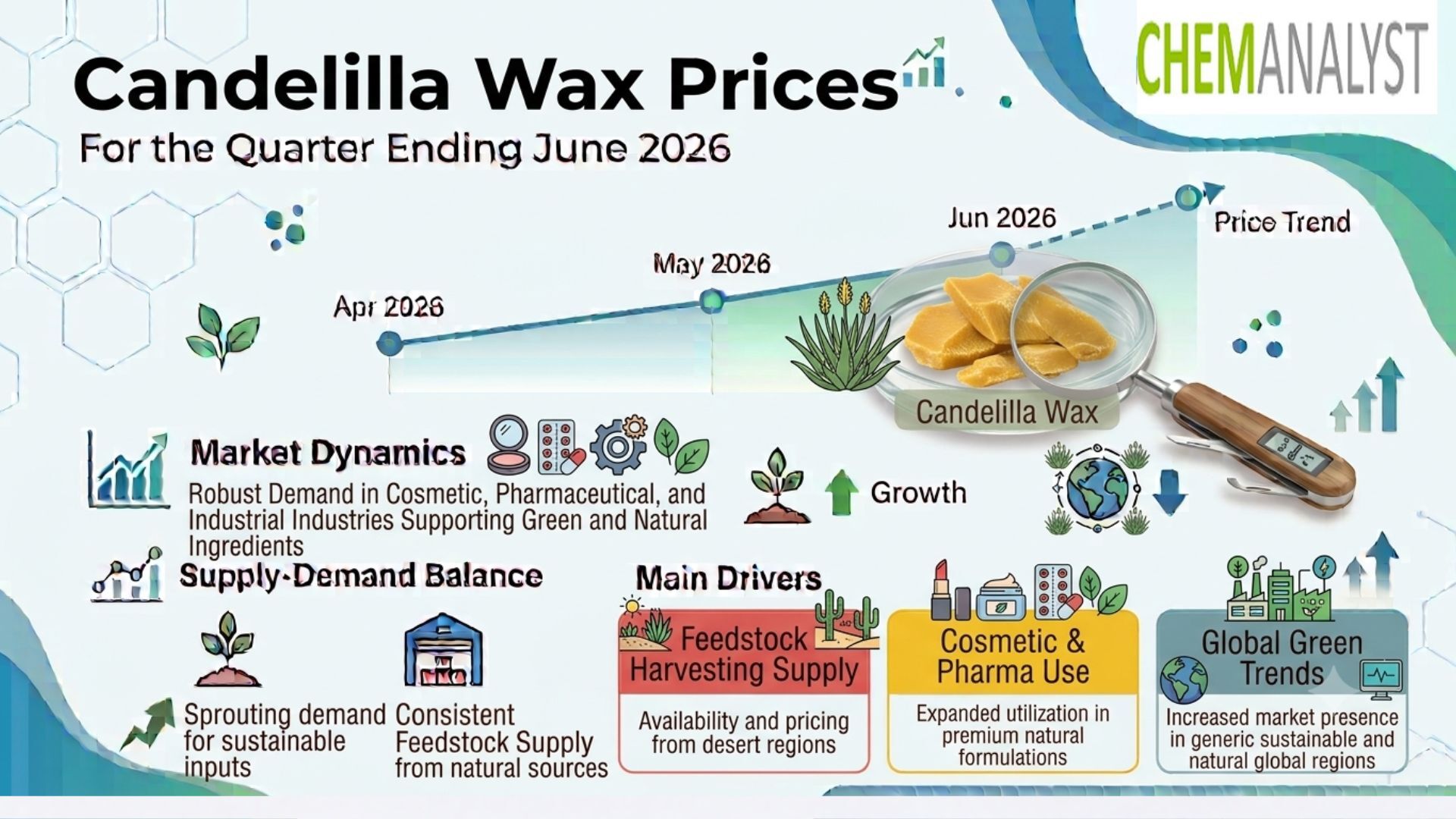
According to ChemAnalyst, the global Candelilla Wax Prices market recorded a generally firm trend during the second quarter of 2026, with prices increasing across key producing and importing markets. Candelilla wax, a natural vegetable wax obtained primarily from the candelilla shrub, remains an important specialty ingredient for cosmetics, pharmaceuticals, food coatings, polishes and personal care formulations. Its natural origin, functional properties and compatibility with a broad range of formulations continue to support demand across multiple downstream industries.
During Q2 2026, supply-side constraints and increasing logistics expenses played a significant role in shaping the Candelilla Wax Price Trend. Mexico, the world's principal source of candelilla wax, experienced constrained exports and higher diesel costs, contributing to an increase in prices. In India, import tightness combined with higher freight expenses pushed prices higher during the quarter. Meanwhile, the European market remained comparatively stable to slightly firm, although buyers faced higher replacement costs in June as raw material availability tightened and transportation expenses increased.
The combination of limited supply availability, rising logistics costs and steady downstream consumption created an environment of moderate price firmness throughout the quarter.
Candelilla Wax Prices in North America
Mexico Candelilla Wax Price Trend
Mexico remained a critical market for Candelilla Wax Prices during Q2 2026 because of its importance in global supply. The Candelilla Wax Price Index in Mexico increased by 12.7% quarter-over-quarter, reflecting constrained exports and rising diesel costs.
The average Candelilla Wax price in Mexico during the quarter was approximately USD 19617/MT, based on FOB Manzanillo offers.
The increase was primarily associated with restricted export availability and elevated operating expenses. Candelilla wax production and collection depend heavily on the availability of natural raw materials, while transportation plays an important role in moving material from producing areas toward export terminals. Higher diesel costs therefore increased the overall cost of handling and transporting the product.
FOB Manzanillo offers reflected the stronger cost environment, with suppliers maintaining firmer price expectations amid limited export availability. For international buyers, this translated into higher procurement costs and increased replacement values during the quarter.
Impact of Constrained Exports on Candelilla Wax Prices
Export availability was one of the most important factors influencing the Mexican market. When export volumes become constrained, international buyers have fewer sourcing options and may need to compete more actively for available cargoes.
For candelilla wax, this effect can be particularly significant because the global supply base is relatively concentrated. Mexico's role as a major source means that changes in its export availability can have an impact on pricing in importing markets.
The Q2 increase of 12.7% quarter-over-quarter demonstrates how supply constraints can quickly translate into higher market assessments, particularly when they occur alongside increasing transportation and energy expenses.
Get Real Time Online for Candelilla Wax Prices: https://www.chemanalyst.com/Pricing-data/candelilla-wax-3051
Candelilla Wax Prices in APAC
India Candelilla Wax Price Trend
The Asia-Pacific market also experienced a notable increase in Candelilla Wax Prices during Q2 2026. In India, the Candelilla Wax Price Index increased by 12.41% quarter-over-quarter, reflecting import tightness and higher freight costs.
The average Candelilla Wax price in India was approximately USD 19909.70/MT, based on trade assessments.
Unlike Mexico, India is primarily an importing market for candelilla wax. Consequently, international supply conditions, freight rates, import availability and supplier replacement costs have a direct influence on domestic market pricing.
During Q2 2026, tighter import availability limited the flexibility of buyers to source material at competitive levels. At the same time, higher freight costs increased the delivered cost of imported material, encouraging suppliers and distributors to maintain higher offers.
Import Tightness Supports Higher Prices
Import-dependent markets such as India are particularly sensitive to changes in international supply. When cargo availability becomes restricted, buyers may need to extend procurement lead times or pay higher prices to secure material.
The 12.41% quarter-over-quarter increase in India's Candelilla Wax Price Index reflected this combination of supply and logistics pressure. Higher freight expenses further amplified the effect because the landed cost of candelilla wax includes transportation expenses in addition to the underlying product value.
For Indian buyers, the Q2 market highlighted the importance of maintaining adequate inventory coverage and monitoring international supplier availability.
Candelilla Wax Prices in Europe
European Market Remains Stable to Slightly Firm
The European market displayed a more moderate movement in Candelilla Wax Prices during Q2 2026. The Candelilla Wax Price Index remained stable to slightly firm, supported by steady demand from cosmetics, pharmaceuticals, food coatings and personal care industries.
Europe continued to depend heavily on imports, particularly from Mexico, due to limited regional production availability. This dependence meant that European buyers remained exposed to developments in Mexican supply, export conditions, freight costs and international replacement values.
Although European market conditions did not show the same magnitude of quarterly increase observed in Mexico and India, the underlying cost environment remained supportive of firmer prices.
Candelilla Wax Spot Price Rises in June
The Candelilla Wax Spot Price increased moderately in June 2026. Limited raw material availability and higher transportation costs supported supplier offers during the month.
Import availability remained balanced overall, meaning that the European market did not experience an acute shortage. However, buyers faced higher replacement costs as suppliers adjusted offers to reflect increasing logistics and raw material expenses.
The distinction between availability and cost was important during the quarter. Material could still be sourced, but replacement cargoes were becoming more expensive. As a result, buyers had to account for higher procurement budgets even without significant physical supply disruptions.
Book A Demo for Candelilla Wax Price: https://www.chemanalyst.com/ChemAnalyst/PricingForm?Product=Candelilla%20Wax
Key Factors Influencing Candelilla Wax Prices in Q2 2026
Several market factors contributed to the movement in Candelilla Wax Prices during the second quarter.
1. Constrained Export Availability
Restricted export availability from Mexico reduced flexibility in international sourcing. Since Mexico is a major source of candelilla wax, changes in export volumes can influence prices across importing regions.
2. Higher Diesel Costs
Increasing diesel expenses raised transportation and operating costs in Mexico. These costs were reflected in FOB offers and contributed to the stronger Candelilla Wax Price Index.
3. Import Tightness in India
India experienced tighter import availability during Q2 2026. Reduced flexibility in international sourcing encouraged buyers to accept higher prices to secure required volumes.
4. Higher Freight Costs
Freight expenses were another major contributor to the Q2 price increase. For importing countries, higher shipping costs increase landed prices even when the underlying commodity value remains relatively stable.
5. Steady Downstream Demand
Demand from cosmetics, pharmaceuticals, food coatings and personal care applications provided a stable foundation for the market. Candelilla wax is valued for its hardness, film-forming properties, gloss and ability to improve formulation characteristics.
Steady consumption prevented significant downward pressure on prices despite balanced availability in some markets.
6. Limited Regional Production in Europe
Europe's limited domestic production capacity kept the region dependent on imported material. This increased exposure to international supply conditions and made European buyers more sensitive to developments in major producing countries.
Example: How Supply and Freight Costs Can Influence Candelilla Wax Prices
Consider a European cosmetics manufacturer that needs to replenish its candelilla wax inventory during June 2026. Even if import availability remains balanced, a supplier may quote a higher replacement price because raw material availability has tightened and transportation costs have increased.
The buyer therefore faces a higher procurement cost despite there being no major shortage.
A similar situation occurred in India, where import tightness and higher freight costs contributed to a 12.41% quarter-over-quarter increase in the Candelilla Wax Price Index. In Mexico, constrained exports and diesel cost increases resulted in an even stronger 12.7% quarter-over-quarter increase.
This example demonstrates why buyers need to evaluate not only physical availability but also the cost structure behind supplier offers.
Impact of Candelilla Wax Prices on Procurement and Supply Chains
Changes in Candelilla Wax Prices have direct implications for manufacturers using the material as a functional ingredient. Cosmetics and personal care companies, pharmaceutical manufacturers, food-coating producers and other industrial users need to consider price movements when preparing procurement budgets.
When prices rise, buyers may respond by increasing inventory coverage, negotiating longer-term contracts, diversifying suppliers, or purchasing ahead of anticipated increases.
However, inventory decisions need to balance price protection against storage costs and working-capital requirements. Excessive stockpiling can create financial pressure, while insufficient inventory can expose manufacturers to higher spot-market replacement costs.
For import-dependent markets, freight monitoring is equally important. A stable product price can still result in a higher landed cost if shipping expenses increase significantly.
Regional Candelilla Wax Price Comparison
The Q2 2026 market showed clear regional differences.
Mexico: The Candelilla Wax Price Index increased by 12.7% quarter-over-quarter, with an average price of approximately USD 19617/MT, based on FOB Manzanillo offers. Constrained exports and higher diesel costs were the primary drivers.
India: The Candelilla Wax Price Index increased by 12.41% quarter-over-quarter, with an average price of approximately USD 19909.70/MT, based on trade assessments. Import tightness and higher freight costs supported the increase.
Europe: The Candelilla Wax Price Index remained stable to slightly firm. The market was supported by steady downstream demand, import dependence, limited regional production and moderately higher June spot prices.
These differences demonstrate how regional supply structures and logistics can create different pricing outcomes even within the same global commodity market.
Candelilla Wax Prices Outlook
The outlook for Candelilla Wax Prices will depend on the balance between raw material availability, Mexican export volumes, freight costs, diesel prices and downstream demand.
If export availability from Mexico improves and logistics costs stabilize, some of the supply-side pressure could ease. However, continued dependence on Mexican material means importing markets may remain sensitive to changes in export conditions.
In India, freight rates and import availability will remain important indicators for future price direction. Any improvement in international supply could reduce import tightness, while renewed logistics pressure could keep prices elevated.
In Europe, steady demand from cosmetics, pharmaceuticals, food coatings and personal care applications is expected to provide continued support. Since regional production remains limited, European buyers will continue monitoring international suppliers and replacement costs closely.
Overall, the market is expected to remain sensitive to supply and logistics developments, with price volatility depending largely on the availability of export material and the cost of moving it to international markets.
Conclusion
The Candelilla Wax Prices market experienced a firm Q2 2026, with Mexico and India recording significant quarter-over-quarter increases. Mexico's Candelilla Wax Price Index rose by 12.7%, reaching an average price of approximately USD 19617/MT, driven by constrained exports and higher diesel costs. India recorded a 12.41% quarter-over-quarter increase, with prices averaging approximately USD 19909.70/MT, supported by import tightness and higher freight costs.
Europe remained comparatively stable to slightly firm, although the Candelilla Wax Spot Price increased moderately in June as limited raw material availability and higher transportation costs pushed supplier offers upward.
The Q2 2026 market demonstrates the importance of monitoring supply availability, export conditions, freight expenses and downstream demand when evaluating Candelilla Wax Prices. For procurement teams, proactive inventory planning, supplier diversification and close monitoring of international market conditions can help manage exposure to future price movements.
ChemAnalsyt
Call +1 3322586602
420 Lexington Avenue, Suite 300, New York, NY, United States, 10170
Website: https://www.chemanalyst.com/
Email: sales@chemanalyst.com
この記事をシェア





