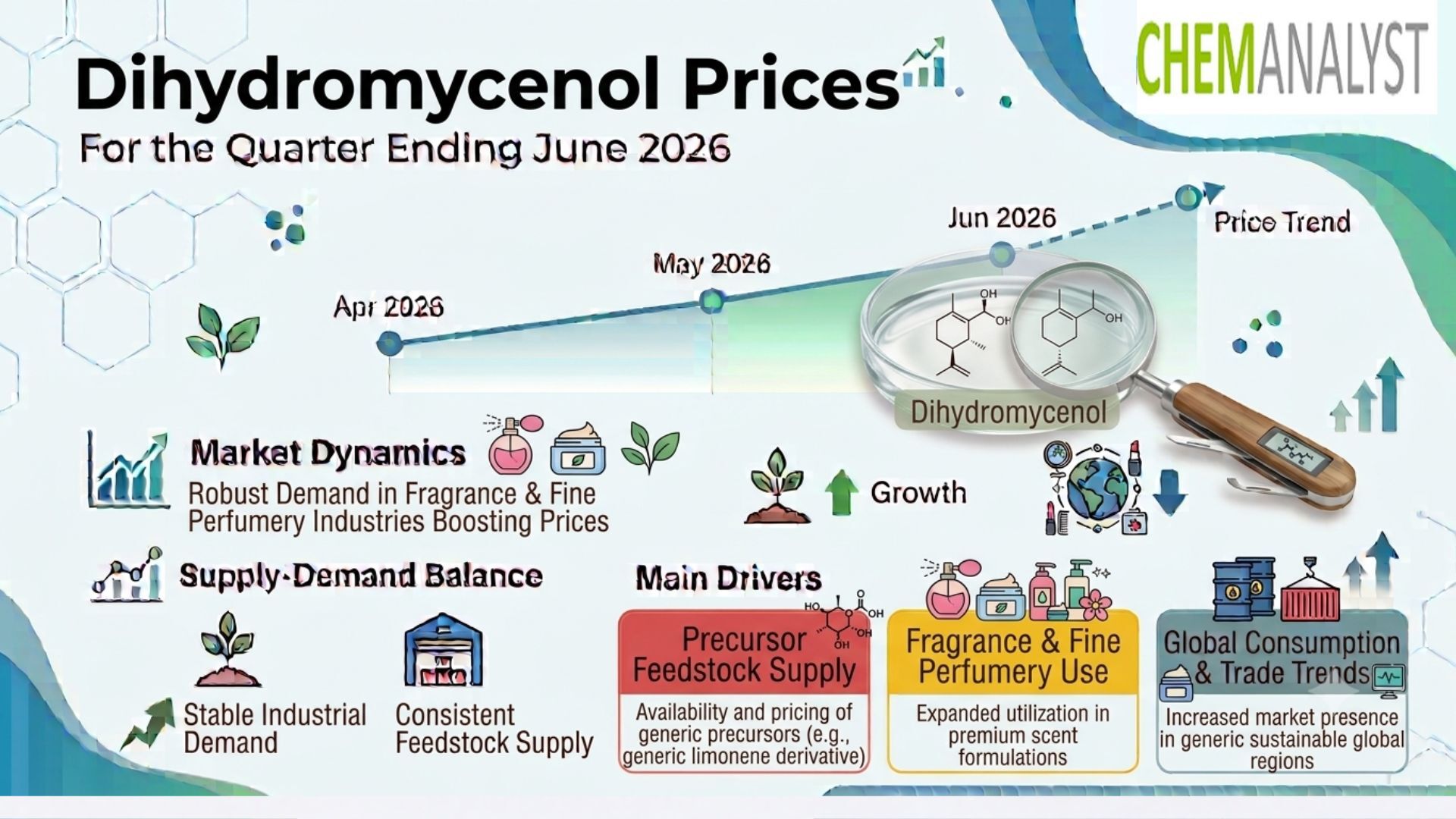
According to ChemAnalyst, the Dihydromycenol Prices market recorded mixed regional movements during the second quarter of 2026. While the United States and Germany experienced quarter-over-quarter increases in their respective Dihydromycenol Price Indexes, China recorded a decline during the same period. Differences in feedstock costs, supply conditions, consumer spending and production economics shaped the market across North America, Asia-Pacific (APAC) and Europe.
Dihydromycenol is an important fragrance ingredient used in a range of perfumery, personal care, household and consumer products. Its demand is therefore closely connected with consumer spending, fragrance formulation activity and the performance of downstream industries. At the same time, its production economics can be influenced by petrochemical feedstocks and broader industrial cost conditions.
During Q2 2026, the U.S. market benefited from resilient consumer spending, while higher naphtha feedstock costs increased production expenses. China moved in the opposite direction as easing supply and softer feedstock costs in June contributed to a lower price index, despite production-cost pressure from a 4.1% year-on-year PPI increase in June 2026. Germany recorded a higher index as elevated production costs continued to influence the market.
Dihydromycenol Prices in North America
United States Dihydromycenol Price Trends
In the United States, the Dihydromycenol Price Index rose quarter-over-quarter in Q2 2026, supported by resilient consumer spending.
Consumer spending is an important demand indicator for fragrance-related ingredients because Dihydromycenol is utilized in products connected with personal care, fragrances, household products and other consumer applications. When consumer expenditure remains resilient, downstream manufacturers can maintain production and procurement activity, providing support to ingredient demand.
During Q2 2026, resilient consumer spending created a favorable demand environment for Dihydromycenol in the United States. This helped support the upward movement in the Dihydromycenol Price Index despite the broader complexity of feedstock and production-cost developments.
Strong downstream demand can also improve supplier confidence. When manufacturers receive consistent orders from fragrance and consumer-product producers, they may have less incentive to reduce prices aggressively. Consequently, steady purchasing activity can contribute to a firmer market environment.
Impact of Naphtha Feedstock Costs
Dihydromycenol production costs increased in June 2026 as naphtha feedstock costs strengthened.
Naphtha is an important petrochemical feedstock and changes in its pricing can influence the economics of downstream chemical production. When naphtha costs increase, manufacturers may face higher raw material expenses, potentially putting pressure on operating margins.
For Dihydromycenol producers, stronger naphtha prices can therefore translate into higher production costs. Depending on demand conditions and competitive dynamics, producers may seek to pass part of these increased expenses through to buyers.
In the United States, the combination of resilient consumer spending and stronger naphtha feedstock costs provided support to the Dihydromycenol market during Q2 2026. The demand-side strength helped reinforce the impact of rising production costs on market pricing.
Consumer Spending and Dihydromycenol Demand
The relationship between consumer spending and Dihydromycenol demand is particularly relevant because fragrance ingredients ultimately serve a wide range of consumer-oriented applications.
Resilient consumer expenditure can encourage downstream manufacturers to maintain production schedules and replenish inventories. This creates a relatively stable purchasing environment for fragrance ingredients.
Therefore, the U.S. Q2 2026 market demonstrated how healthy downstream consumption can contribute to firmer Dihydromycenol Prices, particularly when production costs are also increasing.
Get Real Time Online for Dihydromycenol Prices: https://www.chemanalyst.com/Pricing-data/dihydromycenol-2397
Dihydromycenol Prices in APAC
China Dihydromycenol Price Trends
China experienced a different market direction during Q2 2026. The Dihydromycenol Price Index fell quarter-over-quarter in Q2 2026, due to easing supply and softening feedstock costs in June.
The decline indicated that supply-side and feedstock developments outweighed the broader production-cost pressures recorded during the quarter. As supply became more readily available, producers and suppliers faced greater competition to secure downstream business.
Easing supply can reduce price pressure by giving buyers more procurement options. When multiple suppliers have adequate availability, buyers may be able to negotiate more competitive offers, particularly if feedstock costs are simultaneously weakening.
This dynamic contributed to the decline in China's Dihydromycenol Price Index during Q2 2026.
Effect of Easing Supply
Supply availability was a key factor behind China's downward price movement. As supply conditions eased, the market became less constrained, reducing the immediate upward pressure on prices.
For buyers, improved availability can create greater flexibility in procurement. Buyers may have more opportunities to compare supplier quotations and negotiate favorable purchasing terms.
For producers, however, easing supply can increase competitive pressure. Suppliers may need to adjust their offers to maintain market share, especially when downstream demand is not strong enough to absorb additional availability.
The easing supply environment therefore played an important role in the quarter-over-quarter decline in Chinese Dihydromycenol Prices.
Softening Feedstock Costs in June
China's Dihydromycenol market also benefited from softening feedstock costs in June.
Lower feedstock expenses can reduce the cost of production and provide manufacturers with greater flexibility when setting selling prices. When falling feedstock costs occur alongside easing supply, downward pressure on finished-product prices can become more pronounced.
The combination of these two factors helped offset the production-cost pressures associated with China's broader producer-price environment.
Impact of China's Producer Price Index
Despite the decline in the Dihydromycenol Price Index, production costs faced upward pressure from a 4.1% year-on-year PPI increase in June 2026.
The increase in the Producer Price Index indicated that manufacturers continued to operate in a higher-cost industrial environment. Such cost pressures can normally support higher selling prices, but the impact can be limited when supply is easing and feedstock costs are softening.
China's Q2 2026 market therefore provides an example of how different market forces can move in opposing directions. Higher producer prices created cost pressure, while improved supply and softer feedstock costs created downward pressure on Dihydromycenol Prices.
Dihydromycenol Prices in Europe
Germany Dihydromycenol Price Trends
Germany recorded an upward trend during Q2 2026. The Dihydromycenol Price Index rose quarter-over-quarter, driven by elevated production costs.
The German market reflected a cost-driven pricing environment. Increasing production expenses placed pressure on manufacturers and contributed to higher market assessments.
For chemical producers, elevated production costs can affect pricing decisions across the supply chain. If manufacturers face higher costs for industrial inputs and other production requirements, they may adjust their selling offers to maintain margins.
The quarter-over-quarter increase in Germany's Dihydromycenol Price Index reflected this elevated cost environment.
Impact of Producer Prices in Germany
Dihydromycenol production costs increased in Q2 2026, influenced by a 2.2% rise in producer prices in May 2026.
Higher producer prices can increase the cost base for industrial manufacturers and create upward pressure on finished chemical products. For Dihydromycenol producers, this can translate into higher expenses associated with manufacturing and supply.
The 2.2% increase therefore represented an important market indicator for Germany during the quarter. As production costs remained elevated, suppliers had greater reason to maintain firm pricing.
European Production Economics
The German market highlights the importance of production economics in determining Dihydromycenol Prices. While consumer demand and supply conditions are important, persistent cost increases can independently create upward pressure.
For buyers in Europe, monitoring producer-price indicators can therefore provide useful insight into potential changes in supplier quotations. Rising producer prices can serve as an early signal of increasing manufacturing expenses.
Book A Demo for Dihydromycenol Price: https://www.chemanalyst.com/ChemAnalyst/PricingForm?Product=Dihydromycenol
Key Factors Influencing Dihydromycenol Prices in Q2 2026
Several interconnected factors shaped Dihydromycenol Prices across major regions during Q2 2026.
Feedstock Costs
Feedstock economics were particularly important in both the United States and China. U.S. naphtha feedstock costs strengthened in June, increasing Dihydromycenol production costs. China, by contrast, experienced softening feedstock costs in June, contributing to lower market prices.
Supply Availability
China's easing supply environment was a major factor behind its quarter-over-quarter price decline. Improved availability increased competition among suppliers and reduced the pricing pressure associated with limited material availability.
Consumer Spending
Resilient consumer spending supported the U.S. Dihydromycenol market. Strong consumer expenditure can support demand for fragrance and personal care products, indirectly maintaining demand for fragrance ingredients.
Producer Price Inflation
Producer-price developments influenced production economics in both China and Germany. China's 4.1% year-on-year PPI increase in June 2026 created upward cost pressure, while Germany's 2.2% rise in producer prices in May 2026 contributed to higher production costs.
Example: How Feedstock and Supply Conditions Can Create Different Price Trends
Consider two Dihydromycenol markets operating under different supply and feedstock conditions.
In the United States, stronger naphtha feedstock costs increase production expenses while resilient consumer spending supports downstream demand. Producers therefore face higher costs at a time when purchasing activity remains firm, creating conditions favorable for higher Dihydromycenol Prices.
In China, the situation is different. If supply becomes more readily available and feedstock costs soften, suppliers may have greater flexibility to reduce prices. Even when the PPI increases and creates broader production-cost pressure, easing supply and lower feedstock costs can outweigh those factors.
This example demonstrates why regional Dihydromycenol Prices can move in different directions during the same quarter.
Impact on Procurement and Supply Chain Planning
The mixed Q2 2026 market performance highlights the importance of regional procurement strategies.
In the United States, buyers should monitor naphtha prices and consumer spending because both can influence the market from the supply and demand sides. Higher feedstock costs combined with resilient consumption can create upward pressure on procurement costs.
In China, procurement teams can benefit from tracking supply availability and feedstock trends. Easing supply and softer feedstock costs created a more favorable purchasing environment during Q2 2026.
In Germany, monitoring producer-price indicators remains important. The 2.2% increase in producer prices in May 2026 contributed to higher production costs and supported the upward movement in the Dihydromycenol Price Index.
Companies with regular Dihydromycenol requirements should therefore evaluate regional pricing conditions rather than relying solely on a single global market indicator.
Regional Dihydromycenol Price Comparison
The Q2 2026 market demonstrated significant regional variation.
The United States recorded a quarter-over-quarter increase in the Dihydromycenol Price Index, supported by resilient consumer spending and higher production costs resulting from stronger naphtha feedstock prices.
China recorded a quarter-over-quarter decline as easing supply and softer feedstock costs in June outweighed the upward pressure created by a 4.1% year-on-year PPI increase.
Germany experienced a quarter-over-quarter increase due to elevated production costs, with producer prices rising 2.2% in May 2026.
These contrasting developments demonstrate that Dihydromycenol pricing is influenced by a combination of regional supply, feedstock, demand and macroeconomic factors.
Dihydromycenol Prices Outlook
The outlook for Dihydromycenol Prices will depend on how feedstock costs, supply availability and downstream demand develop during the second half of 2026.
In the United States, continued resilient consumer spending could provide demand-side support. At the same time, movements in naphtha feedstock costs will remain important for production economics.
China's price direction will depend heavily on supply availability and feedstock costs. If supply remains comfortable and feedstock prices remain soft, downward pressure could persist. However, sustained producer-cost inflation could limit the extent of any decline.
Germany's market will remain sensitive to producer-price developments. Continued elevated production costs could support firm pricing, while stabilization in industrial costs could provide greater market stability.
Conclusion
The Dihydromycenol Prices market displayed mixed regional performance during Q2 2026.
In the United States, the Dihydromycenol Price Index rose quarter-over-quarter, supported by resilient consumer spending. Production costs increased in June as naphtha feedstock costs strengthened.
China moved in the opposite direction, with the Dihydromycenol Price Index falling quarter-over-quarter due to easing supply and softening feedstock costs in June. However, production costs still faced upward pressure from a 4.1% year-on-year PPI increase in June 2026.
Germany recorded a quarter-over-quarter increase in its Dihydromycenol Price Index, driven by elevated production costs. Production expenses increased amid a 2.2% rise in producer prices in May 2026.
Overall, Q2 2026 demonstrated that Dihydromycenol Prices can respond differently across regions depending on the balance between feedstock costs, supply availability, consumer demand and production economics. Monitoring these factors will remain essential for manufacturers, suppliers, traders and procurement professionals assessing the Dihydromycenol market during the remainder of 2026.
ChemAnalsyt
Call +1 3322586602
420 Lexington Avenue, Suite 300, New York, NY, United States, 10170
Website: https://www.chemanalyst.com/
Email: sales@chemanalyst.com
この記事をシェア





