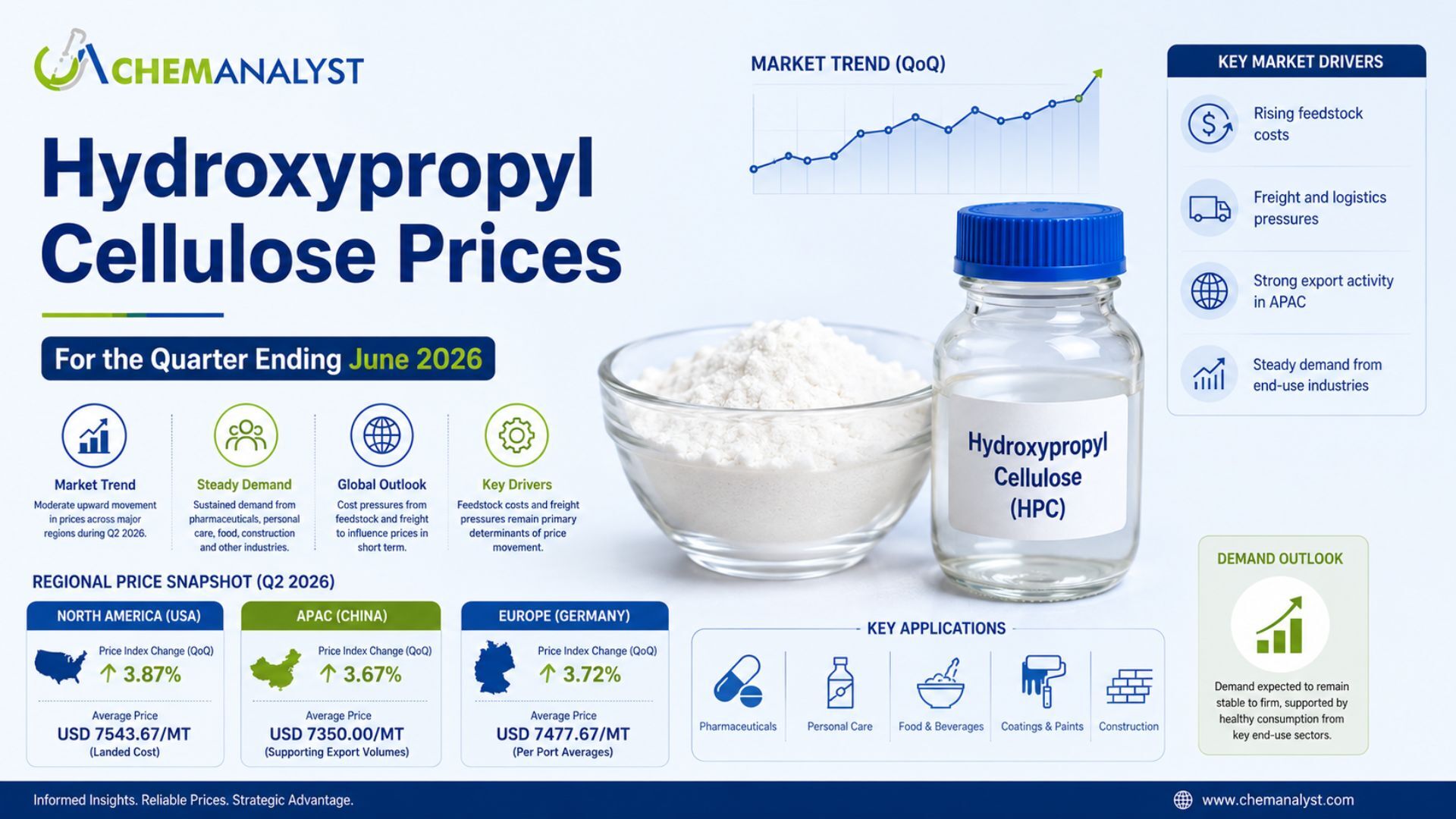
According to ChemAnalyst, the global Hydroxypropyl Cellulose Prices market recorded a moderate upward movement across major regions during the quarter ending June 2026. Prices increased in North America, Asia-Pacific (APAC) and Europe, although the underlying drivers differed by region. In the United States, freight pressures contributed to a 3.87% quarter-over-quarter increase in the Hydroxypropyl Cellulose Price Index. China recorded a 3.67% rise, primarily supported by higher feedstock costs, while Germany witnessed a 3.72% increase due to a combination of feedstock and freight pressures.
Hydroxypropyl Cellulose (HPC) is a cellulose ether derived from cellulose through chemical modification. It is valued for its thickening, film-forming, stabilizing, binding and water-retention properties. These characteristics make HPC useful across pharmaceutical, food, personal care, coatings, construction and other specialty applications.
During Q2 2026, the Hydroxypropyl Cellulose Price Trend reflected the impact of higher production and logistics costs rather than a sudden surge in downstream consumption. The regional market remained relatively balanced, but increasing feedstock and transportation expenses gradually raised the cost base for manufacturers and distributors.
The average Hydroxypropyl Cellulose price stood at approximately USD 7,543.67/MT in the USA, USD 7,350.00/MT in China and USD 7,477.67/MT in Germany during the quarter. These regional price levels highlight the influence of freight, feedstock economics and local supply-chain conditions on HPC pricing.
Hydroxypropyl Cellulose Prices in North America
The Hydroxypropyl Cellulose Prices in North America increased during Q2 2026, with the United States recording a 3.87% quarter-over-quarter rise in the Hydroxypropyl Cellulose Price Index. The increase was primarily associated with freight pressures, which raised landed costs for market participants.
The average Hydroxypropyl Cellulose price in the USA was approximately USD 7,543.67/MT during the quarter. The price reflects landed market costs and therefore incorporates the impact of transportation and logistics expenses in addition to the underlying material value.
Freight remained an important consideration for HPC buyers in North America. Since Hydroxypropyl Cellulose is part of a specialized chemical supply chain, transportation costs can have a meaningful effect on delivered pricing. Any increase in freight expenses can therefore be passed through the supply chain, particularly when suppliers and distributors seek to preserve operating margins.
The Q2 increase did not necessarily indicate a major imbalance between supply and demand. Instead, the market appeared to be influenced by rising logistical costs. Buyers remained attentive to procurement expenses and transportation conditions while suppliers adjusted offers according to changing landed-cost structures.
The North American HPC Price Trend is therefore expected to remain closely linked to freight conditions, import economics, supplier availability and downstream purchasing patterns. Any normalization in transportation costs could reduce upward pricing pressure, while continued logistics challenges could maintain elevated landed prices.
Get Real Time Online for Hydroxypropyl Cellulose Prices: https://www.chemanalyst.com/ChemAnalyst/PricingForm?Product=Hydroxypropyl%20Cellulose
Hydroxypropyl Cellulose Prices in APAC
The APAC market also experienced an upward movement in Hydroxypropyl Cellulose Prices during the quarter ending June 2026. In China, the Hydroxypropyl Cellulose Price Index increased by 3.67% quarter-over-quarter, primarily due to higher feedstock costs.
The average Hydroxypropyl Cellulose price in China was approximately USD 7,350.00/MT during Q2 2026. The price environment supported export volumes while manufacturers remained attentive to changes in production economics.
Feedstock costs represented the principal driver behind the quarterly price increase. As the cost of raw materials used in HPC production rises, manufacturers generally face higher production expenses. Depending on market competition and demand conditions, a portion of these increases can be reflected in selling prices.
China's position as a significant manufacturing and exporting hub also means that changes in its domestic production costs can influence international HPC trade flows. Higher feedstock costs can affect export offers, particularly when producers attempt to maintain margins while remaining competitive in overseas markets.
Despite the increase in the Chinese Hydroxypropyl Cellulose Price Index, export activity remained supportive. The average price of USD 7,350.00/MT provided a competitive base for international trade, although future export pricing will depend on feedstock movements, manufacturing costs, freight rates and overseas demand.
The APAC market will therefore remain an important region to monitor when evaluating global Hydroxypropyl Cellulose Prices. Changes in Chinese production economics can have implications for supply availability and pricing across other importing markets.
Book A Demo for Hydroxypropyl Cellulose Price: https://www.chemanalyst.com/Pricing-data/hydroxypropyl-cellulose-1650
Hydroxypropyl Cellulose Prices in Europe
European Hydroxypropyl Cellulose Prices also moved higher during Q2 2026. Germany recorded a 3.72% quarter-over-quarter increase in its Hydroxypropyl Cellulose Price Index, with feedstock and freight expenses contributing to the upward movement.
The average Hydroxypropyl Cellulose price in Germany was approximately USD 7,477.67/MT, based on port averages. The combination of higher feedstock costs and transportation expenses created additional cost pressure for suppliers operating in the European market.
Freight costs are particularly relevant to European HPC pricing because a portion of market requirements can be influenced by international supply chains. Changes in transportation expenses can affect delivered costs even when the underlying product market remains relatively stable.
At the same time, feedstock costs continued to influence production economics. Higher input expenses can increase the cost of manufacturing HPC and subsequently place upward pressure on market prices. The simultaneous movement of feedstock and freight costs therefore created a supportive environment for European pricing during the quarter.
Germany's 3.72% quarterly increase was broadly comparable with the price movements recorded in North America and China. This suggests that the Q2 2026 increase in Hydroxypropyl Cellulose Prices was not isolated to one market but reflected broader cost pressures across the international supply chain.
Key Factors Influencing Hydroxypropyl Cellulose Prices
Several factors shaped the global Hydroxypropyl Cellulose Price Trend during Q2 2026.
Feedstock Costs
Feedstock economics remained one of the most important factors affecting HPC prices. In China, higher feedstock costs directly contributed to the 3.67% quarter-over-quarter increase. Germany also experienced feedstock-related pressure during the quarter.
Since HPC production depends on processed cellulose and other chemical inputs, fluctuations in raw-material costs can influence the overall manufacturing cost. Producers may adjust quotations when sustained increases in input costs affect production margins.
Freight and Transportation Costs
Freight represented a major pricing factor in North America and Europe. The USA's 3.87% increase was attributed primarily to freight pressures, while Germany experienced a combination of feedstock and freight-related increases.
Transportation costs affect the final delivered price paid by consumers. This is particularly important for specialty chemicals that move through international supply chains, where shipping and handling expenses can represent a significant portion of landed costs.
Export Activity
China's HPC market remained supportive of export volumes during Q2 2026. Export demand provides manufacturers with an important outlet for production and can influence supplier pricing strategies.
Stronger export activity can support producer confidence, whereas weaker international demand can encourage greater competition among suppliers and potentially limit price increases.
Production Economics
The cost of producing Hydroxypropyl Cellulose is influenced by raw materials, energy, labor, processing requirements and logistics. Changes in any of these factors can affect producer margins and market offers.
During Q2 2026, the increase in HPC prices across the three major regions indicated that higher cost pressures were being reflected across different stages of the supply chain.
Regional Comparison of Hydroxypropyl Cellulose Prices
The Q2 2026 regional market showed relatively similar upward trends, although the underlying causes differed.
In North America, the Hydroxypropyl Cellulose Price Index increased 3.87% quarter-over-quarter, the largest increase among the three reported regions. The average US price reached USD 7,543.67/MT, with freight pressures serving as the principal driver.
In APAC, China's Hydroxypropyl Cellulose Price Index increased 3.67% quarter-over-quarter. The average price was approximately USD 7,350.00/MT, with feedstock costs providing the primary upward pressure and supporting export volumes.
In Europe, Germany recorded a 3.72% quarter-over-quarter increase, with the average price reaching approximately USD 7,477.67/MT based on port averages. Both feedstock and freight costs contributed to the price increase.
The regional comparison shows that North America recorded the strongest quarterly increase, followed closely by Europe and APAC. Nevertheless, the absolute price levels remained relatively close, demonstrating the interconnected nature of the global HPC market.
Hydroxypropyl Cellulose Demand Outlook
The demand outlook for Hydroxypropyl Cellulose remains linked to consumption across pharmaceutical, personal care, food, coatings, construction and other specialty industries. HPC's functional properties make it an important ingredient in formulations requiring viscosity control, stabilization, film formation and binding.
Pharmaceutical applications represent an important area of consumption because cellulose derivatives are used in various formulation and drug-delivery applications. Demand from personal care and specialty formulation industries can also influence purchasing activity.
For the coming quarters, downstream demand will remain an important factor in determining whether manufacturers can pass higher production and logistics costs through to buyers. If demand remains stable, suppliers may retain greater pricing power. Conversely, weaker downstream consumption could increase competition and limit the ability of producers to transfer cost increases.
Hydroxypropyl Cellulose Price Outlook
The Hydroxypropyl Cellulose Price Outlook remains moderately firm following the price increases recorded across North America, APAC and Europe during Q2 2026.
In the United States, future pricing will depend heavily on freight conditions. If transportation expenses remain elevated, landed HPC prices could continue to face upward pressure. However, normalization in freight costs could moderate the price trend.
In China, feedstock prices will remain a major variable. Continued increases in production inputs could encourage manufacturers to maintain higher export quotations, while stable feedstock costs could bring greater price stability.
European prices will similarly depend on the interaction between feedstock and freight expenses. Germany's Q2 performance demonstrated that simultaneous increases in these cost components can have a direct impact on market pricing.
Overall, the near-term Hydroxypropyl Cellulose Price Trend is expected to remain sensitive to raw-material costs, transportation expenses, export demand and downstream consumption. Market participants should monitor these variables closely when planning procurement and assessing future price risks.
Conclusion
The quarter ending June 2026 saw a broad-based increase in Hydroxypropyl Cellulose Prices across North America, APAC and Europe. The United States recorded a 3.87% quarter-over-quarter increase, with the average price reaching approximately USD 7,543.67/MT due primarily to freight pressures.
In China, the Hydroxypropyl Cellulose Price Index increased by 3.67% quarter-over-quarter, while the average price stood at approximately USD 7,350.00/MT. Higher feedstock costs were the key driver, while export volumes remained supportive.
Germany experienced a 3.72% quarter-over-quarter increase, with an average price of approximately USD 7,477.67/MT based on port averages. Feedstock and freight costs both contributed to the upward movement.
Overall, Q2 2026 demonstrated that Hydroxypropyl Cellulose Prices remain highly sensitive to input costs and logistics conditions. Going forward, feedstock movements, freight rates, export activity and downstream demand will be the key indicators to watch when assessing the global HPC market and its future pricing direction.
ChemAnalsyt
Call +1 3322586602
420 Lexington Avenue, Suite 300, New York, NY, United States, 10170
Website: https://www.chemanalyst.com/
Email: sales@chemanalyst.com
この記事をシェア





