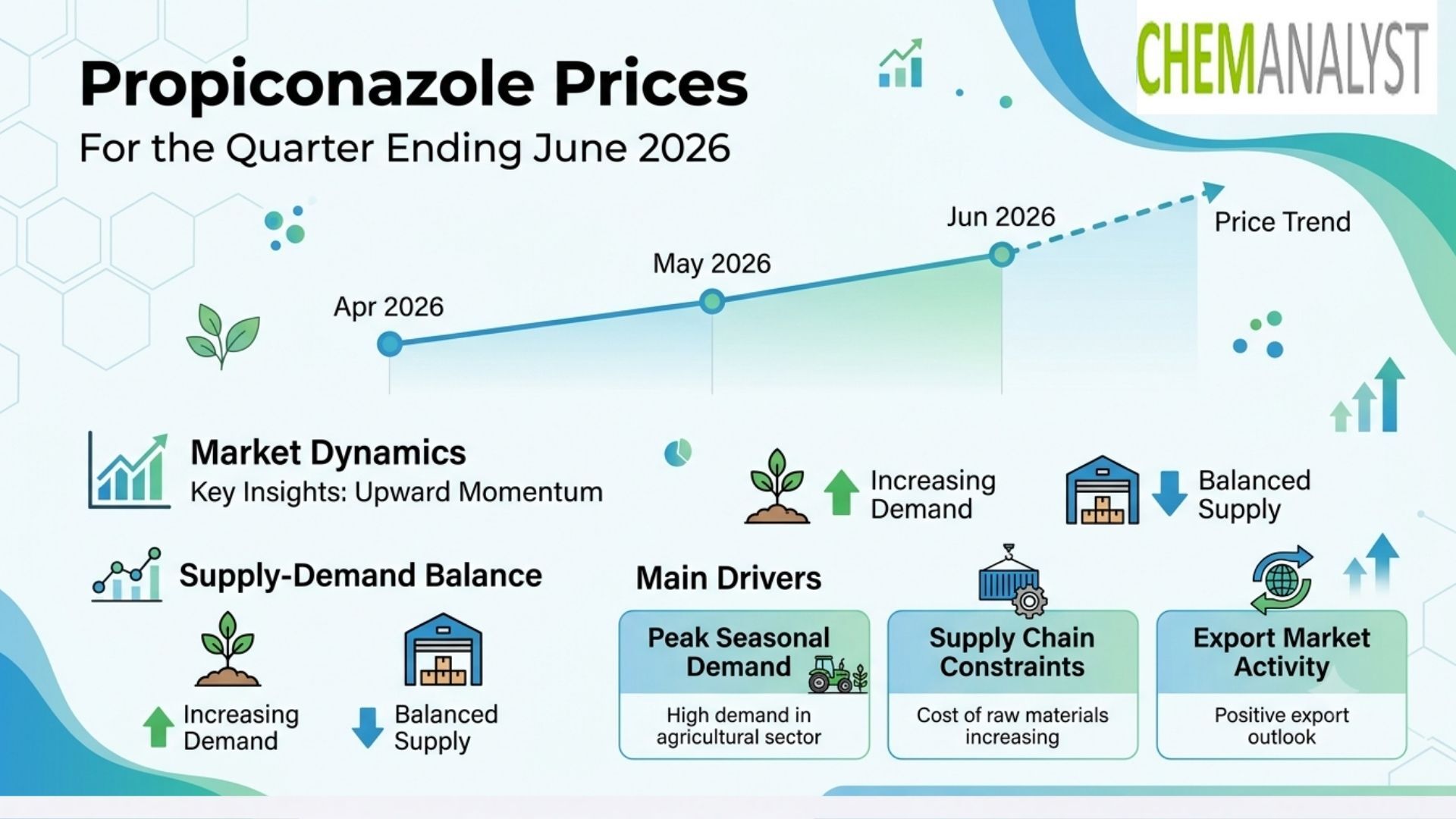
According to ChemAnalyst, the global Propiconazole Prices market presented a mixed regional performance during the second quarter of 2026. While the United States and Germany recorded upward movements in their respective Propiconazole Price Indexes, the Chinese market remained broadly stable. The different regional outcomes reflected variations in agricultural demand, domestic consumption, commodity costs, producer prices and the cost of petrochemical and organic chemical intermediates.
Propiconazole is a systemic triazole fungicide widely used in agricultural applications to protect crops from fungal diseases. Its market is closely linked to planting cycles, crop protection requirements, agricultural activity, formulation demand, raw-material availability and the overall cost of manufacturing agrochemicals.
During Q2 2026, agricultural demand provided important support to the US market. At the same time, producers faced elevated manufacturing expenses. The US Producer Price Index (PPI) increased 5.5% year-over-year in June 2026, highlighting continued cost pressure across the production sector.
China followed a different trajectory. The Propiconazole Price Index remained stable in Q2 2026, as softened domestic demand and easing commodity costs in June balanced the upward pressure originating from petrochemical expenses. Despite these short-term stabilizing factors, Propiconazole production costs remained under pressure during H1 2026 because of surging petrochemical costs.
In Germany, the Propiconazole Price Index rose during Q2 2026, supported by higher producer prices and increasing organic chemical intermediate costs. Producer prices increased 2.2% in May 2026, while higher intermediate costs in April and May contributed to the rising production-cost environment.
Propiconazole Prices in North America
The North American Propiconazole market experienced an upward trend during Q2 2026. In the United States, the Propiconazole Price Index rose quarter-over-quarter, supported by robust agricultural demand and elevated production costs.
Agricultural demand is one of the most important factors influencing fungicide markets. Propiconazole is used in crop protection, meaning its consumption is connected to planting schedules, crop health requirements, disease pressure and agricultural production activity.
During Q2 2026, robust agricultural demand provided a favorable environment for Propiconazole suppliers. Strong purchasing requirements can support market prices because manufacturers and distributors experience healthier order volumes.
At the same time, US producers faced a higher overall cost environment. The PPI increased 5.5% year-over-year in June 2026, indicating that producer-level costs remained elevated. For agrochemical manufacturers, increasing production costs can arise from raw materials, chemical intermediates, energy, utilities, transportation, labor and other manufacturing expenses.
When agricultural demand remains robust while production costs increase, producers generally have greater scope to pass a portion of these expenses through to customers. This combination contributed to the quarter-over-quarter increase in US Propiconazole prices.
The Q2 2026 market also highlights the importance of agricultural procurement cycles. Buyers may increase purchasing activity ahead of key crop-protection periods, particularly when they anticipate higher input costs or seek to secure adequate stocks.
As a result, the US Propiconazole market remained firm during the quarter, with both demand-side and cost-side factors supporting higher prices.
Get Real Time Online for Propiconazole Prices: https://www.chemanalyst.com/Pricing-data/propiconazole-2367
Propiconazole Prices in APAC
The APAC market presented a more balanced picture during Q2 2026, with China recording stable Propiconazole pricing.
In China, the Propiconazole Price Index remained stable in Q2 2026, influenced by softened domestic demand and easing commodity costs in June. These factors offset some of the production-cost pressure that had developed earlier in the year.
Weaker domestic demand can place downward pressure on agrochemical prices because manufacturers and distributors may compete more actively to secure available orders. Softer purchasing activity can also result in more cautious inventory management among buyers.
At the same time, easing commodity costs in June provided additional relief to the Chinese market. Lower commodity costs can reduce some of the immediate pressure on manufacturers, particularly when production inputs represent a significant portion of total manufacturing expenses.
However, the production-cost environment was not entirely favorable. Propiconazole production costs faced upward pressure during H1 2026 because of surging petrochemical costs.
Petrochemical feedstocks are important to many chemical manufacturing value chains. When petrochemical prices rise, they can increase the cost of intermediates and other inputs used in agrochemical production.
Therefore, China's stable Propiconazole prices during Q2 2026 represented a balance between opposing market forces. On one side, higher petrochemical costs created upward pressure on production economics. On the other, softened domestic demand and easing commodity costs in June limited the ability of producers to increase selling prices.
This balance kept the Chinese Propiconazole market relatively stable during the quarter.
Propiconazole Prices in Europe
Germany recorded an upward movement in Propiconazole prices during Q2 2026. The Propiconazole Price Index rose, with higher producer prices and increasing organic chemical intermediate costs contributing to the firmer market.
Producer prices in Germany increased 2.2% in May 2026, indicating continued cost pressure at the manufacturing level. A higher producer-price environment can affect chemical manufacturers by increasing expenses associated with raw materials, processing, energy, logistics and other industrial inputs.
The market also faced higher costs for organic chemical intermediates during April and May. These intermediates are important components of many chemical production processes and changes in their prices can have a direct impact on the overall economics of Propiconazole manufacturing.
As intermediate costs increased, producers faced greater pressure to maintain margins. The resulting cost pass-through contributed to the increase in the German Propiconazole Price Index.
The European market's performance demonstrates how upstream chemical markets can influence agrochemical pricing. Even when downstream agricultural demand remains relatively stable, increasing intermediate costs can push Propiconazole production expenses higher.
For German buyers, procurement costs during Q2 2026 were therefore influenced by the broader chemical-cost environment as well as local market conditions.
Book A Demo for Propiconazole Price: https://www.chemanalyst.com/ChemAnalyst/PricingForm?Product=Propiconazole
Key Factors Influencing Propiconazole Prices in Q2 2026
Several factors shaped the global Propiconazole price trend during Q2 2026.
Agricultural Demand
Robust agricultural demand was a major factor supporting Propiconazole prices in the United States. Strong crop-protection requirements can increase demand for fungicides and encourage manufacturers and distributors to maintain firmer pricing.
Production Costs
Higher production expenses were common across several markets. In the United States, elevated producer prices contributed to manufacturing-cost pressure, while Germany faced higher organic chemical intermediate costs.
Producer Price Index
Producer-price movements provided an indication of the wider manufacturing environment.
The US PPI increased 5.5% year-over-year in June 2026, while German producer prices increased 2.2% in May 2026. These increases contributed to higher production costs and supported upward price movements in the respective markets.
Petrochemical Costs
Surging petrochemical costs placed upward pressure on Propiconazole production costs in China during H1 2026. Since petrochemical inputs influence numerous chemical value chains, their price movements can affect agrochemical manufacturing economics.
Domestic Demand in China
China's softened domestic demand limited price growth during Q2 2026. Lower demand reduced the ability of producers to fully pass higher production costs through to buyers.
Commodity Costs
Easing commodity costs in June provided some relief to Chinese producers and buyers. This contributed to the stable Propiconazole pricing environment in the country.
Propiconazole Price Trend Analysis for Q2 2026
The Q2 2026 Propiconazole market demonstrated clear regional differences.
The United States recorded an increase in its Propiconazole Price Index, supported by robust agricultural demand and elevated production costs. The 5.5% year-over-year increase in US PPI in June reinforced the cost-driven component of the market movement.
China remained comparatively stable. Although surging petrochemical costs had pushed production expenses higher during H1 2026, softened domestic demand and easing commodity costs in June helped offset some of this pressure.
Germany experienced a price increase during the quarter. The 2.2% producer-price increase in May and higher organic chemical intermediate costs in April and May created a supportive cost environment for Propiconazole.
These contrasting developments show that Propiconazole prices are influenced by both global and regional factors. Agricultural demand can strengthen pricing, while softer domestic consumption can limit increases. At the same time, feedstock and intermediate costs can create upward pressure even when demand conditions are less favorable.
Example of Propiconazole Price Dynamics
Consider an agricultural-input distributor planning to purchase Propiconazole during Q2 2026.
In the United States, the distributor may face higher prices because agricultural demand remains robust while manufacturers are dealing with increased production costs. The 5.5% year-over-year PPI increase in June indicates a higher producer-cost environment.
A distributor sourcing from China may encounter a different market situation. Softer domestic demand and easing commodity costs in June could provide greater pricing stability. However, the distributor would still need to consider the impact of higher petrochemical costs on production economics.
In Germany, the distributor could face higher quotations because producer prices increased 2.2% in May and organic chemical intermediate costs increased during April and May.
This example illustrates how procurement conditions can vary considerably by region. A buyer evaluating global Propiconazole supply should therefore consider both local demand conditions and upstream production costs.
Propiconazole Production Cost Trend
The Propiconazole Production Cost Trend remained an important market indicator during Q2 2026.
In the United States, increasing producer prices contributed to higher manufacturing costs. With agricultural demand remaining robust, producers had greater opportunity to transfer some of these expenses to customers.
China experienced a more complex production-cost environment. Surging petrochemical costs placed upward pressure on production expenses during H1 2026. However, easing commodity costs in June and softer domestic demand helped stabilize the market.
Germany experienced higher production expenses because of increasing organic chemical intermediate costs. The 2.2% increase in producer prices in May further reinforced the higher-cost environment.
The differences between these markets demonstrate that production costs do not always translate directly into equivalent price increases. Demand conditions and local competition determine how effectively manufacturers can pass cost increases to buyers.
Propiconazole Prices Forecast
The outlook for Propiconazole prices will depend on agricultural demand, petrochemical costs, commodity prices and the cost of chemical intermediates.
In the United States, continued agricultural demand could support the market. If production expenses remain elevated, suppliers may continue to maintain firm quotations. The direction of producer prices will therefore remain an important indicator.
In China, the balance between domestic demand and petrochemical costs will be critical. If domestic demand remains soft, it could limit price increases. However, continued increases in petrochemical costs could create renewed upward pressure on production expenses.
In Europe, Propiconazole prices could remain sensitive to organic chemical intermediate costs and broader producer-price movements. Persistent increases in intermediate costs could support higher production expenses and firmer supplier quotations.
For procurement teams, monitoring agricultural demand, feedstock costs, producer prices, intermediate prices and inventory conditions will be essential for anticipating future market movements.
Procurement Considerations for Propiconazole
The Q2 2026 market highlights the importance of monitoring both upstream and downstream factors when planning Propiconazole purchases.
Buyers should closely track agricultural demand because changes in crop-protection activity can influence fungicide consumption. Procurement schedules should also account for seasonal requirements and inventory positions.
Monitoring petrochemical and organic chemical intermediate markets is equally important. Rising upstream costs can eventually affect Propiconazole quotations, particularly when manufacturers have limited ability to absorb cost increases.
Regional price differences should also be considered. The United States, China and Germany experienced different market conditions during Q2 2026, demonstrating that procurement strategies should be tailored to individual supply markets rather than based solely on global averages.
Conclusion
The second quarter of 2026 presented a mixed but generally firm global Propiconazole Prices environment. In the United States, the Propiconazole Price Index increased quarter-over-quarter, supported by robust agricultural demand and elevated production costs. The US PPI increased 5.5% year-over-year in June 2026, highlighting continued manufacturing-cost pressure.
In China, the Propiconazole Price Index remained stable as softened domestic demand and easing commodity costs in June balanced the upward pressure caused by surging petrochemical costs during H1 2026.
Germany recorded an increase in its Propiconazole Price Index, supported by a 2.2% increase in producer prices in May 2026 and higher organic chemical intermediate costs during April and May.
Overall, Q2 2026 demonstrated that Propiconazole price trends were shaped by agricultural demand, production costs, petrochemical markets, commodity prices and chemical intermediate expenses. Going forward, tracking these variables will remain important for manufacturers, distributors, agricultural-input suppliers and procurement teams seeking to understand the future direction of Propiconazole prices, production costs and market trends.
ChemAnalsyt
Call +1 3322586602
420 Lexington Avenue, Suite 300, New York, NY, United States, 10170
Website: https://www.chemanalyst.com/
Email: sales@chemanalyst.com
この記事をシェア





