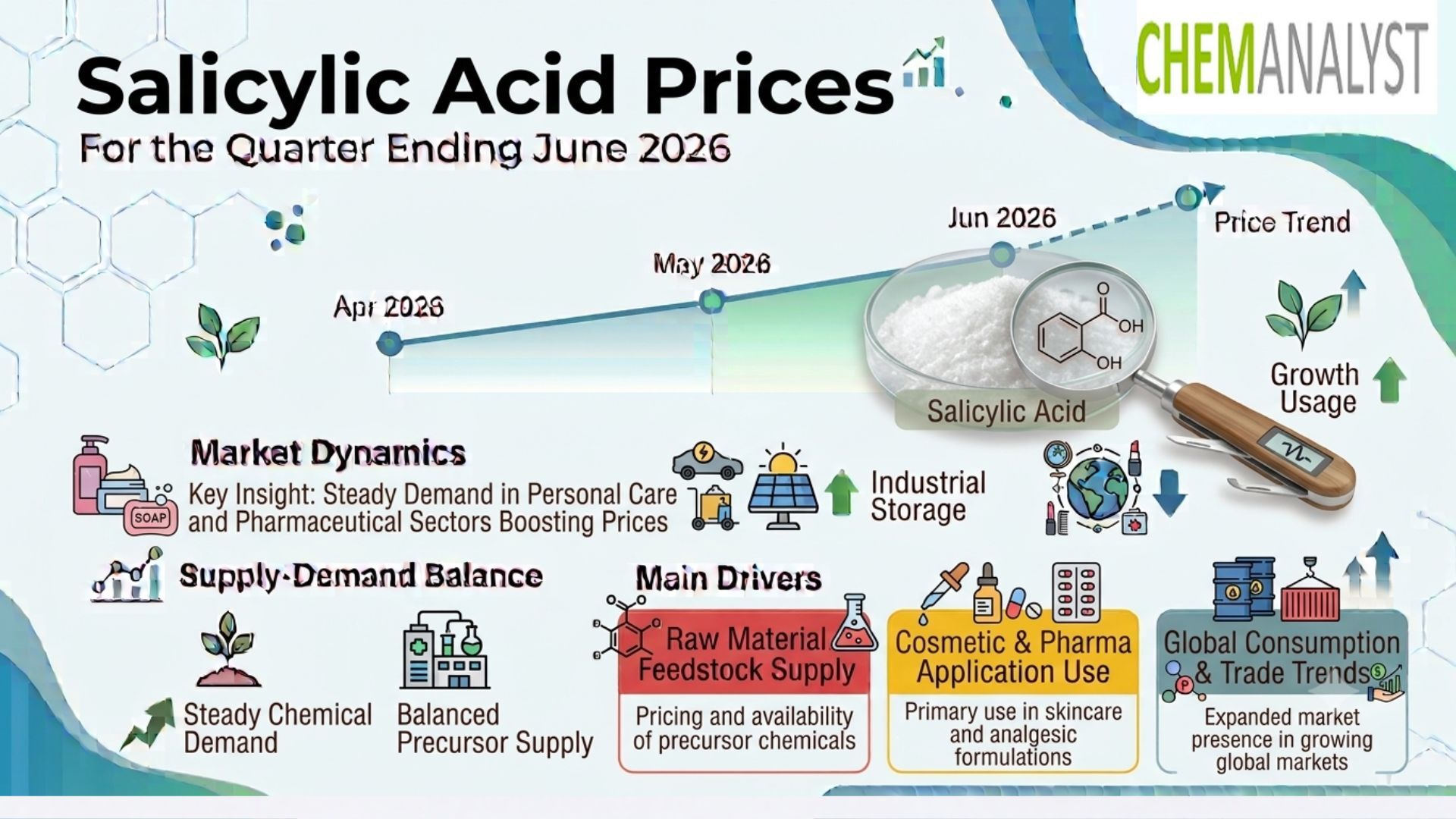
According to ChemAnalyst, the global Salicylic Acid Prices market recorded a broad-based upward movement during the quarter ending June 2026, with North America, Asia-Pacific (APAC), India and Europe all reporting increases in their respective price indices. The market was influenced by a combination of feedstock inflation, stronger export demand, freight cost escalation, import exposure, currency pressures and constrained inventories.
Salicylic acid is an important aromatic organic compound widely used across pharmaceutical formulations, personal care products, cosmetics, preservatives and industrial applications. Because production depends on the availability and cost of upstream raw materials, changes in feedstock economics can quickly influence regional pricing. At the same time, logistics and trade flows remain important factors in determining the final cost paid by buyers in import-dependent markets.
During Q2 2026, the strongest quarterly price increases among the reported markets were observed in China and India. The Chinese Salicylic Acid Price Index increased by 26.81% quarter-over-quarter, while India's index rose by 27.0% quarter-over-quarter. The USA and Germany also recorded notable increases of 11.61% and 11.3%, respectively.
Salicylic Acid Prices in North America
The North American market experienced a clear upward movement during Q2 2026. In the United States, the Salicylic Acid Price Index rose by 11.61% quarter-over-quarter, with feedstock costs identified as a key factor behind the increase.
The average Salicylic Acid price in the USA was approximately USD 3419/MT during the quarter, reflecting landed costs. The increase indicates that higher upstream expenses were being transmitted into the downstream salicylic acid market. For buyers, landed pricing is particularly relevant because it incorporates the broader cost structure associated with bringing material into the market rather than simply reflecting an origin-based benchmark.
Feedstock economics are a crucial component of salicylic acid production costs. When upstream raw-material expenses increase, manufacturers can face higher operating and production costs. Depending on demand conditions and supply availability, producers may attempt to pass these increases through to buyers.
The Q2 2026 increase therefore highlights the sensitivity of Salicylic Acid Prices to feedstock movements. Buyers operating under long-term procurement contracts may have experienced different pricing dynamics from spot-market participants, while distributors may have adjusted offers based on replacement costs.
Get Real Time Online for Salicylic Acid Prices: https://www.chemanalyst.com/Pricing-data/salicylic-acid-1373
Salicylic Acid Prices in APAC
The APAC market registered one of the strongest increases during Q2 2026. In China, the Salicylic Acid Price Index rose by 26.81% quarter-over-quarter, supported by stronger export demand and feedstock inflation.
The average Salicylic Acid price in China was approximately USD 1762.67/MT, reported on a Shanghai FOB assessment basis.
The increase in Chinese pricing demonstrates the combined impact of international demand and upstream cost pressure. Stronger export demand can tighten the availability of material for domestic and overseas buyers, particularly when producers prioritize export opportunities. At the same time, feedstock inflation can raise the cost base for manufacturers, creating additional upward pressure on offers.
China remains an important market in the global supply chain for chemical intermediates and specialty chemicals. Consequently, changes in Chinese export pricing can influence purchasing decisions across other Asian markets and international destinations.
The substantial Q2 increase also indicates that market participants were responding not only to immediate supply and demand conditions but also to changes in production economics. When feedstock costs rise alongside export demand, sellers may have greater ability to implement price increases.
Salicylic Acid Prices in India
India recorded the largest reported quarterly increase among the markets covered in this analysis. The Salicylic Acid Price Index in India rose by 27.0% quarter-over-quarter, driven primarily by freight costs.
The Indian market experienced escalating Salicylic Acid Spot Prices, reflecting a surge in Shanghai–JNPT freight costs and lean distributor inventories that limited availability.
Freight is particularly important for imported chemicals because transportation expenses directly affect the delivered cost of material. An increase in shipping costs between major Asian export locations and Indian ports can therefore significantly influence the price offered to domestic buyers.
The Shanghai–JNPT freight surge created additional cost pressure for Indian importers. At the same time, lean distributor inventories reduced the buffer available within the domestic supply chain. When inventory levels are low, buyers may become more dependent on incoming shipments, increasing the market's sensitivity to freight disruptions and import replacement costs.
The combination of higher logistics expenses and limited distributor inventories created a favorable environment for price increases during Q2 2026. This development also demonstrates why Salicylic Acid Prices in India can move differently from FOB prices in exporting markets.
For procurement teams, monitoring both international benchmark prices and freight rates is therefore important when evaluating the expected landed cost of salicylic acid in India.
Salicylic Acid Prices in Europe
The European market also witnessed an upward movement during Q2 2026. In Germany, the Salicylic Acid Price Index rose by 11.3% quarter-over-quarter, driven by imports and currency pressures.
The average Salicylic Acid price in Germany was approximately USD 3363/MT, reflecting balanced volumes nationally.
The German market's exposure to imports makes international pricing and currency movements important considerations for domestic buyers. Imported material can become more expensive when exchange-rate movements increase the local cost of overseas purchases. Such currency pressures can therefore contribute to higher prices even when physical market volumes remain relatively balanced.
The Q2 2026 increase also suggests that import economics played an important role in determining the German market's pricing direction. Despite balanced national volumes, higher import-related costs were sufficient to support an increase in the regional price index.
For European buyers, this highlights the importance of evaluating not only supply-demand fundamentals but also import costs and currency conditions when planning salicylic acid procurement.
Book A Demo for Salicylic Acid Price: https://www.chemanalyst.com/ChemAnalyst/PricingForm?Product=Salicylic%20Acid
Key Factors Influencing Salicylic Acid Prices in Q2 2026
Several interconnected factors shaped the global Salicylic Acid Prices landscape during the quarter ending June 2026.
Feedstock Cost Inflation
Feedstock costs were an important driver of price increases, particularly in the USA and China. Higher upstream costs can increase the overall cost of manufacturing salicylic acid and encourage producers to revise selling prices upward.
Stronger Export Demand
China experienced stronger export demand during Q2 2026. Increased international buying activity can tighten available supply and strengthen seller pricing power, particularly when combined with higher production costs.
Freight Cost Escalation
Freight costs played a particularly significant role in India. The Shanghai–JNPT freight surge increased the landed cost of imported material and contributed to the rise in India's Salicylic Acid Price Index.
Distributor Inventory Levels
Inventory availability also influenced the Indian market. Lean distributor inventories reduced readily available supply, making the market more responsive to higher import and replacement costs.
Currency Pressures
Currency conditions contributed to the increase in Germany. For markets dependent on imported material, unfavorable currency movements can increase procurement costs and place upward pressure on domestic prices.
Regional Comparison of Salicylic Acid Price Trends
The Q2 2026 market demonstrated considerable variation in the magnitude of regional price movements.
India recorded a 27.0% quarter-over-quarter increase, followed closely by China's 26.81% increase. These markets were influenced by freight, export demand, feedstock inflation and inventory conditions.
North America and Europe experienced comparatively moderate increases. The USA recorded an 11.61% quarter-over-quarter increase, while Germany posted an 11.3% increase.
The differences between regions demonstrate that there is no single factor determining global salicylic acid pricing. Instead, local prices are shaped by the interaction of upstream costs, international trade, transportation, inventory, currency conditions and regional supply-demand balances.
Impact on Buyers and Procurement Strategies
The rise in Salicylic Acid Prices during Q2 2026 has important implications for procurement teams across pharmaceuticals, personal care, cosmetics and other downstream industries.
Buyers should monitor upstream feedstock costs because sustained inflation can translate into higher producer offers. International freight rates should also be tracked closely, particularly for import-dependent markets such as India.
Inventory management can provide an additional layer of protection against sudden market movements. Maintaining appropriate safety stocks may help downstream manufacturers reduce their exposure to short-term supply disruptions, although inventory decisions should be balanced against storage costs and working-capital requirements.
Procurement teams may also benefit from comparing FOB and landed-cost benchmarks. A lower origin price does not necessarily result in a lower delivered price if freight, insurance, currency movements and other import-related costs increase significantly.
Example: Understanding the Q2 2026 Salicylic Acid Price Increase
Consider an Indian buyer sourcing salicylic acid from China. Even if the supplier's FOB price remains relatively competitive, a sharp increase in Shanghai–JNPT freight costs can raise the final landed cost. If domestic distributors simultaneously hold lean inventories, replacement material may become more expensive and immediately available supplies may command a premium.
This example illustrates why monitoring only the international product price may not provide a complete picture of the actual procurement environment. Freight, inventory and local market availability can significantly influence the final Salicylic Acid Price paid by buyers.
Outlook for Salicylic Acid Prices
The direction of Salicylic Acid Prices beyond Q2 2026 will depend on the evolution of feedstock costs, export demand, freight rates, inventory levels, currency movements and regional supply-demand conditions.
Markets where imports represent an important part of supply will remain particularly sensitive to logistics and currency movements. Similarly, sustained feedstock inflation could maintain cost pressure on manufacturers and potentially support elevated selling prices.
On the demand side, changes in pharmaceutical, personal care, cosmetic and industrial consumption could influence purchasing requirements. A moderation in export demand or an improvement in inventories could reduce some of the upward pressure, while continued strong buying interest could support prices.
Overall, Q2 2026 was characterized by a broad increase in Salicylic Acid Prices, with India and China experiencing the most pronounced quarterly gains among the markets covered. The market's performance demonstrates the importance of tracking the entire supply chain—from feedstock and production economics to freight, inventories, imports and currency movements.
Conclusion
The global Salicylic Acid Prices market moved higher during the quarter ending June 2026. The USA recorded an 11.61% quarter-over-quarter increase, with an average price of approximately USD 3419/MT. China registered a 26.81% increase, with an average price of approximately USD 1762.67/MT on a Shanghai FOB assessment basis.
India recorded a 27.0% quarter-over-quarter increase, driven by freight costs, while escalating spot prices reflected the Shanghai–JNPT freight surge and lean distributor inventories. Germany reported an 11.3% increase, with an average price of approximately USD 3363/MT, influenced by imports and currency pressures.
These regional developments underline the importance of monitoring both global and local market fundamentals when assessing Salicylic Acid Prices, trends and procurement conditions. For manufacturers, distributors and buyers, understanding the relationship between feedstock costs, logistics, inventories and international trade will remain essential for effective purchasing and supply-chain planning.
ChemAnalsyt
Call +1 3322586602
420 Lexington Avenue, Suite 300, New York, NY, United States, 10170
Website: https://www.chemanalyst.com/
Email: sales@chemanalyst.com
この記事をシェア





