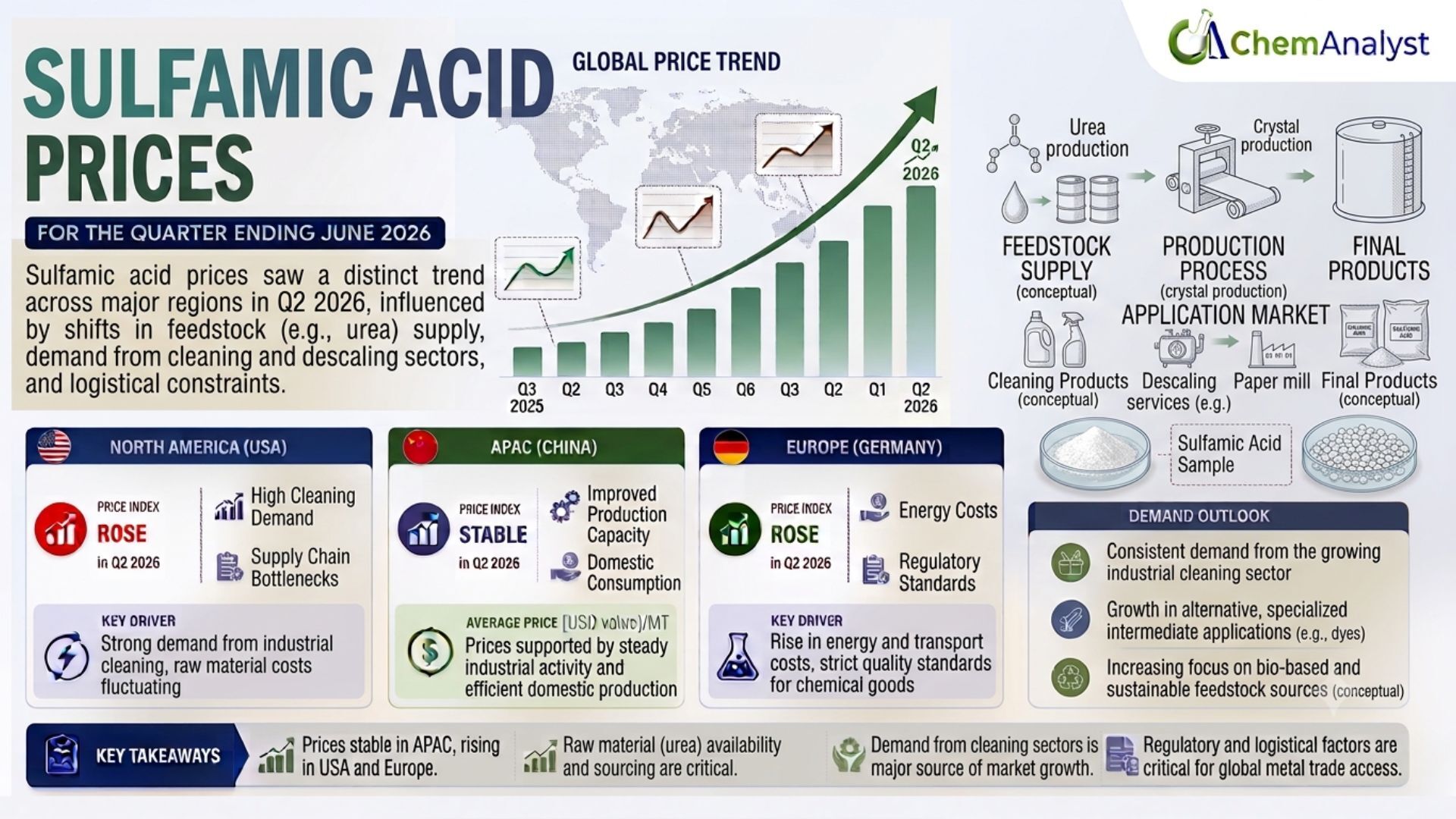
According to ChemAnalyst, the Sulfamic Acid prices moved upward across the major assessed markets during the quarter ending June 2026. China, the United States and Germany all experienced increases in their respective Sulfamic Acid Price Indexes, although the underlying drivers varied between regions. Rising feedstock costs, stronger industrial activity, increasing producer input costs and elevated energy expenses collectively contributed to the firmer market environment.
Sulfamic acid is an important inorganic acid used across several industrial applications, including cleaning and descaling formulations, water treatment, pulp and paper processing, electroplating and chemical manufacturing. Its ability to remove mineral deposits and its relatively stable handling characteristics make it valuable in industrial and commercial applications.
During Q2 2026, higher production costs remained a common theme across the three markets. China experienced increasing feedstock expenses alongside stronger industrial activity, while the United States faced rising producer input costs. Germany's market was influenced by increasing production and energy costs.
Get Real Time Online for Sulfamic Acid Prices: https://www.chemanalyst.com/Pricing-data/sulfamic-acid-2544
Sulfamic Acid Prices in APAC
In China, the Sulfamic Acid Price Index rose quarter-over-quarter during Q2 2026, driven by surging feedstock costs and industrial activity.
Production costs increased during the quarter as the Producer Price Index rose 4.1% year-over-year in June 2026.
The increase in China's producer-level prices indicates a firm manufacturing cost environment toward the end of Q2. For Sulfamic acid producers, higher costs across the industrial supply chain can influence manufacturing economics and encourage suppliers to adjust selling prices.
Feedstock costs were a particularly important factor. When upstream material expenses increase, manufacturers may face pressure on margins unless higher costs can be passed through to downstream customers. The combination of surging feedstock costs and stronger industrial activity created a supportive environment for Sulfamic Acid prices.
Industrial activity also contributed to demand-side support. Sulfamic acid is consumed in multiple industrial applications and stronger manufacturing activity can increase requirements for cleaning agents, water-treatment chemicals and other industrial formulations.
The 4.1% year-over-year increase in PPI in June 2026 further demonstrates the broader producer-cost pressure present in the Chinese market. Higher factory-gate prices can influence the cost structure of chemical manufacturers and contribute to firmer offers.
China's Q2 2026 market therefore reflected both cost-push and demand-related factors, resulting in an upward movement in the Sulfamic Acid Price Index.
Sulfamic Acid Prices in North America
In the United States, the Sulfamic Acid Price Index rose during Q2 2026, driven by increasing producer input costs.
Sulfamic Acid production costs increased in June 2026 as the Producer Price Index rose 5.5%.
The rise in producer prices indicates that manufacturers faced a higher overall cost environment. Chemical production costs can be affected by raw materials, utilities, energy, transportation, industrial services and other operating expenses. When these costs increase, producers may seek to recover part of the additional burden through higher selling prices.
The US Sulfamic acid market also benefits from demand across diverse industrial applications. The product is used in cleaning and descaling formulations, water treatment, industrial processing and other chemical applications. These end uses provide a recurring demand base for manufacturers and distributors.
The upward price movement during Q2 2026 was therefore closely connected with the increase in producer input costs. The 5.5% PPI increase provided evidence of the broader inflationary pressure affecting the manufacturing environment.
Cost pass-through can be more effective when downstream demand remains stable. Buyers requiring Sulfamic acid for regular production and industrial applications may continue procurement even when prices rise, allowing suppliers to maintain firmer offers.
The US market consequently experienced an upward price trend during the quarter, primarily reflecting higher producer-side costs.
Sulfamic Acid Prices in Europe
Germany's Sulfamic Acid Price Index rose quarter-over-quarter during Q2 2026, driven by increasing production costs and energy prices.
Sulfamic Acid production costs increased during the quarter, influenced by a 2.2% year-on-year rise in producer prices in May 2026.
Energy expenses remained an important consideration for German chemical manufacturers. Chemical production requires energy for processing, heating, cooling, material handling and associated industrial operations. Consequently, higher energy prices can increase the overall manufacturing cost base.
The 2.2% year-on-year rise in producer prices for May 2026 also indicated broader upward pressure within the industrial economy. This environment contributed to higher costs for chemical producers and supported the increase in the German Sulfamic Acid Price Index.
Germany's industrial sector provides demand for Sulfamic acid across several applications. Industrial cleaning, water treatment, chemical processing and other manufacturing activities contribute to consumption.
The German market therefore experienced a combination of cost inflation and energy-related pressure. Unlike a market driven primarily by a sudden demand surge, the Q2 2026 increase was strongly associated with rising production economics.
Book A Demo for Sulfamic Acid Price: https://www.chemanalyst.com/ChemAnalyst/PricingForm?Product=Sulfamic%20Acid
Key Factors Influencing Sulfamic Acid Prices in Q2 2026
Several factors shaped Sulfamic Acid prices across the major markets during the quarter ending June 2026.
Feedstock Costs
Feedstock expenses were a significant factor in China's market. Surging upstream costs increased the production burden for manufacturers and contributed to higher Sulfamic Acid prices.
Feedstock movements are particularly important for chemical producers because raw materials represent a core component of manufacturing costs. Persistent increases can eventually result in higher market offers if producers pass costs through the supply chain.
Producer Price Inflation
Producer-level inflation was a common theme across all three markets.
China recorded a 4.1% year-over-year PPI increase in June 2026, while the US PPI rose 5.5% in June 2026. Germany experienced a 2.2% year-on-year increase in producer prices in May 2026.
These indicators demonstrate that producers across the assessed markets were operating in environments where industrial pricing pressures remained significant.
Industrial Activity
Stronger industrial activity supported China's market during Q2 2026. Sulfamic acid's broad industrial applications mean that increased manufacturing activity can translate into higher consumption.
Demand from cleaning, descaling, water treatment and industrial processing applications can provide a stable foundation for market prices.
Energy Costs
Energy prices were particularly important in Germany. Higher industrial energy costs increase the expenses associated with chemical manufacturing and can contribute to higher selling prices.
Energy-intensive production environments can therefore remain sensitive to changes in electricity and other energy costs.
Cost Pass-Through
The ability of producers to transfer higher costs to customers depends on market demand and supply conditions. When demand remains sufficiently strong, producers have greater scope to increase offers.
Q2 2026 demonstrated this dynamic across the assessed markets, with higher producer costs accompanied by upward movements in Sulfamic Acid prices.
Sulfamic Acid Demand Outlook
The demand outlook for Sulfamic acid remains connected to the performance of industrial manufacturing and the applications in which the product is used.
Cleaning and descaling remain important areas of consumption because Sulfamic acid can be used to remove mineral deposits and scale from equipment and surfaces. Water-treatment applications provide another source of demand, while industrial processing and chemical manufacturing add further consumption.
Demand conditions can vary by region depending on manufacturing activity and industrial output. China's stronger industrial activity provided additional support during Q2 2026, while future demand in the United States and Germany will depend on the performance of downstream industries.
Procurement behavior will also influence short-term demand. Buyers may adjust purchasing schedules depending on inventory levels and expectations about future prices. If inventories decline while production activity remains strong, procurement requirements can increase and provide additional support to market prices.
Sulfamic Acid Supply Chain and Procurement Trends
Supply-chain economics remained important to the Sulfamic Acid market during Q2 2026. Buyers must consider raw material costs, producer pricing, energy expenses, transportation, inventory and supplier availability when planning procurement.
China's market demonstrated the impact of feedstock costs, while Germany highlighted the influence of energy expenses. In the United States, broader producer input costs were the main source of upward pressure.
Procurement teams can monitor producer-price indicators as an early signal of potential cost changes. Persistent increases in producer prices can indicate that chemical manufacturers may face continued cost pressure.
Inventory management is equally important. Maintaining sufficient stocks can protect buyers from short-term supply disruptions, while excessive inventories can increase exposure if market prices subsequently weaken.
Regional Sulfamic Acid Market Dynamics
The Q2 2026 Sulfamic Acid market displayed a consistent upward direction across China, the United States and Germany.
China's Sulfamic Acid Price Index increased quarter-over-quarter, supported by surging feedstock costs and industrial activity. Production costs were influenced by a 4.1% year-over-year increase in PPI in June 2026.
The United States also recorded an increase. Rising producer input costs contributed to higher production expenses, while the 5.5% increase in PPI in June 2026 highlighted the broader inflationary environment.
Germany experienced a quarter-over-quarter increase because of increasing production and energy costs. Producer prices rose 2.2% year-over-year in May 2026, adding further support to the market's cost structure.
Although all three markets moved higher, the specific drivers differed. China combined feedstock inflation with stronger industrial activity, the United States was primarily influenced by producer input costs and Germany faced production and energy-cost pressure.
Sulfamic Acid Market Outlook for the Second Half of 2026
The Sulfamic Acid market entered the second half of 2026 with a firm pricing environment. Future price direction will depend heavily on feedstock costs, industrial activity, producer inflation, energy prices and downstream demand.
In China, continued industrial activity combined with elevated feedstock costs could provide further price support. However, any moderation in producer inflation or weakening in downstream consumption could reduce upward momentum.
The US market will remain sensitive to producer input costs. If inflationary pressure across industrial inputs remains elevated, Sulfamic Acid producers could continue facing higher production expenses.
Germany's outlook will depend strongly on energy costs and industrial conditions. Continued increases in electricity and other production expenses could keep prices supported, while a reduction in energy-related costs could moderate the cost burden.
Across all markets, supply availability and inventory levels will remain important. A balanced supply-demand environment could limit volatility, while stronger demand or tighter availability could increase upward pressure.
Conclusion
Sulfamic Acid prices moved higher across the major assessed markets during the quarter ending June 2026. China, the United States and Germany all recorded increases in their respective Sulfamic Acid Price Indexes, with producer costs and industrial conditions serving as major drivers.
In China, the price index rose quarter-over-quarter, supported by surging feedstock costs and industrial activity. Production costs increased alongside a 4.1% year-over-year rise in PPI in June 2026.
In the United States, the Sulfamic Acid Price Index rose during Q2 2026 as increasing producer input costs pushed production expenses higher. The country's PPI increased 5.5% in June 2026, highlighting the broader cost pressure.
Germany also recorded a quarter-over-quarter increase, driven by increasing production costs and energy prices. Producer prices rose 2.2% year-over-year in May 2026, contributing to a firmer manufacturing cost environment.
Overall, the Q2 2026 market was characterized by broad-based cost pressure. Feedstock expenses, producer inflation, industrial activity and energy prices will remain the primary factors to monitor for future Sulfamic Acid Prices. The direction of downstream demand and changes in production economics will ultimately determine whether the market maintains its upward trajectory during the second half of 2026.
ChemAnalsyt
Call +1 3322586602
420 Lexington Avenue, Suite 300, New York, NY, United States, 10170
Website: https://www.chemanalyst.com/
Email: sales@chemanalyst.com
この記事をシェア





