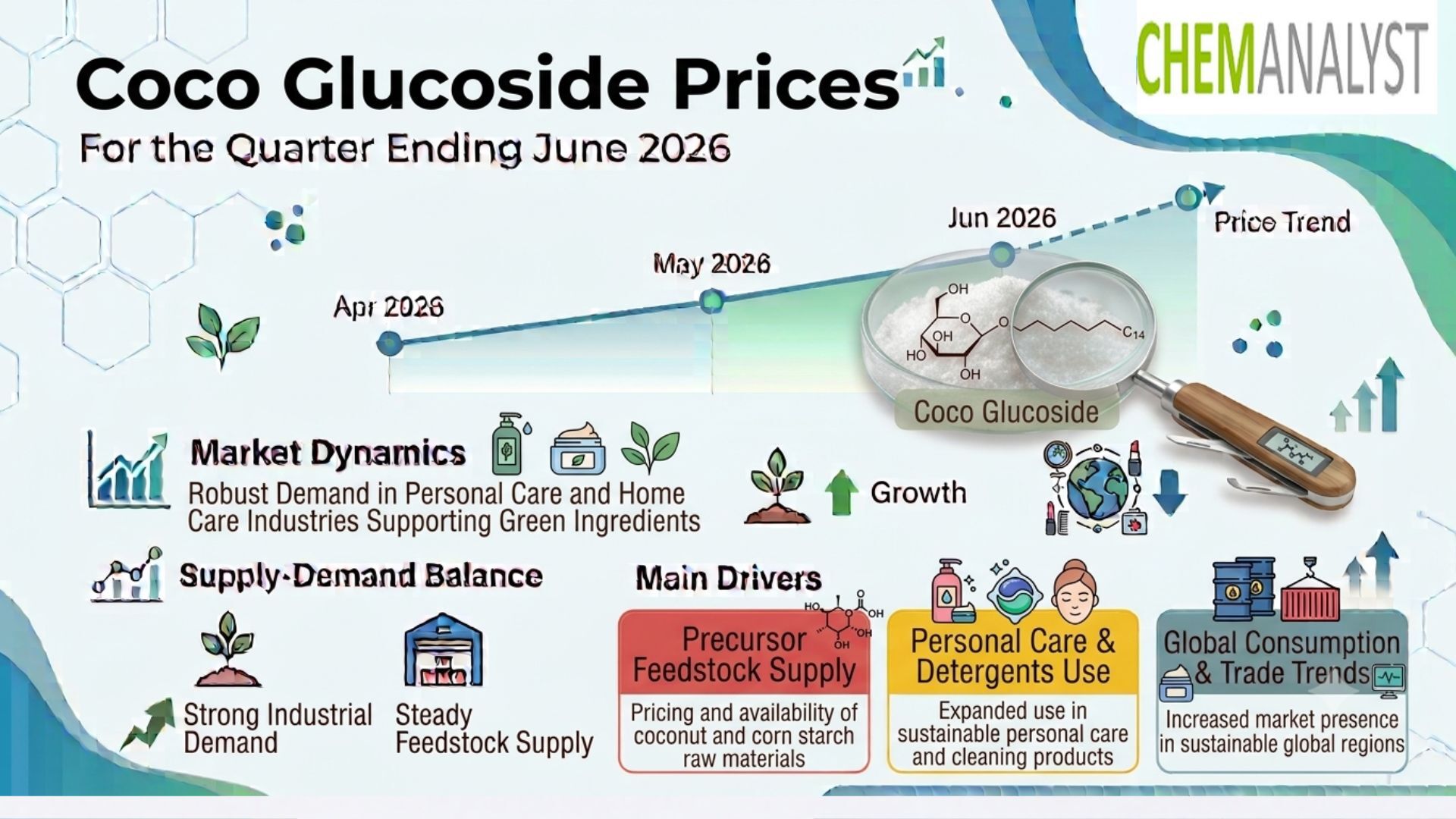
According to ChemAnalyst, the Coco Glucoside Prices market recorded an upward trend across major global regions during the second quarter of 2026. Markets in Asia-Pacific (APAC), Europe and North America experienced quarter-over-quarter increases in their respective Coco Glucoside Price Indexes, supported by robust downstream demand and higher feedstock costs.
Coco Glucoside is a non-ionic surfactant widely used in personal care, cosmetics, hair care, skin care, cleansing formulations and other consumer and industrial applications. Its plant-derived profile and mild cleansing properties have supported its use in formulations seeking naturally derived and biodegradable ingredients. Consequently, changes in personal care consumption, feedstock availability, production expenses and supply-chain conditions can influence Coco Glucoside Prices.
During Q2 2026, increasing coconut oil costs emerged as a major factor affecting production economics. China experienced higher prices because of robust demand and increasing feedstock costs, while Germany saw additional support from strong personal care demand and tightening Southeast Asian copra supply. In the United States, increased production costs and robust end-use demand contributed to the quarter-over-quarter increase in the Coco Glucoside Price Index.
Coco Glucoside Prices in APAC
China Coco Glucoside Price Trends
In China, the Coco Glucoside Price Index rose quarter-over-quarter in Q2 2026, driven by robust demand and increasing feedstock costs.
The Chinese market benefited from steady downstream requirements, particularly from applications connected with personal care and cleansing formulations. Stronger demand can support producer pricing by improving order activity and reducing pressure on suppliers to offer discounts.
At the same time, the cost side of the market became increasingly important. Coco Glucoside production depends on feedstocks such as coconut-derived raw materials, making changes in coconut oil economics particularly relevant to manufacturers.
During Q2 2026, the combination of robust demand and higher feedstock expenses created a supportive environment for Coco Glucoside Prices in China. Producers faced higher input costs while downstream consumption remained sufficiently firm to support market pricing.
Impact of Coconut Oil Feedstock Costs
Coco Glucoside production costs increased in Q2 2026, as coconut oil feedstock costs experienced an upward trend.
Feedstock prices are a critical component of Coco Glucoside production economics. When coconut oil costs increase, manufacturers can face higher expenses throughout the production process. Depending on market competition and demand conditions, some of these additional costs may be reflected in finished-product quotations.
The upward trend in coconut oil feedstock costs therefore contributed to the firm pricing environment in China during Q2 2026. Since demand was also robust, producers had greater scope to maintain or increase selling prices rather than absorbing the full increase in production expenses.
Demand and Supply Dynamics in China
The interaction between demand and supply remained an important factor in China's Coco Glucoside market. Robust demand provided support for producers, while higher feedstock costs increased the minimum economically viable selling price.
For buyers, this combination can result in higher procurement costs and greater sensitivity to changes in feedstock markets. Companies purchasing Coco Glucoside for personal care and cosmetic formulations may therefore benefit from monitoring coconut oil price developments alongside supplier quotations.
Get Real Time Online for Coco Glucoside Prices: https://www.chemanalyst.com/Pricing-data/coco-glucoside-2306
Coco Glucoside Prices in Europe
Germany Coco Glucoside Price Trends
Germany recorded another firm market during Q2 2026. The Coco Glucoside Price Index rose quarter-over-quarter, driven by rising costs and robust personal care demand.
The European personal care sector remained an important source of downstream demand for Coco Glucoside. Its use in shampoos, body washes, facial cleansers, liquid soaps and other formulations makes market consumption closely connected to personal care manufacturing activity.
Strong end-use demand can provide producers with greater pricing stability, particularly when manufacturing costs are simultaneously increasing. In Germany, these two factors worked together during Q2 2026 to support the upward movement in Coco Glucoside Prices.
Coconut Oil Costs and German Production Economics
Production costs increased as coconut oil feedstock strengthened in Q2 2026, influenced by tightening Southeast Asian copra supply.
Copra availability is closely connected with coconut oil production. When supply of the underlying agricultural feedstock becomes tighter, coconut oil prices can experience upward pressure. For manufacturers using coconut oil as an important feedstock, this can translate into higher production expenses.
The tightening of Southeast Asian copra supply therefore became an important factor influencing the German Coco Glucoside market. Higher coconut oil costs increased the input cost for producers, while robust personal care demand helped sustain market prices.
Role of Personal Care Demand in Europe
Coco Glucoside's growing use in personal care formulations makes downstream demand a key factor in its European pricing structure. Manufacturers of cosmetics and personal care products require consistent supplies of surfactants to maintain production schedules.
When personal care demand remains robust, purchasing activity can remain steady even when input costs rise. This creates a more supportive environment for suppliers and can allow higher feedstock expenses to pass through into finished Coco Glucoside prices.
Germany's Q2 2026 market demonstrated this relationship, with robust personal care demand reinforcing the upward impact of increasing production costs.
Coco Glucoside Prices in North America
United States Coco Glucoside Price Trends
In the United States, the Coco Glucoside Price Index rose quarter-over-quarter in Q2 2026, driven by increased production costs and robust end-use demand.
The U.S. market faced a combination of cost-side and demand-side support. Higher production costs placed upward pressure on supplier quotations, while robust end-use demand provided a strong downstream foundation for market prices.
Coco Glucoside consumption across personal care, cosmetics, cleansing products and other formulations makes demand conditions an important component of market pricing. When buyers continue to require material at stable or increasing volumes, producers may have greater ability to pass higher manufacturing expenses through to the market.
Consequently, both production costs and end-use demand contributed to the increase in U.S. Coco Glucoside Prices during Q2 2026.
Impact of the U.S. Producer Price Index
Coco Glucoside production costs increased in Q2 2026, influenced by a 5.5% PPI rise year-over-year in June 2026.
The Producer Price Index is an important indicator of changes in prices received by producers and broader cost pressures across the industrial economy. A 5.5% year-over-year increase indicated a significantly higher producer-cost environment in June 2026.
For Coco Glucoside manufacturers, a stronger producer-price environment can increase expenses associated with production and related industrial activities. Producers may respond by revising selling prices to protect margins.
The PPI increase therefore represented an important cost-side factor behind the quarter-over-quarter rise in the U.S. Coco Glucoside Price Index.
Robust End-Use Demand in the U.S.
Alongside increasing production costs, robust end-use demand supported the U.S. market. Strong consumption from downstream industries can help prevent prices from weakening when manufacturers face higher operating expenses.
For Coco Glucoside, continued demand from personal care and cosmetic applications provided an important market foundation during Q2 2026. Buyers requiring consistent material supplies remained exposed to the higher cost environment.
Book A Demo for Coco Glucoside Price: https://www.chemanalyst.com/ChemAnalyst/PricingForm?Product=Coco%20Glucoside
Key Factors Influencing Coco Glucoside Prices in Q2 2026
Several interconnected factors shaped Coco Glucoside Prices during Q2 2026.
Coconut Oil Feedstock Costs
The most important feedstock-related factor was the upward trend in coconut oil costs. China experienced higher production costs as coconut oil feedstock costs increased, while Germany faced higher production expenses as coconut oil strengthened amid tightening Southeast Asian copra supply.
Because coconut-derived feedstocks are fundamental to Coco Glucoside production, changes in their cost can have a direct effect on manufacturers' overall economics.
Robust Personal Care Demand
Demand from the personal care sector remained an important source of support. Germany experienced robust personal care demand, while the United States recorded robust end-use demand.
Strong downstream demand can provide producers with greater pricing power and help the market absorb higher production costs.
Increasing Production Costs
Higher production costs were a common factor across China, Germany and the United States. Manufacturers operating in each market faced cost pressures that contributed to higher Coco Glucoside Price Index readings.
Southeast Asian Copra Supply
Tightening Southeast Asian copra supply influenced coconut oil economics in Europe. Reduced availability of the underlying agricultural feedstock can contribute to higher coconut oil costs and subsequently affect the production cost of coconut-derived surfactants.
Producer Price Inflation
The U.S. market was additionally influenced by a 5.5% year-over-year PPI rise in June 2026. The increase highlighted the broader producer-cost pressures affecting industrial manufacturers and contributed to the firmer Coco Glucoside pricing environment.
Example: How Feedstock Costs Can Affect Coco Glucoside Prices
Consider a Coco Glucoside producer that relies on coconut oil as a major feedstock. If coconut oil prices increase because of tighter copra availability, the producer's raw material expenditure will also increase.
Initially, the manufacturer may absorb part of the additional expense. However, if feedstock prices remain elevated while downstream demand stays robust, the producer may adjust Coco Glucoside quotations to recover a portion of the higher production cost.
For example, if personal care manufacturers continue purchasing Coco Glucoside at stable volumes, suppliers may have less incentive to reduce prices. Higher feedstock expenses can therefore pass through more effectively into finished-product pricing.
This example illustrates how feedstock costs and downstream demand can work together to influence Coco Glucoside Prices.
Impact on Procurement and Supply Chain Planning
The Q2 2026 market highlights the importance of monitoring both upstream feedstock conditions and downstream demand when planning Coco Glucoside procurement.
Buyers should monitor coconut oil prices and copra supply conditions because changes in agricultural feedstock availability can influence the production cost of Coco Glucoside.
In China, robust demand combined with increasing feedstock costs created an upward market environment. In Germany, tightening Southeast Asian copra supply contributed to stronger coconut oil costs, while robust personal care demand provided additional price support.
In the United States, procurement teams needed to account for the 5.5% year-over-year PPI rise in June 2026, which contributed to increased production costs.
For businesses with regular Coco Glucoside requirements, monitoring these indicators can help improve purchasing schedules, cost forecasting, inventory management and supplier negotiations.
Regional Coco Glucoside Price Comparison
The Q2 2026 market showed a consistent upward direction across the three regions.
China recorded a quarter-over-quarter increase in the Coco Glucoside Price Index, driven by robust demand and increasing feedstock costs. The upward trend in coconut oil feedstock costs increased production expenses and supported firmer pricing.
Germany also recorded a quarter-over-quarter increase. Rising costs and robust personal care demand supported the market, while tightening Southeast Asian copra supply strengthened coconut oil feedstock economics.
The United States experienced a quarter-over-quarter increase as increased production costs coincided with robust end-use demand. The 5.5% year-over-year PPI increase in June 2026 further highlighted the cost pressures affecting the market.
Although the specific drivers differed by region, the common theme was a combination of higher production costs and healthy downstream demand.
Coco Glucoside Prices Outlook
The Q2 2026 market performance indicates that Coco Glucoside Prices entered the second half of 2026 with a firm underlying cost structure.
In China, the future price direction will depend on the movement of coconut oil feedstock costs and the strength of downstream demand. Continued feedstock inflation combined with robust consumption could maintain upward pressure.
In Europe, coconut oil and copra supply developments will remain important. If Southeast Asian copra availability remains constrained, feedstock costs could continue influencing European Coco Glucoside production economics.
In the United States, producer-price developments and end-use demand will remain key indicators. Continued producer-cost inflation could support higher prices, particularly if downstream demand remains robust.
Conclusion
The Coco Glucoside Prices market recorded a broad upward trend across APAC, Europe and North America during Q2 2026.
In China, the Coco Glucoside Price Index rose quarter-over-quarter, supported by robust demand and increasing feedstock costs. Coconut oil feedstock costs experienced an upward trend, increasing production expenses.
Germany also recorded a quarter-over-quarter increase in the Coco Glucoside Price Index, driven by rising costs and robust personal care demand. Production costs increased as coconut oil strengthened amid tightening Southeast Asian copra supply.
In the United States, the Coco Glucoside Price Index rose quarter-over-quarter due to increased production costs and robust end-use demand. The 5.5% year-over-year PPI rise in June 2026 contributed to the higher production-cost environment.
Overall, Q2 2026 demonstrated the importance of feedstock economics, copra availability, producer-price inflation and downstream personal care demand in shaping Coco Glucoside Prices. Monitoring these factors will remain essential for manufacturers, suppliers, traders and procurement professionals assessing market conditions during the remainder of 2026.
ChemAnalsyt
Call +1 3322586602
420 Lexington Avenue, Suite 300, New York, NY, United States, 10170
Website: https://www.chemanalyst.com/
Email: sales@chemanalyst.com
この記事をシェア





