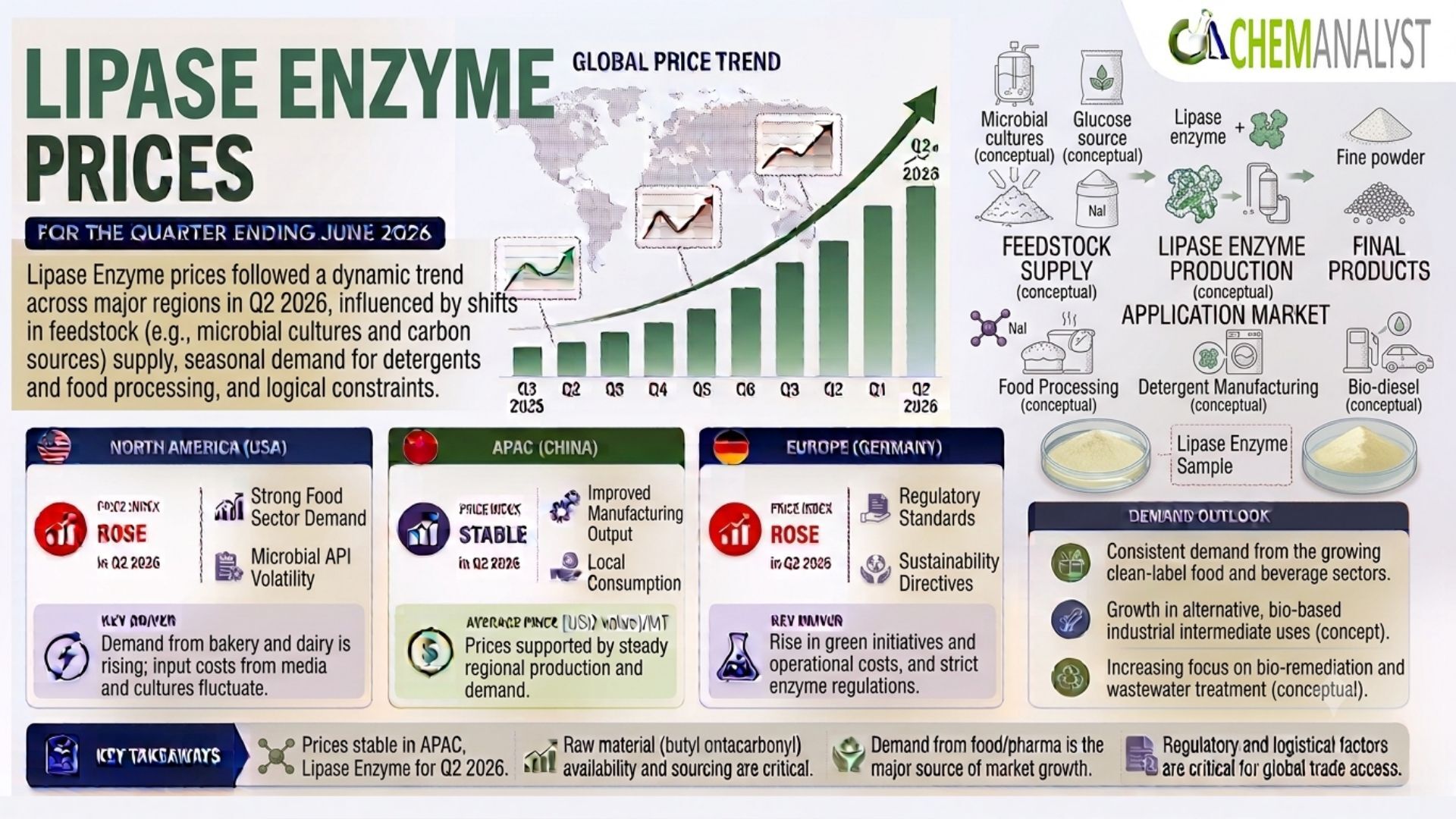
According to ChemAnalyst, the Lipase Enzyme prices increased across the major assessed markets during the quarter ending June 2026, with North America, APAC and Europe all recording significant quarter-over-quarter gains. The market was influenced by freight-driven costs, tighter supply conditions, constrained export availability and increasing import expenses.
Lipase enzymes are specialized biocatalysts that facilitate the breakdown of fats and oils into fatty acids and glycerol. They are widely used across food processing, dairy production, animal feed, pharmaceuticals, detergents, biotechnology and other industrial applications. Because of their broad application base, Lipase Enzyme demand can be influenced by developments across multiple downstream sectors.
During Q2 2026, logistics and supply availability became particularly important. The United States experienced a 20.64% quarter-over-quarter increase in its Lipase Enzyme Price Index, primarily reflecting freight-driven costs. China recorded an 18.05% increase, with tighter supply supporting exports, while the Netherlands registered an 18.035% increase, as import availability tightened across the market.
The synchronized increases across these regions point toward a firm global pricing environment. Although the individual drivers varied by market, freight, supply tightness and import availability collectively contributed to higher Lipase Enzyme prices.
Lipase Enzyme Prices in North America
In the United States, the Lipase Enzyme Price Index rose by 20.64% quarter-over-quarter in Q2 2026, reflecting freight-driven costs.
The average Lipase Enzyme price for the quarter was approximately USD 2283.33/MT on a CFR Los Angeles delivery basis.
Freight costs were a major factor behind the increase in the US market. For imported specialty enzymes, transportation expenses can have a meaningful impact on delivered pricing because buyers must account for ocean freight, handling, insurance and other logistics-related expenses in addition to the underlying product value.
The 20.64% quarter-over-quarter increase indicates that the impact of freight and logistics was substantial during Q2 2026. Even when product availability remains adequate at the source, higher transportation costs can increase the final landed cost paid by downstream users.
The CFR Los Angeles assessment of USD 2283.33/MT reflects the delivered market environment during the quarter. The CFR basis is particularly relevant for buyers evaluating the total cost of imported material because it incorporates freight to the destination port.
Lipase Enzyme demand in the United States is supported by diverse applications. Food processing and dairy production represent important areas of consumption, while pharmaceutical, detergent, animal feed and biotechnology applications provide additional demand channels.
The diversity of these end-use sectors can provide a relatively broad demand base. However, procurement decisions can vary according to production schedules, inventories and downstream operating conditions.
The Q2 2026 increase therefore reflected the interaction between established downstream demand and higher freight-related expenses. For buyers, transportation costs became an important component of overall Lipase Enzyme procurement economics.
Get Real Time Online for Lipase Enzyme Prices: https://www.chemanalyst.com/Pricing-data/lipase-enzyme-2271
Lipase Enzyme Prices in APAC
In China, the Lipase Enzyme Price Index rose by 18.05% quarter-over-quarter during Q2 2026, as tighter supply supported exports.
The average Lipase Enzyme price for the quarter was approximately USD 2103.33/MT FOB Shanghai export.
China's market experienced a significant increase as supply tightened and export demand remained sufficiently supportive. When available supply becomes more constrained, suppliers can gain greater pricing power, particularly when international buyers continue seeking material.
The 18.05% quarter-over-quarter increase reflects the influence of this tighter supply environment. Export-oriented suppliers may prioritize shipments and adjust offers when inventories become less abundant.
The average price of USD 2103.33/MT FOB Shanghai provides a reference for Chinese export-market conditions during Q2 2026. The FOB basis represents the product value at the export location before destination-specific freight and import costs.
Tighter supply can also influence procurement strategies among overseas buyers. Importers may seek to secure material earlier to reduce exposure to further price increases or potential availability constraints. This can, in turn, reinforce buying activity in the export market.
China's position in international chemical and enzyme supply chains makes its availability conditions important for global buyers. Any sustained tightening could continue to influence export pricing and international procurement costs.
The Q2 2026 movement therefore demonstrates the sensitivity of Lipase Enzyme prices to supply availability. If supply conditions improve, some of the upward pressure could ease. However, continued export demand combined with restricted availability could keep the market firm.
Lipase Enzyme Prices in Europe
In the Netherlands, the Lipase Enzyme Price Index rose by 18.035% quarter-over-quarter during Q2 2026, reflecting tightening import availability marketwide.
The average Lipase Enzyme price for the quarter was approximately USD 2242.67/MT, reflecting freight pressures.
The European market was influenced by a combination of tighter import availability and higher freight costs. Import-dependent markets can be particularly sensitive to changes in international supply because buyers depend on overseas producers to meet local requirements.
When import availability tightens, buyers may face fewer sourcing options. Suppliers and distributors can consequently maintain firmer offers, especially when downstream customers require uninterrupted supplies.
The 18.035% quarter-over-quarter increase demonstrates the significance of these supply-chain factors. Freight pressures further increased the landed cost of imported material, adding another layer of upward pressure.
The average price of USD 2242.67/MT reflects the European market during Q2 2026. For importers, the final procurement cost is influenced not only by the producer's offer but also by transportation and other logistics expenses.
Lipase Enzyme demand in Europe is supported by food processing, dairy applications, pharmaceuticals, detergents, animal nutrition and other industrial sectors. Continued requirements from these industries can provide a stable consumption base even when import conditions become tighter.
The combination of steady downstream requirements and constrained import availability therefore supported the firm European market during the quarter.
Book A Demo for Lipase Enzyme Price: https://www.chemanalyst.com/ChemAnalyst/PricingForm?Product=Lipase%20Enzyme
Key Factors Influencing Lipase Enzyme Prices in Q2 2026
Several factors shaped global Lipase Enzyme prices during Q2 2026.
Freight Costs
Freight was one of the most important factors affecting pricing during the quarter. In the United States, freight-driven costs were directly identified as a key reason for the 20.64% quarter-over-quarter increase.
The Netherlands also experienced freight-related pressure, contributing to the 18.035% increase in its Price Index.
For internationally traded enzymes, transportation costs can significantly influence the final price paid by buyers.
Supply Tightness
China experienced tighter supply during Q2 2026, which supported exports and contributed to an 18.05% quarter-over-quarter increase in the Price Index.
When supply becomes less readily available, buyers may compete more actively for available volumes. This can strengthen producer and exporter pricing.
Import Availability
The European market experienced tightening import availability during the quarter. Reduced availability can increase procurement competition and limit the ability of buyers to negotiate lower prices.
Import-dependent markets therefore tend to remain sensitive to changes in international supply.
Downstream Demand
Lipase enzymes serve a broad range of industries, including food processing, dairy, pharmaceuticals, detergents, animal feed and biotechnology.
Demand across multiple sectors can provide support to the market and help maintain purchasing activity when supply-chain costs rise.
Logistics and Landed Costs
The difference between FOB and CFR pricing illustrates the importance of logistics. China's average price was USD 2103.33/MT FOB Shanghai, while the US assessment was USD 2283.33/MT CFR Los Angeles.
The comparison highlights how freight and destination-related costs can influence regional pricing.
Lipase Enzyme Demand Outlook
The demand outlook for Lipase Enzymes remains supported by their wide range of industrial and commercial applications.
Food processing represents one of the most important demand channels. Lipases are used in applications involving fats and oils and can contribute to specific processing and formulation requirements.
The dairy industry also uses enzymes in various processes, while animal feed applications provide another source of consumption.
Pharmaceutical and biotechnology applications can generate demand for specialized grades where purity and performance are important. Detergent manufacturers also utilize enzymes as functional ingredients in cleaning formulations.
Because Lipase Enzymes serve several end-use industries, market demand is not dependent on a single sector. This diversification can provide a degree of resilience to overall consumption.
However, procurement levels can still fluctuate based on production schedules, inventory positions, economic conditions and raw-material availability.
Lipase Enzyme Supply Chain and Procurement Trends
Supply-chain conditions were central to the Q2 2026 market. Buyers increasingly needed to consider not only the underlying enzyme price but also freight costs and availability.
In the United States, freight-driven expenses increased delivered costs. Buyers importing through the Los Angeles market therefore faced higher procurement expenses even as downstream demand remained active.
In China, tighter supply supported exports. This environment may encourage overseas buyers to secure volumes earlier, particularly when they anticipate further supply restrictions.
European buyers faced tightening import availability alongside freight pressure. Importers may therefore need to maintain closer relationships with suppliers and monitor international logistics conditions.
Inventory planning can also become more important during periods of tight availability. Maintaining sufficient stocks can protect downstream operations against delays or short-term supply disruptions. At the same time, excessive inventory can increase financial exposure if prices later decline.
Regional Lipase Enzyme Market Dynamics
The Q2 2026 market showed a clear upward trend across all three assessed regions.
In the United States, the Lipase Enzyme Price Index increased 20.64% quarter-over-quarter, reflecting freight-driven costs. The average price reached approximately USD 2283.33/MT CFR Los Angeles.
In China, the Lipase Enzyme Price Index increased 18.05% quarter-over-quarter, as tighter supply supported exports. The average price stood at approximately USD 2103.33/MT FOB Shanghai.
In the Netherlands, the Lipase Enzyme Price Index rose 18.035% quarter-over-quarter, reflecting tightening import availability. The average price was approximately USD 2242.67/MT, with freight pressures contributing to the market increase.
Although the percentage changes were relatively close, the principal drivers differed. Freight was particularly influential in the United States, supply tightness shaped China's market and import availability and freight affected the Netherlands.
Lipase Enzyme Market Outlook for the Second Half of 2026
The Lipase Enzyme market entered the second half of 2026 with a firm pricing environment. Future price direction will depend heavily on freight costs, supply availability, international trade flows and downstream demand.
In the United States, any moderation in freight expenses could reduce delivered-cost pressure. However, continued demand from food processing, pharmaceuticals, animal feed and other sectors could continue supporting the market.
China's outlook will depend on whether supply remains tight. If export demand continues while available supply remains constrained, prices could retain upward momentum. Improved supply availability could moderate price pressure.
The Netherlands and broader European market will remain sensitive to import availability. Continued dependence on imported material means freight and international supply conditions will remain important.
Overall, the market's trajectory will depend on whether supply-chain constraints ease or persist during the second half of 2026.
Conclusion
Lipase Enzyme prices increased significantly across North America, APAC and Europe during the quarter ending June 2026.
In the United States, the Lipase Enzyme Price Index rose 20.64% quarter-over-quarter, reflecting freight-driven costs. The average price was approximately USD 2283.33/MT CFR Los Angeles.
In China, the Price Index increased 18.05% quarter-over-quarter, with tighter supply supporting exports. The average Lipase Enzyme price reached approximately USD 2103.33/MT FOB Shanghai.
In the Netherlands, the Price Index rose 18.035% quarter-over-quarter, reflecting tightening import availability marketwide. The average price stood at approximately USD 2242.67/MT, with freight pressures contributing to the increase.
Overall, Q2 2026 was characterized by firm Lipase Enzyme prices, with freight costs, tighter supply, import availability, export activity and downstream demand emerging as the key market drivers. During the second half of 2026, buyers and suppliers will continue to monitor logistics expenses, international supply conditions, inventory levels and demand from food, pharmaceutical, detergent, animal feed and biotechnology applications to assess the future direction of Lipase Enzyme Prices.
ChemAnalsyt
Call +1 3322586602
420 Lexington Avenue, Suite 300, New York, NY, United States, 10170
Website: https://www.chemanalyst.com/
Email: sales@chemanalyst.com
この記事をシェア





