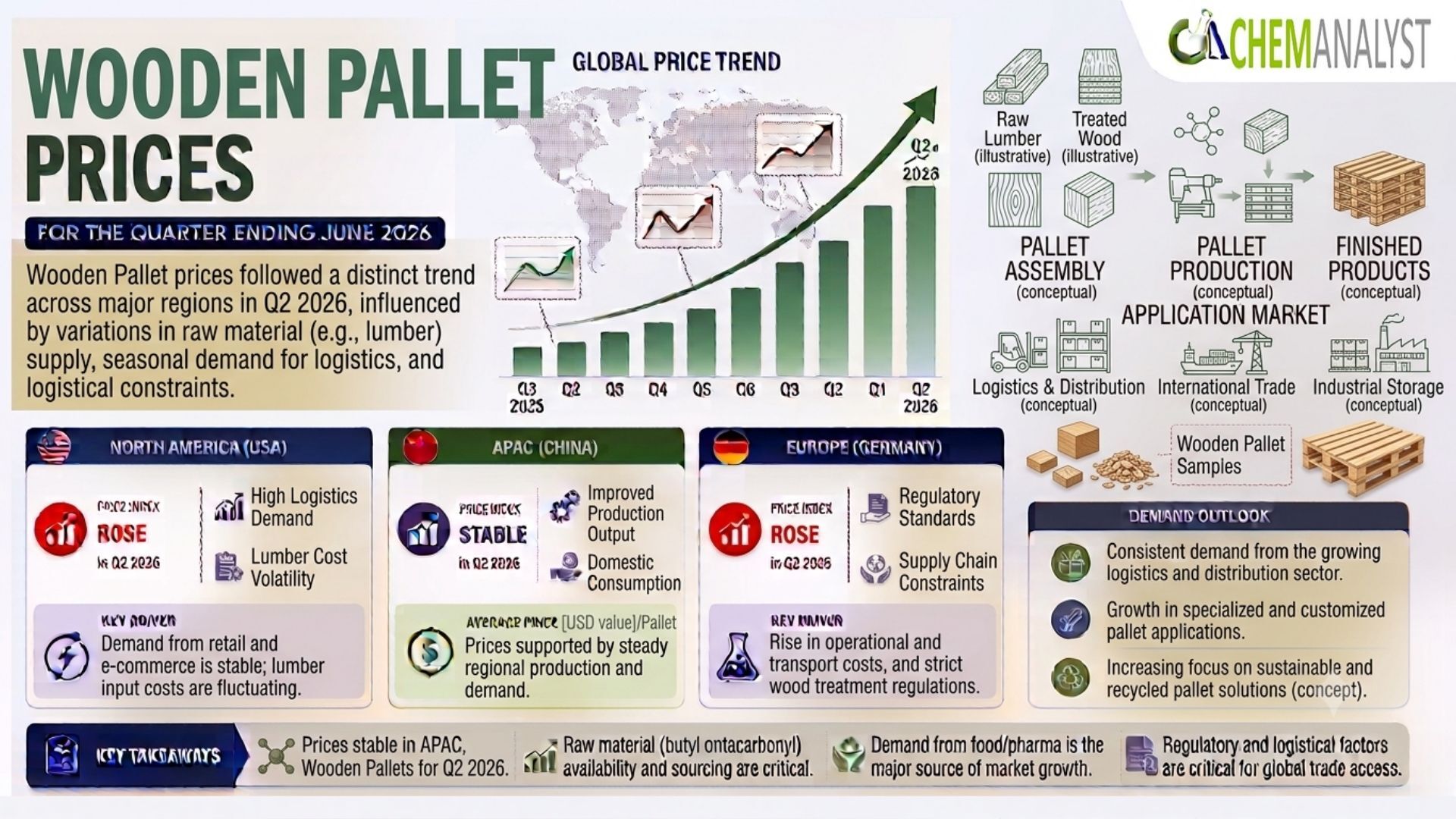
According to ChemAnalyst, the Wooden Pallet prices showed mixed regional movements during the quarter ending June 2026. While the United States and Poland experienced upward price trends, China recorded a notable quarter-over-quarter decline. The different regional movements reflected variations in downstream demand, lumber costs, export activity and supply conditions.
Wooden pallets remain an important component of global logistics and supply-chain operations. They are widely used for the storage, handling and transportation of goods across manufacturing, retail, agriculture, food processing, warehousing and international trade. Because pallets are directly connected to the movement of physical goods, their demand is closely linked to industrial production, distribution activity, exports and warehouse utilization.
During Q2 2026, the United States market remained on a moderate upward trajectory, supported by a stable demand base and elevated lumber costs. China, in contrast, experienced weaker downstream demand, resulting in a 7.08% quarter-over-quarter decline in the Wooden Pallet Price Index. Poland recorded a 2.87% quarter-over-quarter increase, supported by steady export demand and balanced supply.
The contrasting regional movements highlight the importance of both raw-material costs and downstream logistics activity in determining Wooden Pallet prices.
Wooden Pallet Prices in North America
In the United States, the Wooden Pallet Price Index remained on a moderate upward trajectory during Q2 2026, supported by a stable demand base and elevated lumber costs.
Wooden Pallet prices hovered around USD 22000/1000 Pcs on an FOB basis during Q2 2026.
The US market benefited from a relatively stable demand environment. Pallets are essential to the movement and storage of goods, meaning demand is closely associated with warehouse operations, manufacturing output, distribution networks and transportation activity.
A stable demand base provided support to pallet consumption during the quarter. At the same time, elevated lumber costs increased the underlying production expenses faced by pallet manufacturers.
Lumber is a fundamental input for wooden pallets, making changes in timber and lumber prices particularly important to the pallet market. When lumber becomes more expensive, manufacturers can experience higher production costs. Depending on market conditions, these costs can be reflected in higher pallet prices.
The moderate upward trajectory observed in the United States therefore resulted from the interaction between stable downstream demand and higher raw-material expenses. The market did not experience a sharp increase, suggesting that demand and supply remained relatively balanced despite elevated lumber costs.
The average price of USD 22000/1000 Pcs FOB provides a reference for the US market during Q2 2026. The FOB basis reflects the price at the point of shipment before destination-specific freight and other logistics expenses.
For pallet buyers, lumber prices will remain a key indicator when evaluating future procurement costs. If lumber prices remain elevated, pallet manufacturers may continue facing cost pressure, particularly if demand remains stable.
Get Real Time Online for Wooden Pallet Prices: https://www.chemanalyst.com/Pricing-data/wooden-pallet-2268
Wooden Pallet Prices in APAC
In China, the Wooden Pallet Price Index fell by 7.08% quarter-over-quarter during Q2 2026, driven by downstream demand.
The average Wooden Pallet price for the quarter was approximately USD 18412.67/1000 Pcs, per industry data.
China's market moved in the opposite direction to the United States and Poland. The decline was primarily associated with downstream demand conditions. When manufacturers, distributors and other users reduce their pallet requirements, purchasing activity can weaken and place downward pressure on prices.
Wooden pallets are closely tied to industrial and logistics activity. Lower downstream demand can reduce the need for new pallets, particularly when businesses have existing inventories that can be reused or repaired.
The 7.08% quarter-over-quarter decline indicates a more pronounced adjustment than the modest movements recorded in the United States and Poland. The decrease suggests that demand-side conditions were a significant influence on the Chinese market during Q2 2026.
The average price of USD 18412.67/1000 Pcs reflects the market conditions observed during the quarter. The relatively lower price level compared with the US assessment also illustrates how regional production costs, market structures, specifications and supply-demand conditions can differ.
China's extensive manufacturing and export sector makes pallet demand particularly connected to industrial production and trade activity. Changes in factory output, warehousing requirements and export shipments can consequently influence pallet consumption.
If downstream activity strengthens, pallet procurement could recover and provide support to prices. Conversely, continued weakness in demand could keep prices under pressure.
Wooden Pallet Prices in Europe
In Poland, the Wooden Pallet Price Index rose by 2.87% quarter-over-quarter during Q2 2026, reflecting steady export demand.
The average Wooden Pallet price for the quarter was approximately USD 13495.00/1000 Pcs, amid balanced supply.
Poland's market benefited from steady export demand during the quarter. Export-oriented manufacturing and logistics activity can generate consistent requirements for pallets because goods often need to be securely packaged and handled throughout the transportation process.
The 2.87% quarter-over-quarter increase indicates moderate upward movement rather than a sharp price escalation. Balanced supply helped prevent a more significant increase by ensuring that available pallet volumes remained sufficient to meet market requirements.
The average price of USD 13495.00/1000 Pcs reflects the assessed market conditions in Poland during Q2 2026.
The combination of stable export demand and balanced supply created a relatively orderly pricing environment. Steady exports supported consumption, while sufficient availability limited the potential for excessive price increases.
Poland's position within European manufacturing and trade networks makes export activity an important factor for wooden pallet demand. Continued international shipments could therefore remain supportive of pallet consumption during the second half of 2026.
Book A Demo for Wooden Pallet Price: https://www.chemanalyst.com/ChemAnalyst/PricingForm?Product=Wooden%20Pallet
Key Factors Influencing Wooden Pallet Prices in Q2 2026
Several factors influenced Wooden Pallet prices across the assessed regions during Q2 2026.
Lumber Costs
Lumber costs were a key factor in the United States. Elevated lumber prices increased the production costs associated with manufacturing wooden pallets.
Because wood represents the primary raw material in conventional wooden pallets, changes in lumber prices can have a direct impact on manufacturing economics.
Downstream Demand
Demand was particularly important in China, where weaker downstream requirements contributed to a 7.08% quarter-over-quarter decline.
Pallet consumption generally follows logistics and industrial activity. When production or distribution requirements weaken, businesses may reduce purchases of new pallets.
Export Activity
Export demand supported the Polish market during Q2 2026. The 2.87% quarter-over-quarter increase in the Wooden Pallet Price Index reflected steady export demand.
International shipments require efficient handling, storage and transportation, creating recurring demand for pallets.
Supply Availability
Supply conditions also affected regional pricing. Poland's market remained balanced, limiting the extent of upward price pressure despite steady export demand.
A balanced supply-demand relationship generally reduces price volatility and provides buyers with greater procurement predictability.
Logistics and Transportation
Wooden pallets are an essential logistics product, so transportation and distribution activity directly affect their consumption. Changes in freight volumes, warehousing requirements and international trade can influence pallet demand.
Wooden Pallet Demand Outlook
The demand outlook for Wooden Pallets remains closely connected to global manufacturing, warehousing, retail distribution, agriculture, food processing and international trade.
In the United States, the stable demand base observed during Q2 2026 could continue supporting pallet requirements. As long as manufacturing and distribution activity remain stable, demand for pallets should retain a relatively firm foundation.
China's demand outlook is more dependent on downstream industrial activity. The 7.08% quarter-over-quarter decline during Q2 2026 demonstrates how changes in downstream demand can quickly affect pallet procurement.
If manufacturing and export activity recover, demand for pallets could strengthen. However, continued weakness in downstream industries could keep purchasing activity subdued.
Poland's outlook remains supported by export demand. Continued international trade activity could maintain pallet requirements, while balanced supply would help keep the market orderly.
Wooden Pallet Supply Chain and Procurement Trends
Supply-chain conditions remain an important consideration for pallet buyers because pallets are required throughout the logistics process.
US buyers must closely monitor lumber prices because elevated raw-material costs can influence pallet quotations. Companies with predictable pallet requirements may benefit from planning purchases according to their operational schedules.
In China, buyers may have greater negotiating leverage when downstream demand is weak. The Q2 2026 decline indicates that softer demand can create a more competitive procurement environment.
In Poland, steady export demand and balanced supply provided a relatively stable procurement environment. Buyers could continue monitoring export activity and supply availability to anticipate future price changes.
Inventory management is another important consideration. Maintaining adequate pallet stocks can support uninterrupted logistics operations, while excessive inventories may increase storage requirements and costs.
Companies can also evaluate pallet reuse and repair programs to optimize procurement requirements. Extending pallet life can reduce the frequency of new purchases and improve overall logistics efficiency.
Regional Wooden Pallet Market Dynamics
The Q2 2026 Wooden Pallet market displayed three different regional trends.
In the United States, the Wooden Pallet Price Index remained on a moderate upward trajectory. Stable demand and elevated lumber costs supported the market, while prices hovered around USD 22000/1000 Pcs FOB.
In China, the Wooden Pallet Price Index fell 7.08% quarter-over-quarter, driven by downstream demand. The average price was approximately USD 18412.67/1000 Pcs.
In Poland, the Wooden Pallet Price Index rose 2.87% quarter-over-quarter, reflecting steady export demand. The average price was approximately USD 13495.00/1000 Pcs, amid balanced supply.
These regional differences demonstrate that Wooden Pallet prices are highly dependent on local market conditions. Raw-material costs were particularly important in the United States, downstream demand shaped China's market and export activity supported Poland.
Wooden Pallet Market Outlook for the Second Half of 2026
The global Wooden Pallet market entered the second half of 2026 with a mixed outlook.
In the United States, elevated lumber costs could continue providing upward pressure if raw-material expenses remain high. Stable demand would further support the market and help manufacturers pass through some of their production costs.
China's outlook will depend primarily on downstream demand. A recovery in manufacturing, distribution and export activity could improve pallet procurement and support prices. Conversely, continued weak demand could maintain downward pressure.
Poland is likely to remain influenced by export activity. Continued demand from international shipments could support pallet consumption, while balanced supply may prevent excessive price volatility.
Across all regions, lumber availability, production costs, logistics activity, international trade and downstream manufacturing will remain important indicators for market participants.
Conclusion
Wooden Pallet prices showed divergent regional trends during the quarter ending June 2026, reflecting differences in raw-material costs, downstream demand, export activity and supply conditions.
In the United States, the Wooden Pallet Price Index remained on a moderate upward trajectory, supported by a stable demand base and elevated lumber costs. Prices hovered around USD 22000/1000 Pcs FOB during Q2 2026.
In China, the Wooden Pallet Price Index declined 7.08% quarter-over-quarter, driven by downstream demand. The average price stood at approximately USD 18412.67/1000 Pcs.
In Poland, the Wooden Pallet Price Index increased 2.87% quarter-over-quarter, reflecting steady export demand. The average price reached approximately USD 13495.00/1000 Pcs amid balanced supply.
Overall, Q2 2026 highlighted the importance of lumber costs, downstream demand, export activity, supply availability, manufacturing conditions and logistics requirements in determining Wooden Pallet prices. During the second half of 2026, buyers and suppliers will continue monitoring these factors to evaluate procurement costs and market direction.
ChemAnalsyt
Call +1 3322586602
420 Lexington Avenue, Suite 300, New York, NY, United States, 10170
Website: https://www.chemanalyst.com/
Email: sales@chemanalyst.com
この記事をシェア





