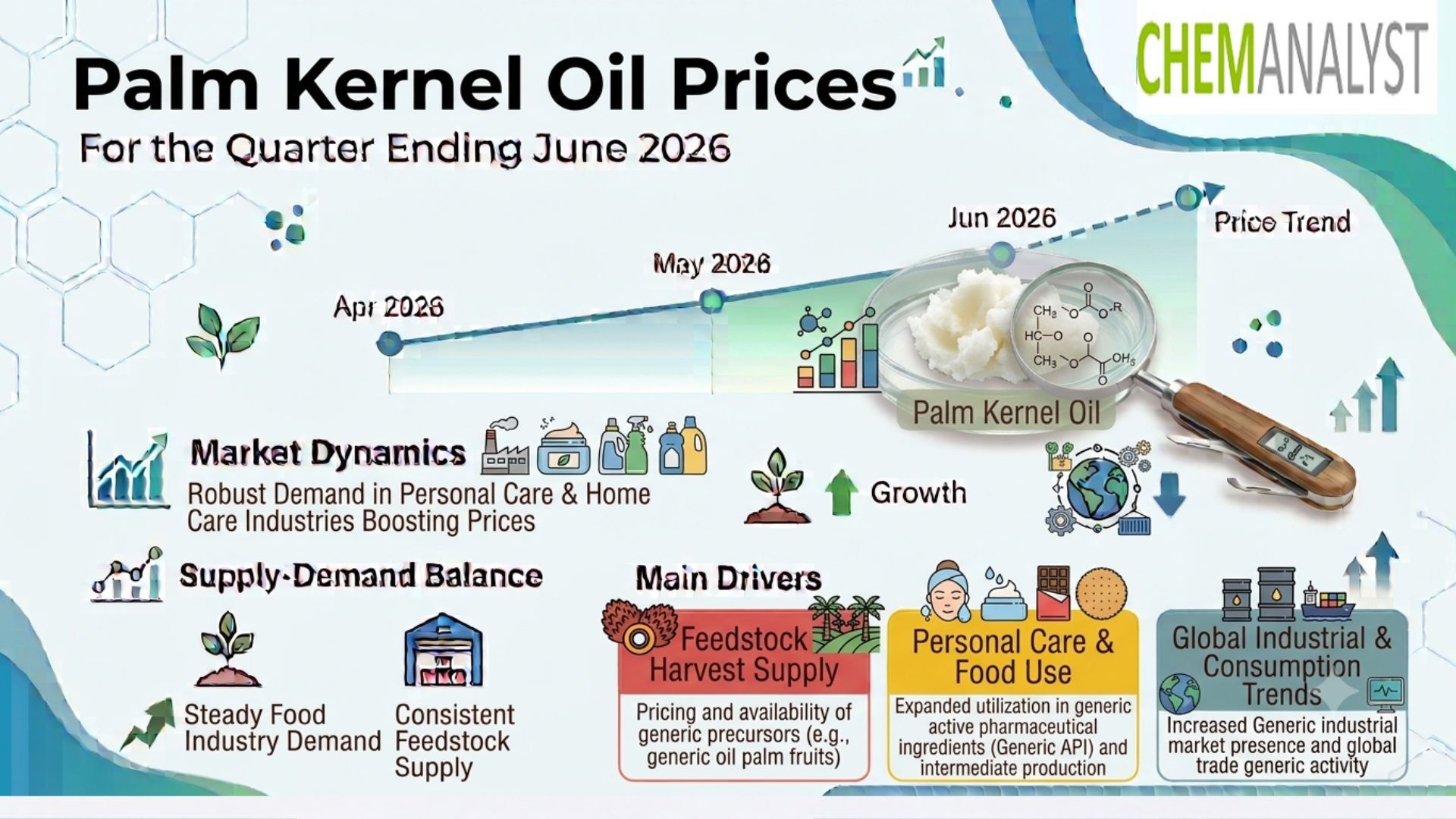
According to ChemAnalyst, the global Palm Kernel Oil Prices market recorded an overall firm trend during the second quarter of 2026, with major markets across North America, Asia-Pacific and Europe reporting quarter-over-quarter increases. The market was influenced by a combination of freight and levy inflation, restocking activity, tight import demand, strengthening exports, oleochemical consumption, seasonal throughput and changing regional availability.
Palm Kernel Oil (PKO) is an important vegetable oil used extensively in oleochemicals, personal care products, cosmetics, soaps, detergents, food applications and other industrial formulations. Its pricing is closely connected to palm kernel availability, regional processing activity, international trade flows, freight expenses and downstream demand from oleochemical manufacturers.
During Q2 2026, the United States and Canada experienced notable price increases as import-related costs and procurement activity supported the market. In Asia-Pacific, Indonesia, Malaysia and Thailand also recorded quarter-over-quarter gains, although local market dynamics differed considerably. Indonesia benefited from stronger exports, while Malaysia and Thailand were supported by oleochemical demand but experienced localized supply pressure.
European markets also moved higher. The Netherlands recorded a 6.02% quarter-over-quarter increase, supported by export strength, while Italy posted a 6.75% quarter-over-quarter increase as stronger imports supported the market.
Palm Kernel Oil Prices in North America
United States Palm Kernel Oil Price Trend
In the United States, the Palm Kernel Oil Price Index rose by 9.82% quarter-over-quarter during Q2 2026. The increase was driven primarily by freight and levy inflation, while restocking activity provided additional support to the market.
The average Palm Kernel Oil price in the United States was approximately USD 2101.67/MT during the quarter, reflecting restocking activity.
The U.S. market remained sensitive to import costs because Palm Kernel Oil supply depends significantly on international trade. Higher freight expenses increased the delivered cost of imported material, while levy inflation added another layer of cost pressure.
At the same time, restocking activity strengthened purchasing interest. Buyers that needed to replenish inventories contributed to improved demand, allowing suppliers to maintain firmer offers.
Freight and Levy Inflation Support Prices
Freight is a significant component of the landed cost of imported Palm Kernel Oil. When transportation expenses increase, buyers typically face higher delivered prices even if the underlying commodity value remains relatively stable.
During Q2 2026, freight and levy inflation created additional upward pressure on the U.S. market. The combination of higher import-related costs and restocking demand contributed to the 9.82% quarter-over-quarter increase in the Palm Kernel Oil Price Index.
For procurement teams, monitoring freight rates and import-related charges remained as important as tracking the underlying PKO price.
Canada Palm Kernel Oil Price Trend
Canada also recorded an increase in Palm Kernel Oil Prices during Q2 2026. The Canadian Palm Kernel Oil Price Index rose by 9.69% quarter-over-quarter, reflecting tight import demand.
The Palm Kernel Oil Spot Price 12-week moving average stood at 2123.15 USD/Tonne, with costs into Vancouver influencing the market.
The Canadian market remained exposed to international supply and logistics conditions. Tight import demand increased competition among buyers for available cargoes, while transportation costs into Vancouver contributed to the delivered cost structure.
The relatively firm 12-week moving average indicated sustained pricing pressure rather than a short-lived spot-market movement.
Get Real Time Online for Palm Kernel Oil Prices: https://www.chemanalyst.com/Pricing-data/palm-kernal-oil-1527
Palm Kernel Oil Prices in APAC
Indonesia Palm Kernel Oil Price Trend
Indonesia experienced a 4.29% quarter-over-quarter increase in its Palm Kernel Oil Price Index during Q2 2026, as exports strengthened.
The average Palm Kernel Oil price for the quarter was approximately USD 2067.67/MT at origin.
Stronger export activity provided support to the Indonesian market by improving demand for locally available material. As international buyers increased their participation, suppliers benefited from stronger market interest.
Indonesia's position within the global palm oil supply chain makes its export performance an important indicator for international Palm Kernel Oil Prices. Changes in export volumes can influence regional availability and the balance between domestic consumption and international demand.
Strengthening Exports Support Market Values
Export strength generally provides additional support to producers and traders because stronger overseas demand can absorb available inventories.
During Q2 2026, improved Indonesian export activity contributed to the upward movement in the Palm Kernel Oil Price Index. However, the 4.29% quarter-over-quarter increase remained comparatively moderate compared with the larger gains recorded in some North American and European markets.
This difference highlights how local supply availability and trade structures influence regional pricing outcomes.
Malaysia Palm Kernel Oil Price Trend
In Malaysia, the Palm Kernel Oil Price Index rose by 5.16% quarter-over-quarter, driven by oleochemical demand.
Malaysia's oleochemical industry is an important source of Palm Kernel Oil consumption. PKO serves as a feedstock for the production of fatty acids, fatty alcohols, surfactants, soaps and other downstream products.
Stronger oleochemical demand therefore provided a fundamental source of price support during Q2 2026.
However, the market also faced supply-side pressure. Port Klang builds and seasonal throughput pressured the Palm Kernel Oil Spot Price as sellers competed.
Oleochemical Demand and Port Inventories
The relationship between oleochemical demand and port inventories played an important role in Malaysia.
While downstream oleochemical demand supported the broader price index, increasing inventories at Port Klang and seasonal throughput created competition among sellers. When sellers compete for buyers amid higher local availability, spot prices can face downward pressure even when broader market fundamentals remain positive.
This created a mixed market environment in Malaysia, with strong demand supporting the quarterly index while localized inventory conditions influenced spot pricing.
Thailand Palm Kernel Oil Price Trend
Thailand recorded a 5.80% quarter-over-quarter increase in the Palm Kernel Oil Price Index during Q2 2026, driven by oleochemical demand.
The Thai market benefited from continued consumption from oleochemical applications, which helped maintain a firm quarterly price environment.
However, the spot market weakened toward the end of the quarter. Palm Kernel Oil Spot Price eased in June as the Price Index signalled regional oversupply.
Regional Oversupply Pressures Spot Prices
Regional oversupply can create a disconnect between quarterly price trends and short-term spot-market movements. Although average prices can rise over an entire quarter, increased availability toward the end of the period can put immediate pressure on spot offers.
This dynamic was visible in Thailand during June 2026. Oleochemical demand continued to support the broader market, but increasing regional availability resulted in softer spot prices.
For buyers, this meant that timing became an important consideration. Those purchasing during periods of greater availability could potentially obtain more competitive offers than buyers entering the market during tighter supply conditions.
Palm Kernel Oil Prices in Europe
Netherlands Palm Kernel Oil Price Trend
In the Netherlands, the Palm Kernel Oil Price Index rose by 6.02% quarter-over-quarter, supported by export strength.
The average Palm Kernel Oil price for the quarter was approximately USD 2055.67/MT per imports.
The Netherlands serves as an important trading and logistics hub for vegetable oils in Europe. Stronger export activity supported market sentiment during Q2 2026 and contributed to firmer price assessments.
Import costs and international availability remained important factors because European buyers depend heavily on global supply flows for Palm Kernel Oil.
Import Economics and European Palm Kernel Oil Prices
The European market remains closely connected to Asian supply. Changes in Southeast Asian production, exports, freight rates and international demand can therefore influence European replacement costs.
During Q2 2026, stronger export conditions supported the Dutch Palm Kernel Oil market. The 6.02% quarter-over-quarter increase reflected this firmer environment.
For European procurement teams, monitoring Asian export availability remains essential because changes at origin can affect the cost and timing of replacement cargoes.
Italy Palm Kernel Oil Price Trend
Italy recorded a 6.75% quarter-over-quarter increase in the Palm Kernel Oil Price Index during Q2 2026, reflecting stronger imports.
However, the Palm Kernel Oil Spot Price eased as ample Southeast Asian exports increased availability, pressuring offers.
The Italian market therefore demonstrated a similar divergence between broader quarterly pricing and short-term spot conditions. Stronger imports supported the quarterly index, but abundant Southeast Asian material later increased supply availability and encouraged sellers to compete more aggressively.
This dynamic suggests that international trade flows remained a major determinant of Italian Palm Kernel Oil Prices during Q2 2026.
Book A Demo for Palm Kernel Oil Price: https://www.chemanalyst.com/ChemAnalyst/PricingForm?Product=Palm%20Kernel%20Oil
Key Factors Influencing Palm Kernel Oil Prices in Q2 2026
Several factors shaped the global Palm Kernel Oil Price Trend during the quarter.
1. Freight and Logistics Costs
Higher freight costs increased delivered Palm Kernel Oil prices in North America and influenced import economics across other regions.
2. Restocking Activity
Restocking in the United States increased purchasing interest and contributed to the 9.82% quarter-over-quarter rise in the U.S. Palm Kernel Oil Price Index.
3. Tight Import Demand
Canada experienced tight import demand, supporting a 9.69% quarter-over-quarter increase in its Palm Kernel Oil Price Index.
4. Stronger Exports
Indonesia's stronger exports supported a 4.29% quarter-over-quarter increase in its Palm Kernel Oil Price Index.
5. Oleochemical Demand
Malaysia and Thailand both recorded price increases of 5.16% and 5.80% quarter-over-quarter, respectively, supported by oleochemical demand.
6. Regional Oversupply
Despite strong downstream demand, increased availability placed pressure on spot markets in Malaysia, Thailand and Italy. Port Klang builds, seasonal throughput and ample Southeast Asian exports encouraged sellers to compete.
Example: How Supply and Demand Influence Palm Kernel Oil Prices
Consider an oleochemical manufacturer in Southeast Asia that needs to replenish Palm Kernel Oil stocks. Strong demand from several downstream producers could initially push prices higher as buyers compete for available material.
However, if seasonal throughput increases and inventories build at major ports, supply availability can improve. Sellers may then compete for buyers, causing spot prices to ease even though the quarterly market remains higher.
A similar dynamic occurred in Malaysia and Thailand during Q2 2026. Oleochemical demand supported quarterly price increases, while higher availability placed pressure on spot prices.
In Europe, stronger imports also created a comparable situation in Italy, where ample Southeast Asian exports increased availability and pressured spot offers.
Impact on Procurement and Supply Chain Planning
The Q2 2026 movement in Palm Kernel Oil Prices highlights the importance of monitoring both fundamental demand and short-term inventory conditions.
Procurement teams should track origin prices, export volumes, port inventories, freight rates, seasonal throughput and downstream oleochemical demand when planning purchases.
For North American buyers, freight and levy costs are particularly important because they influence landed costs. In Canada, Vancouver-related logistics should be monitored alongside international prices.
European buyers should closely monitor Southeast Asian export availability because changes in Asian supply can quickly influence replacement costs.
Meanwhile, oleochemical manufacturers in APAC need to balance demand expectations against regional inventory levels. Periods of oversupply can provide procurement opportunities, while tighter availability can result in higher replacement costs.
Regional Palm Kernel Oil Price Comparison
The Q2 2026 market showed firm quarterly price movements across all major regions, although individual drivers differed.
United States: Palm Kernel Oil Price Index increased 9.82% quarter-over-quarter, with the average price at approximately USD 2101.67/MT, supported by freight and levy inflation and restocking.
Canada: Palm Kernel Oil Price Index increased 9.69% quarter-over-quarter, reflecting tight import demand. The 12-week moving average stood at 2123.15 USD/Tonne.
Indonesia: Palm Kernel Oil Price Index increased 4.29% quarter-over-quarter, with the average price at approximately USD 2067.67/MT at origin, supported by stronger exports.
Malaysia: Palm Kernel Oil Price Index increased 5.16% quarter-over-quarter, supported by oleochemical demand, while Port Klang builds and seasonal throughput pressured spot prices.
Thailand: Palm Kernel Oil Price Index increased 5.80% quarter-over-quarter, driven by oleochemical demand, although spot prices eased in June amid regional oversupply.
Netherlands: Palm Kernel Oil Price Index increased 6.02% quarter-over-quarter, supported by export strength, with the average price approximately USD 2055.67/MT per imports.
Italy: Palm Kernel Oil Price Index increased 6.75% quarter-over-quarter, reflecting stronger imports, while ample Southeast Asian exports pressured spot prices.
Palm Kernel Oil Prices Outlook
The outlook for Palm Kernel Oil Prices will depend on global export activity, oleochemical demand, freight costs, inventories and regional supply availability.
In North America, continued restocking could support prices, although changes in freight and import costs will remain important. In Canada, tight import demand and Vancouver logistics will continue to influence delivered pricing.
In APAC, Indonesia's export performance will remain a key indicator for international supply. Malaysia and Thailand will continue to be influenced by oleochemical demand, while inventory builds and seasonal throughput could create short-term spot-price pressure.
In Europe, import availability from Southeast Asia will remain central to market direction. Stronger imports could increase availability and limit spot-price increases, while tighter export conditions could raise replacement costs.
Overall, the market may continue to experience firm quarterly pricing alongside short-term regional corrections as inventories, trade flows and downstream demand change.
Conclusion
The global Palm Kernel Oil Prices market recorded broad-based increases during Q2 2026. The United States saw a 9.82% quarter-over-quarter increase, with prices averaging approximately USD 2101.67/MT, driven by freight and levy inflation and restocking. Canada recorded a 9.69% increase amid tight import demand, while its 12-week moving average reached 2123.15 USD/Tonne.
In APAC, Indonesia's Palm Kernel Oil Price Index increased 4.29% quarter-over-quarter, supported by stronger exports, while Malaysia and Thailand recorded increases of 5.16% and 5.80%, respectively, driven by oleochemical demand. However, localized oversupply, Port Klang builds and seasonal throughput created pressure on spot prices.
European markets also moved higher, with the Netherlands increasing 6.02% and Italy 6.75% quarter-over-quarter. Stronger imports and Southeast Asian export availability influenced regional spot-market conditions.
Going forward, Palm Kernel Oil Prices will remain closely linked to international trade flows, freight costs, oleochemical demand, inventory levels and Southeast Asian export availability. Monitoring these variables will be essential for manufacturers, traders and procurement professionals managing Palm Kernel Oil exposure.
ChemAnalsyt
Call +1 3322586602
420 Lexington Avenue, Suite 300, New York, NY, United States, 10170
Website: https://www.chemanalyst.com/
Email: sales@chemanalyst.com
この記事をシェア





